
Casey's General Stores Extends Footprint with Wholesale Expansion and Fresh Food Growth
Casey’s latest quarterly filing highlights growth driven by its expanded wholesale fuel network from the Fikes acquisition and sustained momentum in prepared food sales.
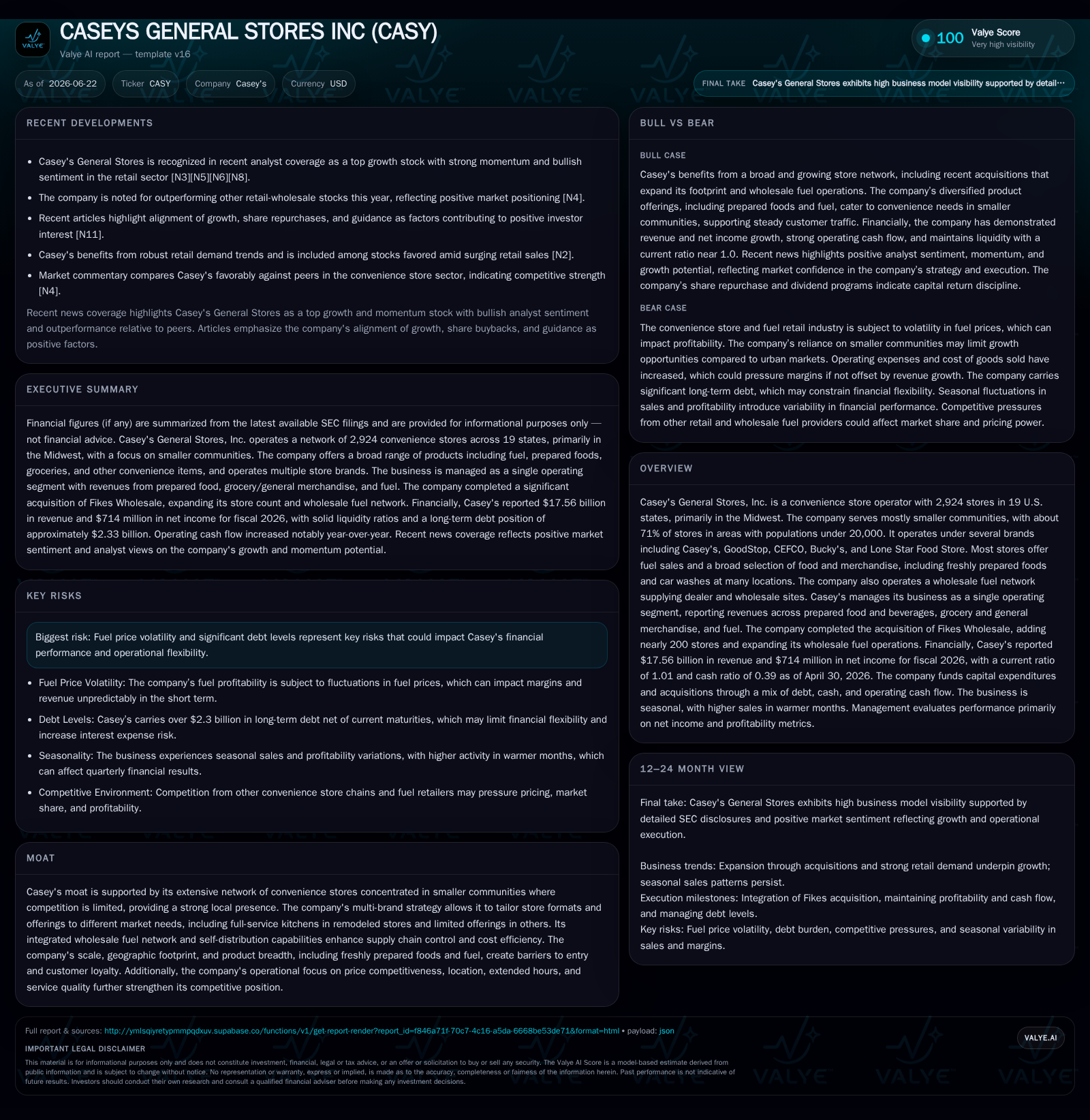
As of the third quarter of fiscal 2026, Casey's General Stores operates 2,924 stores across 19 states, primarily serving smaller U.S. communities. The company's recent acquisition of Fikes Wholesale significantly bolstered its wholesale fuel distribution capabilities, complementing its core retail fuel and convenience merchandise business. Same-store sales growth remains positive, supported by increased prepared food contribution with higher margins. Despite ongoing fuel price volatility and substantial debt levels near $2.33 billion, Casey's maintains operational resilience through supply chain integration, multi-brand store formats, and loyalty programs tailored to local market needs.
Latest Quarter Operating Highlights: Footprint & Margin Trends
Casey's General Stores reported operating 2,924 convenience stores across 19 states as of January 31, 2026, predominantly in smaller communities often with populations under 20,000 [S2]. This reflects the continued integration of the Fikes Wholesale acquisition completed in November 2024, which brought nearly 200 stores into Casey's network and expanded its wholesale fuel distribution reach significantly [S1][S2]. This strategic move broadened Casey's footprint beyond owned retail locations into supplying third-party dealer sites, enhancing supply chain control upstream.
Same-store sales growth has shown resilience driven by sustained consumer demand for freshly prepared foods—a higher-margin category relative to traditional fuel or grocery merchandise. The company continues remodeling initiatives to elevate in-store dining experiences and expand foodservice offerings. These factors collectively support increased traffic and average transaction size ('ticket') even amid external pressures such as fuel price fluctuations [N3][S1]. Fuel margins per gallon remain a critical focus area given the commodity-driven volatility that characterizes this segment.
Casey's Integrated Business Model: Fuel Retail and Convenience Merchandise Synergy
Casey’s business model merges revenue streams from retail fuel sales—which benefit from high customer traffic but yield thinner margins—with higher-margin convenience merchandise including prepared foods and beverages [S1]. This blend helps balance margin pressure inherent in commodity fuel retailing. The acquisition of Fikes Wholesale adds an asset-light wholesale arm that improves supply chain integration by allowing more direct control over fuel sourcing and logistics
The company operates multiple store brands—Casey’s itself targeted mostly at small communities; GoodStop and CEFCO providing regional presence; alongside Bucky’s and Lone Star Food Store—which enable tailoring store formats and product mixes to local market requirements. Such a multi-brand strategy enhances adaptability to demographic nuances across its largely rural/suburban footprint, supporting differentiation from urban-centered national chains [S1].
Operationally, centralized self-distribution capabilities underpin cost efficiency in both merchandise replenishment and fuel delivery. Investments in store remodels typically focus on modernizing kitchens to boost fresh food sales while loyalty programs encourage repeat guest visits by driving incremental traffic and ticket growth [N2][S1]. Extended store hours further enhance convenience value propositions for customers
Competitive Landscape: Small Communities Focus Amid Broad Industry Players
Casey’s distinct competitive position lies in its concentrated presence within smaller community markets where competition is less intense compared to urban areas dominated by larger convenience chains like Murphy USA or national players such as 7-Eleven. This focused geographic strategy fosters strong local brand recognition and engenders customer loyalty through tailored offerings adapted via multi-brand formats.
While competitors may benefit from scale in urban centers or broader national reach, Casey’s moat is strengthened by barriers to entry related to established site locations in underserved regions combined with integrated wholesale operations providing supply chain advantages. These factors contribute to defensible pricing power despite overall industry margin sensitivity caused by thin fuel markup structures [S1]
Growth Catalysts: Wholesale Expansion, Foodservice Innovation, and Loyalty Programs
Key growth drivers reflect a multi-pronged approach:
- Wholesale Network Expansion: Integration of Fikes Wholesale allows Casey’s to supply a growing number of dealer sites beyond its own stores. This strategic vertical extension diversifies revenues beyond retail gasoline sales while leveraging economies of scale in logistics [S2][S1].
- Prepared Foods & Beverage Sales: Freshly prepared foods now constitute an increasing share of total sales, contributing favorably to gross margins relative to traditional fuel or grocery items. Continued investment in kitchen upgrades through store remodels aims to boost this high-margin segment further [N3][S1].
- Loyalty Programs & Service Enhancements: Rewards initiatives deployed company-wide help drive frequency and basket size among existing customers. Extended operating hours improve accessibility for time-constrained consumers seeking convenience [N2][S1].
- Footprint Growth: Selective new store openings focus on expanding presence in underserved rural or suburban areas exhibiting favorable demographic trends supportive of long-term demand growth.
Collectively these factors strengthen top-line growth quality while mitigating margin compression inherent in commodity-based segments.
Risks to Monitor: Fuel Price Volatility, Leverage Levels, and Competitive Pressures
Fuel price fluctuations continue posing significant risk as volatile crude oil markets impact consumption patterns and compress retail margins per gallon sold. While Casey’s merchandise mix partially offsets this cycle due to higher margins on prepared foods and general merchandise, overall profitability is sensitive to sustained adverse pricing environments [S2]
The capital-intensive nature of store development coupled with the acquisition financing led to elevated gross debt approximating $2.33 billion as of April 30, 2026 against cash balances near $523 million—a net leverage factor demanding calibrated free cash flow generation for timely service [F1][S2]
Competition from large national chains dominates urban corridors as well as price-driven rivals including dollar stores that encroach on convenience categories requires vigilant execution on customer experience enhancements.
Upcoming Catalysts: Guidance, Store Openings, and Margin Management
Investors should monitor forthcoming fiscal guidance updates following recent earnings announcements for indications on same-store sales trajectories amid macro uncertainties impacting discretionary spending patterns [S3]. Additionally, schedules for planned store openings or remodel completions provide tangible milestones reflecting expansion execution capacity.
Margin management remains paramount given the sensitivity of retail fuel earnings; thus evolving hedging strategies or pricing adjustments aligning with commodity swings warrant attention.
Financial Overview: Solid Liquidity Supports Strategy Amid Debt Obligations
As of April 30, 2026, Casey's held cash and equivalents of approximately $523 million against total debt of about $2.33 billion, resulting in net debt near $1.81 billion [F1]. The current ratio stood at approximately 1.01, indicating liquidity roughly sufficient for near-term obligations though with limited buffer for adverse scenarios [F1][S2].
Debt instruments include several series of senior notes with fixed interest rates around 3.65% to 3.77%, maturing in installments through 2031, alongside finance lease liabilities consistent with industry norms [S2][F1]
This capital structure supports ongoing investments in footprint expansion and margin-enhancing initiatives but highlights the importance of monitoring refinancing needs amid potential interest rate fluctuations.
DISCLAIMER: This analysis is based solely on publicly filed regulatory disclosures up to June 2026 without access to non-public management insights or forward-looking guidance outside documented sources. It does not constitute investment advice but aims for objective evaluation grounded in verified evidence.
Disclaimer: This is research-only, informational analysis and not investment advice. It may include AI-generated interpretation and general industry context. Always verify important details using primary sources.

Comments