
MADE IN USA Inc. Faces Execution and Liquidity Challenges in Reshoring and Edge AI Pivot
MADE IN USA Inc. is repositioning with a novel reshoring and certification model but struggles with early-stage technology deployment and financial sustainability.
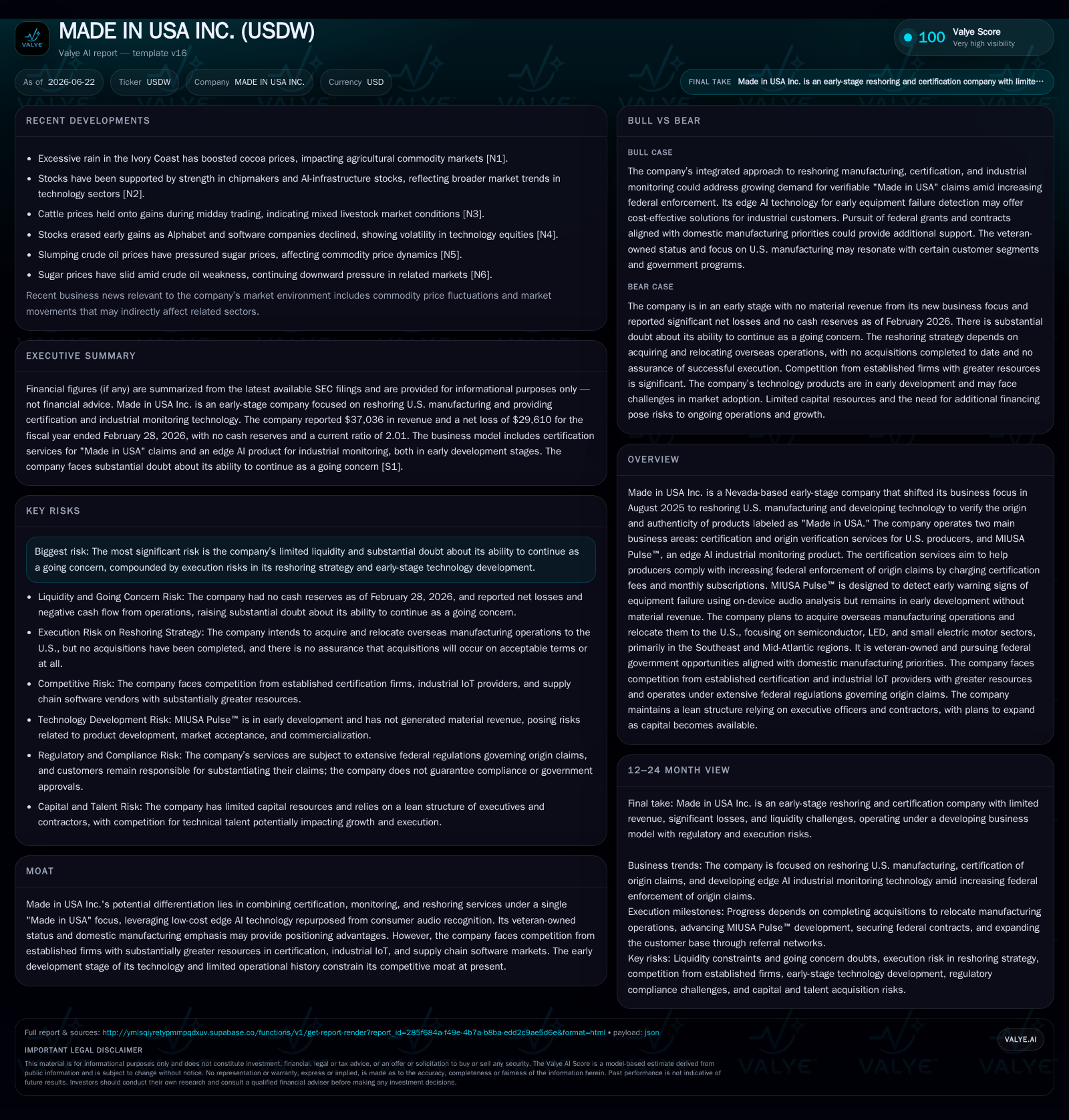
In its latest annual filing, MADE IN USA Inc. reported flat revenue around $37,000, reflecting its transition away from legacy API sales toward a reshoring-focused business model emphasizing certification and industrial edge AI. The company’s operating expenses rose 10%, driven by professional fees and marketing, resulting in a $29.6 million net loss and zero cash reserves as of fiscal year-end 2026, raising substantial going concern doubts. MADE IN USA operates two synergistic businesses: an origin verification certification service addressing growing federal enforcement on 'Made in USA' labeling claims, and the early-stage MIUSA Pulse™ edge AI product targeting predictive maintenance through on-device acoustic analysis. The company plans to acquire and relocate overseas manufacturing in semiconductor, LED, and electric motor sectors to the U.S., aiming to create a vertically integrated domestic manufacturing ecosystem. However, the combination of nascent technology development, limited current revenue, capital constraints, and a competitive landscape marked by established certification and industrial IoT incumbents poses significant execution risks.
Recent Operating Update
ile cash and equivalents were reported at zero [F1]
Business Model
MADE IN USA Inc. is evolving from its legacy API package sales toward two main interconnected business segments: (1) certification and origin verification services supporting "Made in USA" claims mandated by federal regulators such as the FTC and USDA/FSIS; (2) an industrial edge AI hardware/software product branded MIUSA Pulse™ designed for machine condition monitoring through acoustic signal analysis conducted on-device [S5][S10]
The certification service addresses rising demand from U.S.-based manufacturers who must substantiate origin claims amid increasing regulatory enforcement penalties [S11]. The company aims to monetize via initial certification fees plus recurring monthly subscription revenue for maintaining records and compliance data — leveraging a referral affiliate network rather than direct sales force deployment [S5]. This subscription-driven approach aligns with growing industry trends favoring recurring compliance services tied to supply chain transparency.
MIUSA Pulse™ repurposes consumer audio recognition algorithms through edge AI deployment for industrial environments such as factories or maritime engine rooms, enabling early detection of mechanical failure indicators like bearing wear or gear chatter while minimizing data transmission through local on-device analysis [S5][S10]. While technologically innovative within industrial IoT sectors emphasizing predictive maintenance utilizing low-cost sensors and acoustic signatures, MIUSA Pulse™ remains at an early prototype stage without significant commercial traction.
A strategic core pillar is MADE IN USA's commitment to reshoring manufacturing facilities from overseas back into targeted U.S. regions—principally the Southeast and Mid-Atlantic—with initial vertical focuses on semiconductor fabrication, LED manufacturing, and small electric motor production [S5][S10]. This vertically integrated ambition seeks synergy by coupling physical manufacturing capacity rebuilding with digital origin verification plus worker training support capabilities.
Industry Structure and Competitive Position
The sectors intersected by MADE IN USA encompass industrial hardware production (monitoring devices), manufacturing certification/compliance service providers, edge AI startups focusing on predictive maintenance applications, supply chain traceability software vendors, as well as contract manufacturers pursuing reshoring initiatives.
Within certification markets dominated by legacy bodies like UL or Intertek—firms well-resourced with established client bases—MADE IN USA's value proposition centers on offering affordable origin verification attuned to specialized "Made in USA" regulatory standards tightened recently by the FTC’s labeling rule updates and USDA FSIS final rules effective January 2026 [S11]. The increasing federal scrutiny potentially expands demand structurally but also attracts competitors entrenched in global compliance domains.
On the industrial monitoring front, incumbents including Rockwell Automation or Honeywell implement sophisticated predictive maintenance solutions using sensor fusion across multiple modalities beyond acoustic signals. In comparison, MIUSA Pulse™'s niche of using audio-based edge AI might offer cost advantages but faces adoption hurdles typical of pioneering industrial IoT applications requiring customers' trust in accuracy and integration capabilities.
Reshoring efforts are tethered closely to broader geopolitical dynamics favoring domestic manufacturing revival driven by supply chain resilience policies encapsulated in legislation such as the CHIPS Act. However, execution risk is elevated given MADE IN USA’s lack of completed acquisitions or operational facilities at present [S5][S14]. Larger contract manufacturers like Jabil or Flex represent potential indirect peers with far greater scale.
Growth Drivers
Regulatory Environment: Heightened federal enforcement on country-of-origin claims compels manufacturers towards formal certification solutions guaranteeing compliance documentation—directly fueling demand growth for MADE IN USA's subscription-based verification platform [S11].
Supply Chain Transparency: Increasing corporate emphasis on provenance validation amid consumer pressure enhances appeal of origin-verification technologies.
Edge AI Adoption: Industrial sectors steadily embrace predictive maintenance tools powered by edge computing capabilities that reduce latency and data bandwidth requirements—validating MIUSA Pulse™’s market rationale despite early developmental status.
Reshoring Momentum: Strategic government incentives supporting semiconductor fabrication plants (FABs), LED production expansions, and small electric motor manufacturing provide tangible opportunities aligned with MADE IN USA's acquisition targets geographic focus [S5][S14]
Subscription Revenue Expansion: Transitioning from one-time API sales towards recurring revenue models via monthly certifications enables predictable cash flow profiles upon successful scale-up.
Risks / Watchpoints / Growth Constraints
- Financial Sustainability: The company’s zero cash balance coupled with steep annual negative cash flow raises immediate survival concerns absent successful capital raises or monetization breakthroughs [F1][S1].
- Execution Risk: No completed acquisitions or reshored operations currently; success depends heavily on negotiating deals under acceptable terms while managing relocation complexities [S5].
- Early Stage Technology: MIUSA Pulse™’s developmental phase precludes meaningful revenue contributions and requires significant R&D investments fraught with uncertain timing for commercialization.
- Competition: Established certification firms have deeper client trust networks; industrial IoT vendors possess more mature technology stacks limiting price-setting power.
- Customer Adoption: Reliance on limited referral networks rather than direct sales may constrain rapid customer acquisition; slow brand recognition within fragmented U.S manufacturing landscape also limits near-term growth.
- Regulatory Dependencies: Future changes or delays in government enforcement intensity could soften urgency among producers for paid certification services.
- Capital Market Access: Uncertain availability of financing options may force dilutive equity issuance which can hurt shareholder value while constraining operational runway.
What to Watch Next
- Progression from pilot to commercial deployments of MIUSA Pulse™ devices along measurable KPIs such as number of installations or detection accuracy milestones.
- Customer acquisition rates within origin-certification programs including subscription renewals and retention metrics indicating market acceptance.
- Any announced acquisitions or firm commitments detailing geographic locations, production capacities acquired/resourced.
- Capital raise activities or financing arrangements alleviating current zero cash position.
- Regulatory developments from the FTC or USDA that either raise compliance bar thresholds or expand scope affecting potential addressable market size.
- Management commentary addressing paths toward positive operating cash flow sustainability.
Financial Profile Summary
Disclaimer
This analysis is based solely on publicly available SEC filings up through June 22, 2026 ([S1], [S2]) complemented by structured financial data ([F1]). It avoids forward-looking assertions beyond documented company disclosures. No investment advice or price-related guidance is provided hereon.
Disclaimer: This is research-only, informational analysis and not investment advice. It may include AI-generated interpretation and general industry context. Always verify important details using primary sources.

Comments