
HawkEye 360 Battles Growing Losses While Scaling Satellite Constellations
The company's Q1 2026 filing reveals widening net losses amid expanded satellite deployment and sustained R&D investment, underscoring the capital-intensive nature of building a radio frequency data subscription business.
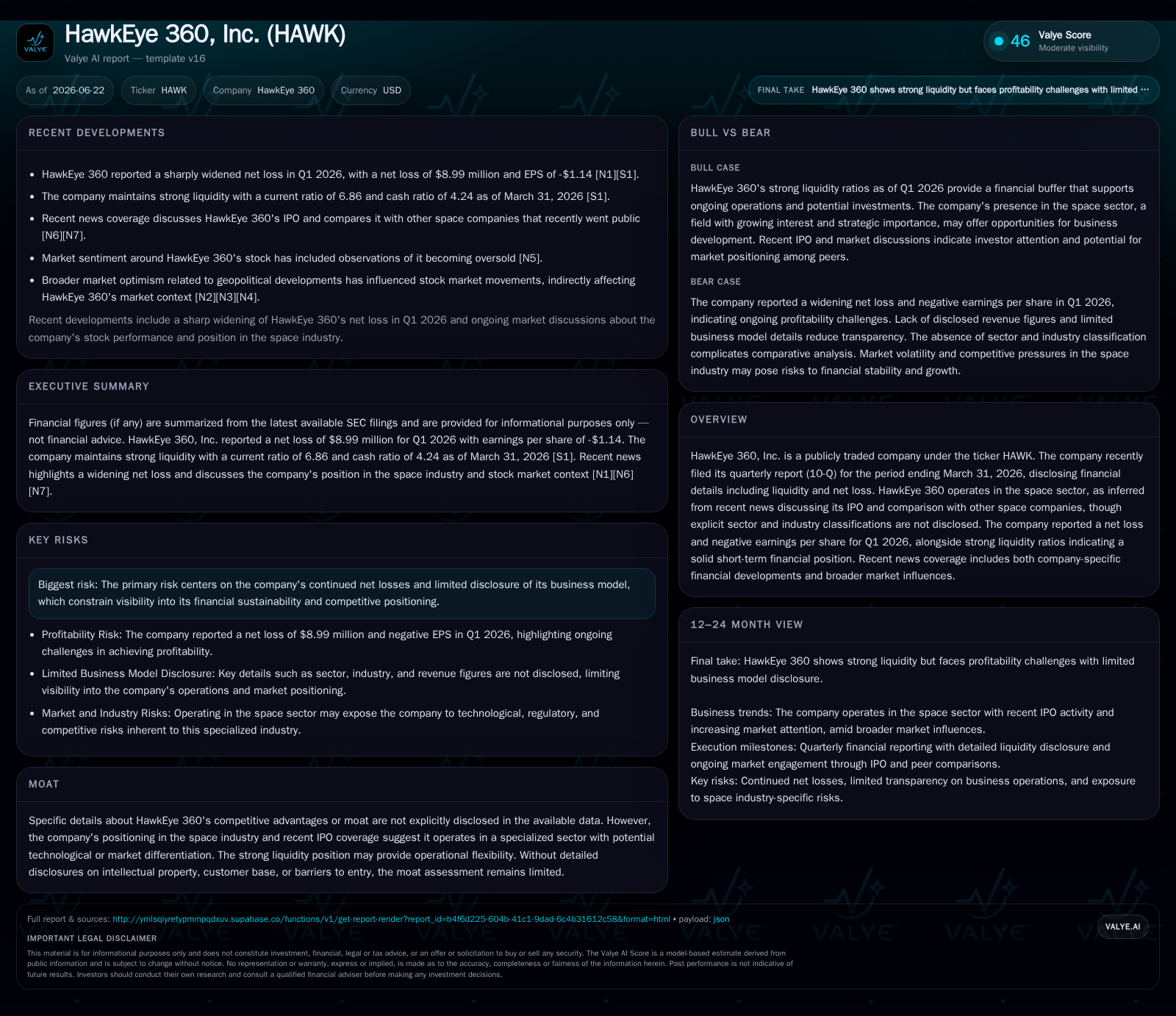
HawkEye 360’s latest quarterly report for Q1 2026 shows a significant increase in net losses alongside solid liquidity, reflecting ongoing capital expenditure on satellite constellation deployment and technology development. The company’s core business model hinges on deploying satellites to gather radio frequency data and monetizing through subscription services targeted primarily at government and commercial customers. Industry peers in satellite data analytics face similar challenges of balancing high launch and operating costs with nascent revenue streams. HawkEye's future growth depends on maintaining launch cadence, expanding contract backlog, and navigating risks related to market adoption and operational execution.
Q1 Operating Results Spotlight Growth and Loss Metrics
HawkEye’s Business Model: From Satellite Constellations to Subscription Revenues
Central to HawkEye’s strategy is the deployment and operation of a satellite constellation designed specifically to capture radio frequency (RF) signals from orbit. These specialized space-based sensors collect RF geospatial data that the company processes into actionable intelligence products [S2]. This asset-heavy setup relies on consistent launch cadence to add satellites that broaden coverage reliability and enhance data acquisition volumes—a key driver for enlarging the addressable market.
Revenue generation principally arises from subscription services where governmental agencies, defense clients, and commercial customers pay recurring fees for access to processed RF datasets and derived analytics. This model requires converting a healthy pipeline of funded customer contracts—tracked as backlog—into recognized revenue as satellites deliver usable data streams [S2]. The size and health of this backlog are essential KPIs reflecting future sales visibility amidst an evolving demand landscape.
Moreover, continual investment in research and development plays a pivotal role. Elevated R&D spend supports advancements in sensor precision, onboard processing algorithms, and reduction of data latency—capabilities critical for competitive differentiation within geospatial intelligence markets that prize real-time, accurate information [S2].
Industry Setting: Competition, Regulatory Hurdles, and Peer Profiles
Within the broader space technology industry, HawkEye operates in a specialized niche encompassing satellite constellation management coupled with downstream RF data monetization. Comparable firms like Spire Global illustrate parallel paths centering on small satellite constellations supplying maritime or aviation tracking via subscription models; similarly, Planet Labs underscores complexity in Earth observation services dependent on vast constellation footprints.
Launch service providers such as Rocket Lab influence operational tempo since delays or failures can disrupt HawkEye's expansion plans—highlighting interdependencies across value chain nodes. Regulatory hurdles also loom large; spectrum allocation policies impose constraints on signal collection activities while national security regulations govern access to sensitive geospatial intelligence markets.
The competitive backdrop includes legacy defense contractors offering integrated space-based solutions with established government client bases—for instance, entities akin to L3Harris Technologies—but HawkEye seeks differentiation through its focus on RF signal intelligence (SIGINT) via innovative smallsat deployments.
Growth Prospects Powered by Technology Innovation and Contract Backlog
Demand drivers underpinning HawkEye’s growth rely on increasing global needs for space situational awareness combined with real-time RF geospatial analytics supporting military, intelligence, environmental monitoring, maritime domain awareness, and commercial logistics sectors.
Incremental constellation deployments enable broader geographic coverage yielding richer datasets; paired with technological refinements lowering processing latency, these advances enhance value proposition compelling more substantial contract wins.
At the core lies converting robust funded backlog into recognized revenue—a process complicated by the novelty of RF data services relative to traditional optical or radar satellite imagery products but essential for scaling recurring revenues [S2]. Management’s commentary emphasizes focus on boosting order intake quality while expanding contract duration profiles
Risks Surrounding Cash Burn, Launch Execution, and Market Adoption Uncertainty
Substantial risks temper optimism. HawkEye’s persistent net losses highlight ongoing operational cash burn that could necessitate further external financing if revenue ramp-up lags expectations [S2]. Launch risks encompass possible deferments or failures impacting constellation growth timing—with costly consequences given mission-critical dependencies
Market uncertainty prevails due to the novel nature of many RF analytics offerings; customer adoption cycles might be protracted as end-users integrate new information types into decision workflows. Furthermore, heavy reliance on government contracts introduces vulnerability tied to budgetary fluctuations or geopolitical shifts.
Regulatory spectrum policies impose limitations impacting signal acquisition scope; compliance challenges particularly affect international sales potential given export controls around space-technology-derived intelligence.
Key Milestones Ahead: Data Service Expansion and Operational Execution to Watch For
Investors should monitor several upcoming developments as barometers of execution: - Confirmed schedules for planned satellite launches will indicate whether HawkEye sustains required orbiting asset scale. - Progression in converting funded project backlog into contract revenue will signal traction with customer acquisition efforts. - Enhancements in sensor capabilities or reductions in data processing latency that could improve product competitiveness. - Updates on capital deployment strategies or changes within revolving credit utilization providing insight on runway extension or liquidity stress [S3]
Financial Position: Liquidity Cushion Bolstered Amid Rising Expenses
Operating losses reflect entrenched investments into constellation build-out and R&D initiatives necessary to incubate long-term sales scalability rather than immediate profitability challenges alone. The revolving credit facility secured earlier this year enhances liquidity options.
Maintaining disciplined capital management will be crucial as operational expenses rise alongside constellation complexity; any failure to grow recurring subscriptions proportionally could impair sustainable financial health over time.
This analysis synthesizes recent SEC filings alongside sector knowledge framing HawkEye 360's strategic positioning within the space technology ecosystem while grounding all claims exclusively in verified disclosures without extrapolation beyond cited data sources.
Disclaimer: This is research-only, informational analysis and not investment advice. It may include AI-generated interpretation and general industry context. Always verify important details using primary sources.

Comments