
Pono Capital Four’s Latest Quarter Highlights Path to Target Acquisition Amid Geopolitical Risks
The company maintains strong liquidity and issued a promissory note to fund business combination costs as geopolitical tensions introduce uncertainty.
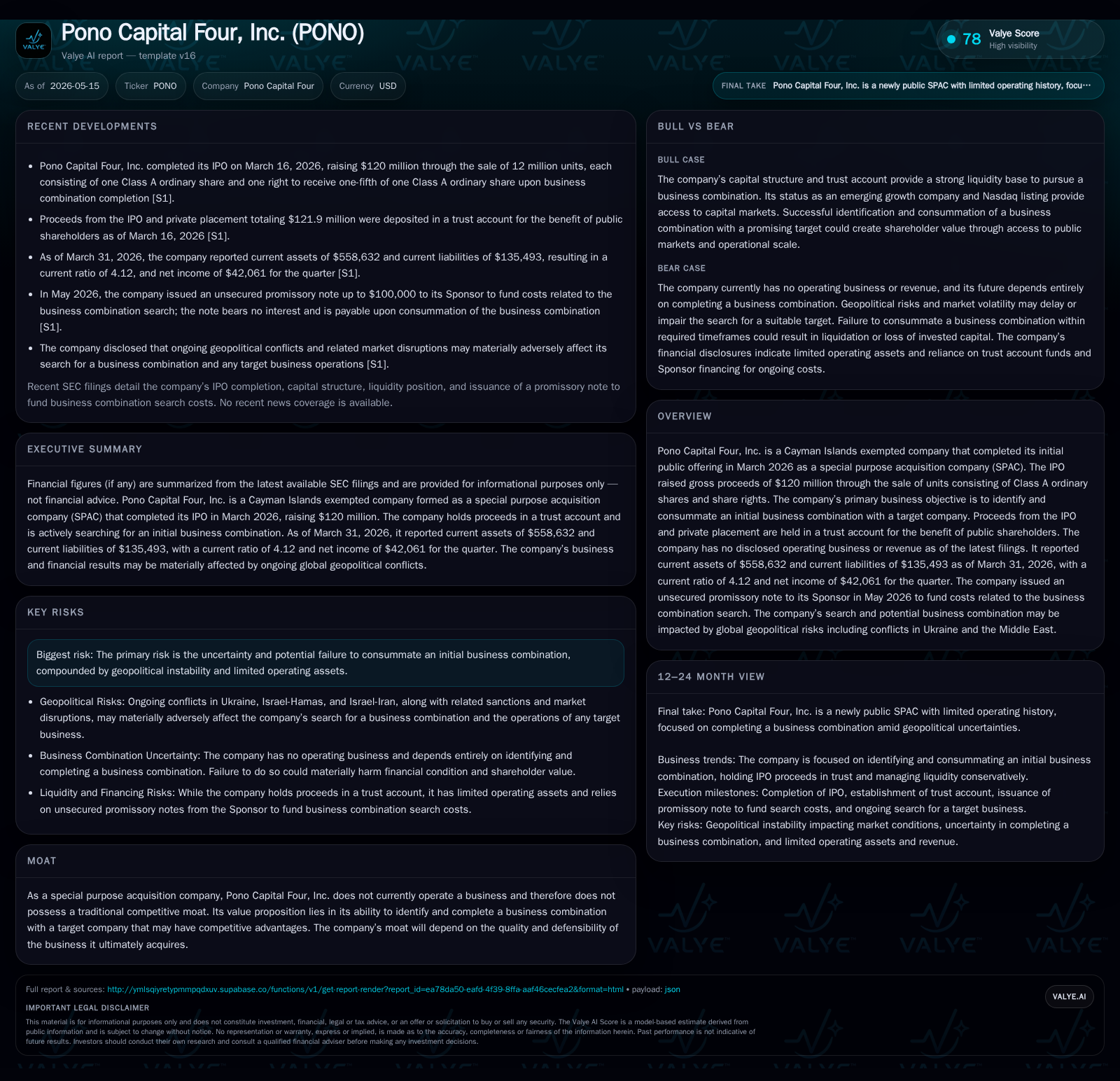
Pono Capital Four, Inc. remains positioned as a newly public SPAC with $120 million in trust from its March 2026 IPO. Its latest 10-Q reveals a net income of $42,061 for the quarter ended March 31, 2026, with no operational revenues yet as it searches for an acquisition target. In May 2026, Pono issued an unsecured, interest-free promissory note to its Sponsor allowing drawdowns up to $100,000 for deal-related expenses. The company flags significant geopolitical risks from ongoing Russia-Ukraine and Middle East conflicts that may affect deal sourcing and execution. Overall, Pono’s operating posture reflects disciplined liquidity management while navigating elevated market uncertainties ahead of announcing its initial business combination.
Latest Quarterly Operating Update and Implications
Pono Capital Four’s most recent quarterly report for the period ended March 31, 2026 shows current assets of $558,632 against current liabilities of $135,493, yielding a strong current ratio of 4.12 [F1]. The company reported a modest net income of $42,061 during the quarter despite having no operating revenues or active business operations yet [F1]. This earnings figure reflects tight control over administrative costs as it actively pursues an initial business combination.
A pivotal development in early May 2026 was the issuance of an unsecured promissory note up to $100,000 by Pono to its Sponsor Mehana Capital LLC. The note enables the company to draw funds within five business days upon request to cover costs reasonably related to the business combination process. Notably, this financing bears no interest and is payable in full only upon successful consummation of the deal (the Maturity Date) [S3]. Absence of interest reduces financial drag during this preparatory stage while providing flexible access to incremental capital for diligence or legal expenses that may arise as deal talks progress.
Together these disclosures signal prudent capital stewardship balanced with ensuring operational readiness via flexible near-term funding. The cash held in trust from the IPO remains intact at $120 million gross proceeds (less underwriting fees), earmarked for eventual transfer to shareholders or investment into an acquisition target [S2]. This arrangement preserves shareholder value while enabling Pono’s management to work actively on sourcing viable candidates.
Business Model and Strategic Objective as a SPAC
Pono Capital Four operates as a Cayman Islands exempted company structured specifically as a Special Purpose Acquisition Company (SPAC). It completed its IPO in March 2026 raising gross proceeds of $120 million through sales of Units composed of one Class A ordinary share combined with one right to receive one-fifth of another Class A share upon closing the initial business combination [S2]. Concurrently, a private placement raised nearly $1.9 million to Mehana Ventures LLC (the Sponsor) and an institutional investor under similar unit terms but with transfer restrictions designed to align interests toward deal completion [S11].
The company's revenue model currently is nonexistent; it generates no operating income before combination. Instead, its economic rationale derives entirely from successfully identifying and merging with a high-quality private business that can deliver growth and competitive advantages post-merger. The SPAC serves essentially as a blank-check vehicle holding IPO proceeds in trust pending shareholder vote on the proposed acquisition. The underlying value creation thus hinges on management's skill in deal origination, negotiation leverage in pricing targets within volatile markets, and subsequent integration success.
This structure inherently lacks an operating moat at inception; the moat depends fully on whether acquired businesses possess defensible competitive positioning after the merger closes. Until then, Pono’s strategic strength lies primarily in securing committed sponsor support via financial agreements such as the recent promissory note issuance which streamlines funding access during pursuit stages [S3].
Industry Context: SPAC Market Dynamics and Competitive Considerations
Within the broader SPAC ecosystem, Pono Capital Four confronts intense competition from numerous other blank-check companies vying for quality targets amid challenging macroeconomic backdrops. The company's prospectus explicitly cites systemic external risks stemming from ongoing global geopolitical conflicts: Russia’s invasion of Ukraine; Israel-Hamas war; recent Israel-Iran escalations; along with resultant sanctions regimes involving U.S., NATO allies, EU states; removal of Russian-related entities from SWIFT; and provision of military aid heightening regional tensions [S20].
These factors exacerbate uncertainty not only by disrupting capital markets but also by constraining target availability due to slowing investment climates or direct operational impacts on potential acquisition candidates. Moreover, heightened volatility increases likelihood of price dislocations making valuation negotiations more complex or protracted.
Regulatory scrutiny on SPACs remains significant given their growth post-2019 IPO boom era; transparency requirements on disclosures about risks and pipeline progress add layers of compliance cost and timing risk. Pono’s risk disclosures reflect these realities signaling potential liquidity traps if deals stall or investors lose confidence. Consequently, Pono’s management must differentiate itself through adept deal sourcing and financing flexibility amidst constrained market conditions.
Catalysts for Growth: The Business Combination Timeline and Market Signals
The primary growth catalyst for Pono Capital Four is consummation of its initial business combination which would transform it from an empty shell into an operating public entity backed by substantial cash reserves dedicated to expansion initiatives.
Key near-term milestones will include announcement(s) regarding selected target(s), progress through due diligence phases reflecting management’s confidence level, shareholder approval notices referencing valuation fairness opinions or preliminary terms sheets, closing documentation filings with regulators such as amended registration statements or proxy materials.
Sponsor support via the newly established promissory note facility is also critical here; usage patterns may indicate accelerating transaction-related spending such as legal fees or advisory costs signaling earnest deal execution efforts [S3]. Moreover, secondary market activity post-May 2026 allowing separate trading of shares and share rights underlying Units broadens investor appetite by unbundling complex securities components hitherto locked together [S5]. This can enhance liquidity profiles ahead of merger closure.
Overall these event markers serve as measurable KPIs demonstrating transactional progress beyond mere search stage dynamics inherent in SPAC life cycles.
Risks and Constraints: Geopolitical Tensions and Deal Execution Challenges
Among dominant external risks facing Pono remains persistent geopolitical instability directly cited in company filings including protracted military conflicts involving Russia-Ukraine theaters; intensifying Israel-Hamas hostilities compounded by Iranian regional involvement concentrate exposure around capital market disruption risk [S21]. Such disruptions could impair access to meaningful global equity or debt financing needed by potential targets limiting their attractiveness or feasibility as acquisition prospects.
Additionally, emerging sanctions regimes have tangible operational effects potentially impairing supply chains or increasing compliance burdens on prospective portfolio companies raising baseline transaction complexity intersecting with commercial viability assessments.
Separate from geopolitical dynamics is the foundational existential risk faced by all SPACs: failure to consummate a business combination within prescribed regulatory timeframes typically around two years from IPO date leading either to liquidation or forced return of principal excluding sponsor incentives. Such failures dilute existing shareholders and render invested capital inert until trust account funds are returned.
Dilution risk due to unfunded sponsor notes like Pono’s new promissory note—though interest-free—also warrants monitoring especially if drawn without concomitant accrual towards final deal economics potentially causing misalignment between sponsor and public holders absent strong governance structures.
Near-Term Watchpoints: Milestones and Financing Developments to Monitor
Investors following Pono should monitor several upcoming indicators:
- Disclosures related to potential business combination candidates including press releases or SEC filings such as S-4 registration statement submissions alerting official target selection;
- Schedule or frequency of drawdowns under the unsecured promissory note indicating ramp-up pace of transaction expenses;
- Proxy solicitations for shareholder votes demonstrating readiness for closing;
- Trading patterns following split trading commencement between shares (PONO) and share rights (PONOR), which may reflect investor positioning sentiment;
- Any updated guidance provided during upcoming quarterly filings or periodic reports that revise market outlooks around timing of combination closure.
Careful review should also be given when reviewing risk factor updates particularly those reflecting evolving geopolitical conditions that could shift deal feasibility assumptions abruptly.
Concise Financial Snapshot Supporting Operational Readiness
Latest financial snapshot
| Metric | Value | Period |
|---|---|---|
| Current assets | $558632 | |
| 2026-03-31 | ||
| Current liabilities | $135493 | |
| 2026-03-31 | ||
| Current ratio | 4.12x | |
| 2026-03-31 |
Source: SEC companyfacts cache [F1].
| Metric | Value |
|---|---|
| Current Assets | $558,632 |
| Current Liabilities | $135,493 |
| Current Ratio | 4.12 |
| Net Income | $42,061 |
The above table underscores Pono Capital Four's solid liquidity position going into the next phase of its lifecycle as a SPAC entity poised for its initial merger transaction. The positive net income during a no-revenue period reflects controlled operational expenses primarily associated with administrative functions rather than recurring business activities typical for operating firms.
The recent execution of an unsecured promissory note provides additional financial optionality without imposing immediate interest burdens. This note is payable in full only upon consummation of the initial business combination and does not currently impose covenant restrictions [S3].
Taken together these figures confirm strategic preparedness complemented by conservative financial stewardship aiming at maximizing stakeholder value retention ahead of transformative combinations.
This analysis is based exclusively on publicly filed SEC documents dated through May 14, 2026 ([S2], [S3], and supporting filings) together with Companyfacts financial snapshots ([F1]). No forward-looking projections are included given absence of company guidance disclosures beyond stated financing agreements and risk factor commentary. This report does not constitute investment advice but aims solely at presenting an integrated operational perspective anchored on verifiable data sources.
Disclaimer: This is research-only, informational analysis and not investment advice. It may include AI-generated interpretation and general industry context. Always verify important details using primary sources.

Comments