
Bain Capital GSS Investment's Strategic Moves in SPAC Evolution
The company leverages its Sponsor backing and cash trust structure as it approaches its October 2027 business combination deadline.
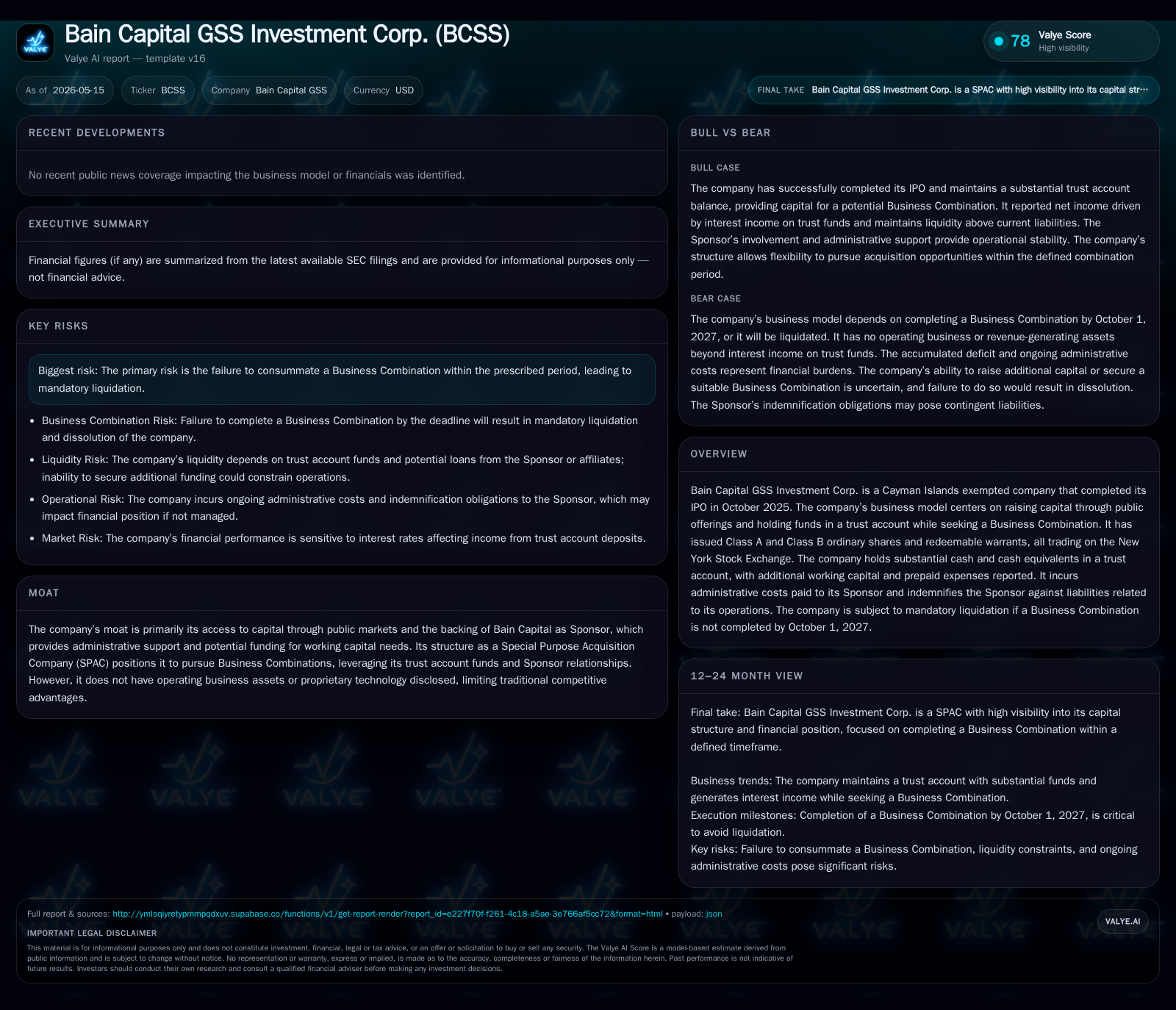
Bain Capital GSS Investment Corp. remains on track toward executing a Business Combination before its mandatory liquidation date in October 2027, as detailed in its latest 10-Q filing. The company operates as a blank check SPAC with no current operating revenue, relying on trust account funds and potential Working Capital Loans from its Sponsor to finance deal-sourcing activities. Its strategic strength lies in Bain Capital’s sponsorship and capital access, though it faces typical risks tied to deal completion and investor redemptions. Upcoming milestones around target identification and proxy filings will mark critical execution phases for the SPAC’s lifecycle.
Latest Quarterly Operating Update: Positioning for Business Combination
Bain Capital GSS Investment Corp., a Cayman Islands exempted company formed as a Special Purpose Acquisition Company (SPAC), reported its unaudited quarterly results for the period ending March 31, 2026 [S2]. The filing confirms BCSS remains in its pre-merger phase without operational revenues but with ongoing administrative expenses primarily related to its Sponsor relationship. Key updates include the status of authorized share classes where there are 900,000 Class A ordinary shares issued excluding 46 million shares subject to redemption [S2].
The company retains working capital sufficient for administrative costs and deal exploration activities. Although the cash balance reported via companyfacts is zero as of quarter-end [F1], the filing clarifies this discrepancy, noting a $637K cash balance in the latest financial notes [S7]. This nuance likely reflects timing differences between accounting treatment and cash flow statements. BCSS benefits from discretionary Working Capital Loans by the Sponsor or affiliates up to $1.5 million to cover transaction-related costs if needed; however, this facility was unused at period end [S2]. These loans are repayable only after completing a Business Combination with proceeds from the Trust Account or from funds outside it if no merger occurs.
Administrative fees paid to Bain Capital's affiliate approximate $20,000 per month, covering office space and support services under an indemnification agreement protecting Sponsor assets from liabilities tied to BCSS operations or offerings [S1]. This operating posture is typical for blank-check entities advancing towards a merger within their fixed timeframe.
SPAC Business Model and Sponsor Dynamics
BCSS’s core business model centers on raising IPO proceeds through public units comprising Class A shares paired with redeemable warrants – all held in an interest-bearing trust account — while seeking a Business Combination [S1],[S2]. The Sponsor owns Class B shares issued in exchange for initial organizational services and may receive finder’s fees or consulting compensation contingent upon successful deal closure; such fees and reimbursements are disclosed in proxy statements filed at the point of merger announcement [S1].
This arrangement aligns incentives but also embeds potential conflicts given fiduciary duties officers or directors hold toward other affiliated entities which may have priority claim on business opportunities overlapping BCSS interests [S1]. Indemnification clauses further protect the Sponsor from liabilities arising out of such dynamics – importantly, they preclude accessing trust account funds for any Sponsor claims and limit recourse exclusively to BCSS itself.
BCSS operates under JOBS Act provisions as an emerging growth company enjoying relaxed regulatory requirements regarding reporting and accounting transitions [S2],[S16]. This status tempers disclosure obligations but heightens reliance on transparency around governance practices tied to merger execution.
Competitive Environment in the SPAC Sector
The SPAC market remains competitive as numerous blank-check companies vie for attractive targets; BCSS differentiates itself primarily through Bain Capital’s prominent brand recognition and financial backing [S1]. Unlike some SPACs targeting niche sectors or led by less established sponsors, BCSS benefits from the depth of Bain Capital's network and expertise potentially increasing credibility among target companies.
However, this advantage must be weighed against sector-wide challenges such as intensified regulatory scrutiny post-IPO boom years and greater investor skepticism regarding valuation discipline leading up to combinations. Redemption risks by public shareholders holding redeemable Class A shares or warrants inject further uncertainty affecting deal pricing and execution strategies.
Growth Opportunities and Deal Pipeline Potential
Though BCSS has not publicly named candidate targets yet, its ability to source deals rests heavily on utilizing Bain’s proprietary dealflow channels coupled with potential incentives like finder’s fees payable upon closing [S1],[S2]. The structure allowing sponsor loans enhances flexibility in financing diligence and transaction expenses without diluting trust account funds prematurely.
The extension runway until October 2027 provides management time for rigorous negotiation leveraging their capital commitment window effectively. For investors monitoring progression, indications such as material definitive agreements filed via Form 8-Ks or proxy filings detailing proposed combinations will mark critical markers reflecting pipeline maturation.
Risks and Redemption Triggers Ahead of Liquidation Deadline
Foremost among risks is the fundamental possibility that BCSS fails to consummate its initial Business Combination within the stipulated deadline — October 1, 2027 — at which point mandatory liquidation would return remaining trust account assets pro rata to public shareholders [S1],[S2]. This outcome would result in loss of any anticipated upside beyond principal investment minus offering expenses.
Additional structural risk emerges from the coexistence of redeemable warrants exercisable post-IPO alongside Class B shares held by sponsors bearing limited liquidity unless conversion conditions are met or warrants are exercised favorably. Accounting guidance under ASC470-20 signals complex allocations between equity and debt components highlighting that investors should carefully consider dilution potential upon merger consummation [S2].
Potential fiduciary conflicts borne by management due to external obligations may also shape deal prioritization possibly constraining opportunity sets if competing entities intervene with overlapping claims [S1].
Upcoming Milestones and What Investors Should Monitor
Investors should focus on near-term triggers associated with advancing toward an announced Business Combination. Proxy statement filings (Schedule 14A) connected with initial combination proposals will provide detailed disclosures including target identity, financial terms, sponsor compensation arrangements such as finder’s fees, due diligence scope, and shareholder voting requirements [S1],[S2].
Audit committee oversight over reimbursed expenses serves as an internal governance barometer reflecting executive accountability standards pre-merger [S1]. The Board’s approval timeline for agreements coupled with any reported borrowing activity under Working Capital Loans will offer additional insight into operational readiness.
Tracking redemption rates following combination announcements will also serve as an important demand indicator reflecting public market confidence in proposed deals amid broader SPAC valuation trends.
Financial Snapshot: Liquidity and Working Capital Status
Latest financial snapshot
| Metric | Value | Period |
|---|---|---|
| Cash & equivalents | 0 USD | |
| 2026-03-31 | ||
| Current assets | $932,225 | |
| 2026-03-31 | ||
| Current liabilities | $401,797 | |
| 2026-03-31 | ||
| Current ratio | 2.32x | |
| 2026-03-31 |
Source: SEC companyfacts cache [F1].
A concise overview of BCSS liquidity fundamentals at quarter-end March 31, 2026 reveals:
| Metric | Value | Date |
|---|---|---|
| Current Assets | $932,225 | |
| 2026-03-31 | ||
| Current Liabilities | $401,797 | |
| 2026-03-31 | ||
| Current Ratio | 2.32 | |
| 2026-03-31 | ||
| Cash & Equivalents | $0 / $637,186* | |
| 2026-03-31 | ||
| *Note: The discrepancy between cash metrics reflects timing differences between internal reports and footnote disclosures [F1][S7]. |
Sponsor loans previously utilized have been repaid fully; no borrowings were outstanding under Working Capital Loans as of March-end providing optional capacity should transaction costs increase unexpectedly [S2]. Such financial posture underscores prudent cash management reflective of typical SPACs pre-combination phase.
Disclaimer: This analysis is based solely on publicly available SEC filings dated up to May 14, 2026 and does not constitute investment advice. It reflects operational facts about Bain Capital GSS Investment Corp.’s business model as a Special Purpose Acquisition Company navigating the path toward a Business Combination prior to regulatory-mandated liquidation deadlines.
Disclaimer: This is research-only, informational analysis and not investment advice. It may include AI-generated interpretation and general industry context. Always verify important details using primary sources.

Comments