
WEBUY GLOBAL Shifts from Grocery to AI-Driven Travel Services Amid Nasdaq Equity Compliance
Latest quarterly filings confirm WEBUY GLOBAL's successful transition into travel services with a technology-enabled platform while regaining Nasdaq listing compliance.
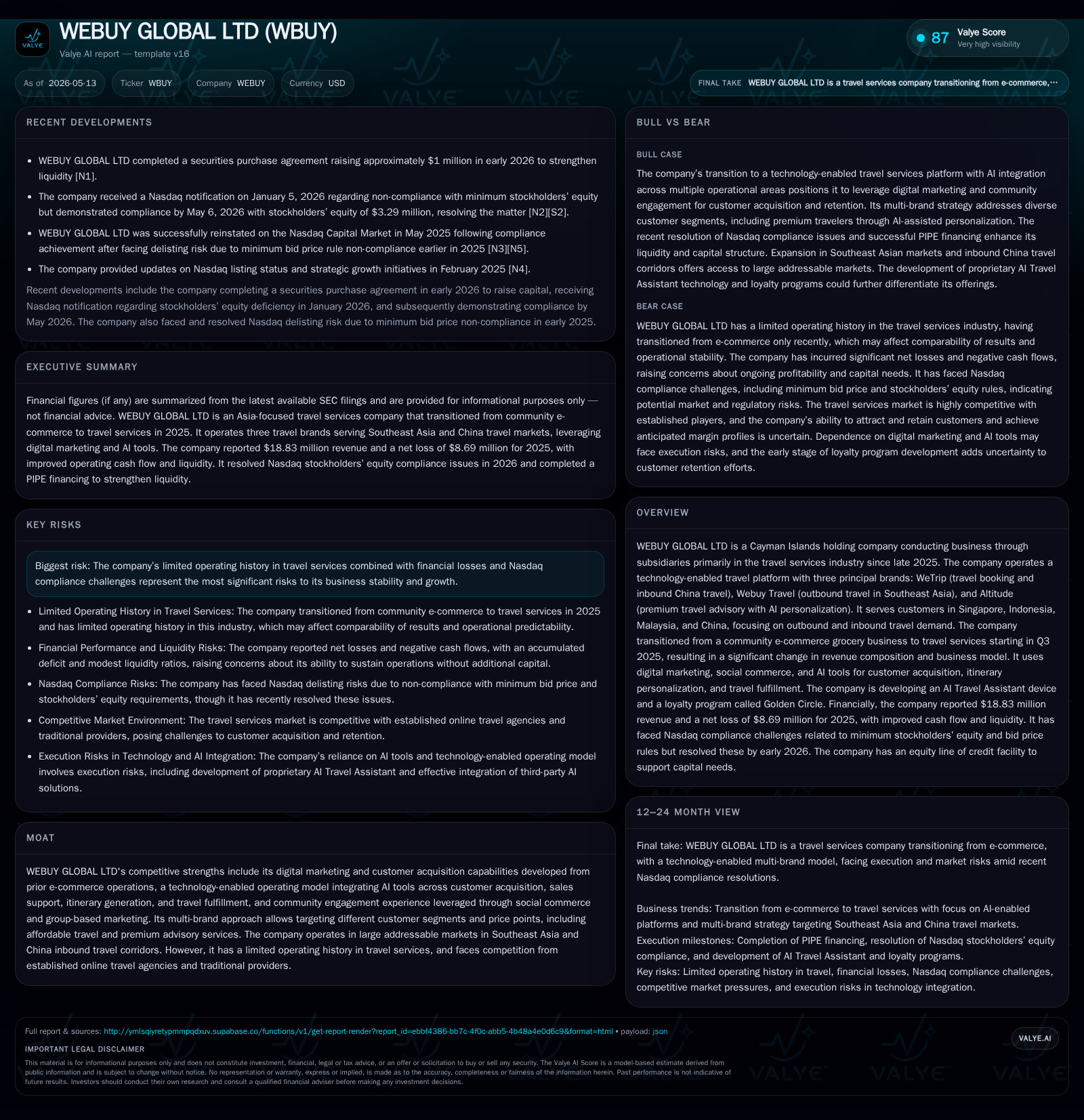
WEBUY GLOBAL LTD has radically transformed its business model from community e-commerce grocery retail into a technology-driven travel services company focused on Southeast Asia and China travel corridors. The shift, effective from late 2025, has driven a significant revenue composition change, with packaged tours now dominating sales. Despite operating challenges including sustained net losses and limited travel operating history, the company leverages digital marketing, social commerce experience, and AI-powered itinerary tools to target both budget and premium customer segments. Recently, WEBUY resolved Nasdaq minimum stockholders' equity deficiencies, providing regulatory stability as it continues building its AI-assisted multi-brand travel platform in competitive regional markets.
Recent Operating Update
WEBUY GLOBAL LTD confirmed through its May 6, 2026 Form 6-K filing [S2] that it has successfully regained compliance with Nasdaq's minimum stockholders' equity rule (Rule 5550(b)(1)). After receiving a deficiency notice in early January 2026 due to equity dipping below $2.5 million, the company submitted a compliance plan and demonstrated equity of approximately $3.29 million as of December 31, 2025. This resolution avoids delisting risks and provides needed regulatory stability during the company's strategic business overhaul.
This announcement anchors recent progress following a transformative pivot announced in late 2025. Specifically, WEBUY shifted its primary operations from a community e-commerce grocery business — historically inventory intensive and low margin — to a technology-enabled travel services platform beginning Q3 2025 [S1]. The most recent annual disclosure shows the dramatic impact: revenue from continuing operations plunged by roughly 63% year-over-year to $18.83 million for calendar year 2025 due predominantly to the wind-down of grocery operations [F1][S13]. Conversely, revenue from packaged tours increased by around 24% to $18.4 million, underscoring the company's reorientation towards higher-margin travel offerings.
In parallel with this operational pivot, WEBUY has bolstered its leadership equity position through private placements executed in April 2026 involving CEO Bin Xue acquiring Class B shares with enhanced voting rights [S3], indicating aligned insider incentives during this growth phase.
Business Model
WEBUY operates as a Cayman Islands holding company with consolidated subsidiaries primarily based in Singapore that conduct nearly all substantive business activities [S22]. It generates revenues principally through three discrete but integrated travel brands addressing various outbound and inbound travel segments across Asia:
- WeTrip targets inbound China tourism via international travelers primarily from Western countries such as the U.S., U.K., and Australia.
- Webuy Travel focuses on affordable outbound travel packages for customers in Southeast Asian markets like Singapore and Indonesia.
- Altitude delivers curated premium travel advisory services enhanced by AI-powered itinerary customization tools.
Revenue mechanics revolve around transaction-based fees from selling packaged tours, customized itineraries, hotel bookings, flights, and other complementary services via their digital platforms which incorporate AI capabilities to personalize trip planning and streamline fulfillment [S1]. Customers pay directly for these offerings online or through associated platforms leveraging social commerce mechanisms borne out of WEBUY’s previous retail experience.
Margins are under upward pressure given the shift away from low-margin inventory-heavy grocery sales towards service-based travel offerings enabled primarily through digital infrastructure investments [S10]. Operating leverage is emerging but presently offset by elevated selling & distribution expenses related to heavy digital marketing spend aimed at customer acquisition in competitive markets [S10].
The firm relies on recurring customer engagement fueled by localized content delivery, community-based marketing cohorts, and advanced CRM tailored by data insights. The planned launch of an AI Travel Assistant device anticipates deepening customer interaction and potentially generating ancillary revenue streams [S12].
Industry Structure and Competitive Position
WEBUY operates within the highly fragmented Asian regional travel services industry marked by established online travel agencies (OTAs), traditional tourism operators, niche luxury advisors, and emerging technology-driven disruptors. The company’s differentiation lies chiefly in:
- Extensive expertise in digital marketing originating from its e-commerce legacy,
- Integration of AI tools across sales support, itinerary design, and booking fulfilment,
- Multi-brand approach addressing disparate consumer segments ranging from budget travelers to affluent clientele.
Despite limited operating history in travel (just transitioning in late 2025), WEBUY leverages sizable addressable markets including rapidly growing middle classes in Southeast Asia and pent-up post-pandemic inbound demand into China [S1]. However, competition remains intense against entrenched players like Ctrip (Trip.com Group), Agoda, Expedia affiliates, plus local companies well versed in regional specificities.
Switching costs for customers are moderate given abundant alternatives but improved personalization capabilities promise to enhance retention rates over time. Additionally, social commerce strategies could generate network effects if effectively scaled.
Growth Drivers
Packaged Tour Expansion
Significant growth in packaged tours—up over 24% YoY—reflects both market recovery dynamics following COVID disruptions and strategic portfolio repositioning toward higher-value services [S13]. Continued expansion of outbound offerings particularly across Singapore and Indonesia highlights targeted regional demand.
Technology-Enabled Customer Acquisition
Leveraging previous digital marketing assets alongside aggressive social commerce tactics supports efficient customer acquisition with scalable reach beyond conventional offline channels. Enhancements in AI-supported itinerary generation help differentiate offerings while optimizing operational delivery cost structures.
Product Diversification Across Price Points
The tri-brand strategy allows segmentation capturing value-conscious tourists through Webuy Travel while cultivating margins via Altitude’s premium advisory model utilizing immersive destination presentation technologies.
Development of Proprietary AI Travel Assistant Hardware
The nascent project around an AI-integrated assistant device represents both innovation potential for enhancing user experience and an opportunity for creating additional service layers or recurring hardware/software revenue streams if successfully commercialized.
Risks / Watchpoints / Growth Constraints
Limited Travel Industry Experience & Execution Risk
Having only recently pivoted completely into travel services starting Q3 2025 introduces execution uncertainties related to market penetration effectiveness, supply chain integration with tourism suppliers, regulatory navigation across multiple jurisdictions (Singapore, Indonesia, Malaysia, China), and scalability constraints inherent to premium advisory models.
Financial Losses & Liquidity Management Challenges
Ongoing net losses totaling roughly $8.5 million for year-end 2025 despite improved cash management highlight strained profitability regimes amid investment-heavy transformations [F1][S4]. Liquidity appears manageable currently but depends on access to further financing facilities such as the existing $20 million Equity Line Of Credit (ELOC) [S4], which lacks guaranteed drawdown timing or amounts.
Competitive Pressure & Market Fragmentation
Strong competition from larger OTAs with deeper capital pools could restrict growth rate acceleration while pricing pressures might compress gross margins absent strong differentiation by service quality or technology integration.
Regulatory & Listing Compliance Risks
While recent Nasdaq equity compliance was achieved lowering delisting threats [S2], future volatility or operational setbacks could pose renewed listing risk scenarios undermining investor confidence.
What To Watch Next
Key upcoming milestones include:
- Progress on commercial release and adoption metrics of the AI Travel Assistant device,
- Expansion pace of outbound tour bookings especially within Webuy Travel’s Southeast Asian footprint,
- Customer acquisition cost trends reflecting digital marketing efficiency across platforms,
- Quarterly gross margin movement indicating stabilization or improvement amid evolving product mix,
- Further developments related to regulatory compliance or capital structure adjustments enhancing liquidity profiles,
- Execution status on newer ancillary product launches or partnerships designed to diversify revenue sources.
Monitoring second quarter results filings will provide more granularity on the trajectory post-transition as well as management commentary regarding scaling hurdles or strategic pivots if required.
Financial Profile Summary
Latest financial snapshot
| Metric | Value | Period |
|---|---|---|
| Current assets | $14mm | |
| 2025-12-31 | ||
| Current liabilities | $12mm | |
| 2025-12-31 | ||
| Current ratio | 1.15x | |
| 2025-12-31 |
Source: SEC companyfacts cache [F1].
As of December 31, 2025 (latest annual data):
- Revenue: $18.8 million (down ~63% YoY due mainly to grocery exit; packaged tours rising)
- Operating Income: -$6.6 million reflecting continued spending on tech-enabled operations [F1]
- Net Income: -$8.5 million loss partly influenced by transition costs [F1]
- Current Assets vs Liabilities: $13.7M vs $11.9M resulting in modest current ratio approx. 1.15 indicating borderline working capital sufficiency [F1]
- Cash & Equivalents: Approximately $4.15 million as of end-2024 latest hard metric available prior year-end [F1]
- Total Debt: Approximately $166 thousand nominal debt burden not materially constraining balance sheet [F1]
- Equity: Cleared Nasdaq minimum requirement ($3.29 million per filing) alleviating near-term listing concerns [S2]
Operating cash flows remain negative but significantly improved versus prior years owing mainly to better working capital controls including increased deferred revenues reflecting customer prepayments [S7]. Financing activities have supported cash needs through private share placements led by executives reinforcing insider confidence [S3].
Overall financial posture supports ongoing investment in growth initiatives but sustainability hinges on achieving meaningful scale along newer travel-focused revenue streams while controlling operating expenses tightly.
This report is prepared solely for informational purposes without regard to specific investment objectives or financial situations. It does not constitute investment advice or recommendations regarding any securities discussed herein.
Disclaimer: This is research-only, informational analysis and not investment advice. It may include AI-generated interpretation and general industry context. Always verify important details using primary sources.

Comments