
SoundHound AI’s Q1 2026 Update Highlights Voice AI Revenue Model Amid Scaling and Cost Pressures
SoundHound AI reported improved revenue visibility in Q1 2026 with ongoing investments in technology and sales, but profitability remains distant amid competitive and execution challenges.
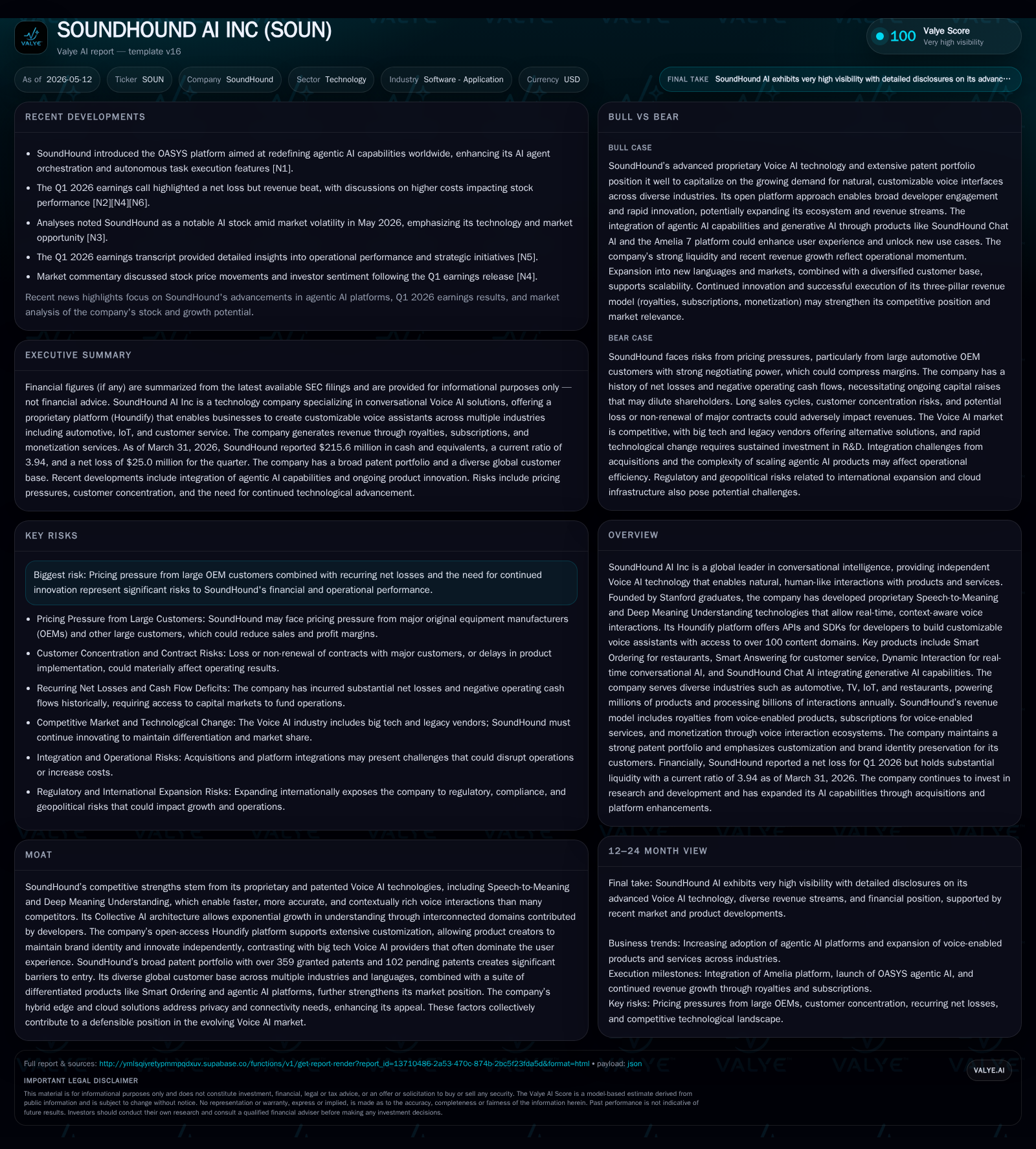
In its latest quarterly filing ending March 31, 2026, SoundHound AI confirmed steady progress in commercial adoption of its proprietary voice AI platform Houndify, with diversified revenue streams spanning royalties, subscriptions, and monetization services. The company continues to invest heavily in research and development and sales, reflecting its strategy to capture a growing $140 billion total addressable market for conversational intelligence across automotive, IoT, and customer service sectors. Despite revenue beats, cost pressures and net losses persist owing to acquisition-related expenses and scaling challenges. SoundHound benefits from a strong patent moat and an open-access platform that differentiates it from big tech assistants but faces risks including pricing pressure from OEMs and evolving technology competition. Key near-term focus includes expanding customer engagements, stabilizing margins through scale, and executing on integrations from recent acquisitions.
Recent Operating Update
Liquidity remains solid with cash and equivalents totaling $215.6 million as of quarter-end March 31, 2026 [F1], providing runway to maintain aggressive R&D spend and sales expansion. The company also maintains a strong current ratio of approximately 3.94x indicating comfortable short-term financial flexibility [F1]. No material changes were reported to risk factors compared with the prior annual filing on December 31, 2025 [S2].
A recent event filing reaffirmed SoundHound's commitment to enterprise-level execution with updates on operational progress related to strategic partnerships and contract fulfillments [S3]. The company's CEO emphasized expanding commercial penetration especially around integrated voice ordering solutions for restaurants and enhanced customer service automation capabilities.
Business Model
SoundHound’s business model is built around an independent Voice AI platform that enables product creators—OEMs in automotive or device manufacturers—to embed natural language voice interaction capabilities directly into their products rather than relying on dominant third-party assistants provided by big tech platforms. This standalone approach empowers brands to customize voice interfaces tailored to their unique user experiences without ceding control over user engagement or data.
Revenue generation follows three key pillars:
Royalties: Customers integrate SoundHound's voice AI into physical products such as connected cars or smart TVs. SoundHound earns royalties typically based on volume metrics like units sold or usage duration.
Subscriptions: For voice-enabled services that do not require hardware integration (e.g., restaurant food ordering platforms or customer support portals), SoundHound charges recurring subscription fees based on service agreements.
Monetization: This pipeline generates revenues from transactional leads driven by voice interactions—for example enabling commerce opportunities through conversational commerce features—and shares proceeds with partners depending on outcomes.
The company actively fosters a developer ecosystem through its Houndify platform which provides APIs/SDKs accessing over 100 content domains spanning weather data to local points of interest. This collective development approach combines proprietary conversational AI language (CaiLAN) with machine learning architecture (CaiNET) to improve response relevance continuously via community contributions.
Research & development remains integral; SoundHound invests heavily in advancing Speech-to-Meaning recognition that bypasses conventional speech-to-text bottlenecks enabling faster semantic understanding essential for real-time conversational use cases. Proprietary Deep Meaning Understanding technologies further enhance multi-turn contextual inquiry handling critical for complex queries in automotive infotainment or enterprise help desks [S1][S18].
Industry Structure and Competitive Position
The Voice AI software market today is characterized by intense competition dominated by large tech firms offering assistant solutions deeply integrated with their ecosystems (e.g., Amazon Alexa, Google Assistant). However, these platforms present limitations for product creators seeking control over user experience or data privacy.
SoundHound distinguishes itself through patented innovations—359 granted patents and over 102 pending—that cover multiple aspects of speech recognition, natural language understanding (NLU), machine learning models tailored for voice interfaces as well as monetization engines [S1]. This IP portfolio represents a significant barrier deterring new entrants from replicating core capabilities easily.
Moreover, SoundHound’s open-access Houndify platform contrasts with closed big tech ecosystems by allowing brand owners extensive customization freedom while maintaining their product identity without risk of disintermediation by third-party assistants.
The company operates globally serving diverse end-customer segments across automotive OEMs supplying connected vehicle infotainment systems; smart TVs requiring voice search & control; wide IoT devices embedding voice commands; fast-growing food ordering applications where seamless contactless ordering adds value; plus enterprise-facing customer service automation utilizing AI-driven Smart Answering tools [S1][S16].
Small specialized startups may also offer regionally focused or niche solutions at aggressive price points impacting market share dynamics [S17].
Growth Drivers
Several structural factors underpin SoundHound’s growth prospects:
- Expansion in Automotive Connectivity: Increasing adoption of sophisticated voice interfaces in vehicles powering infotainment systems creates large volume royalty opportunities tied to unit deployments worldwide.
- Proliferation of IoT Devices: As more household appliances become smart enabled with voice control capability in TVs, kitchen appliances, speakers etc., demand for customizable independent Voice AI platforms grows.
- Enterprise Customer Service Automation: Rising interest from enterprises to deploy Agentic AI platforms such as Dynamic Interaction™ addresses customer support workflows efficiently reducing call center costs while enhancing customer satisfaction.
- Restaurant Industry Digital Transformation: Smart Ordering solutions embedded into cars or mobile apps fulfill consumer preferences for frictionless food ordering ahead of arrival fostering subscription revenue streams.
- Generative AI Integration: Embedding generative AI within its SoundHound Chat AI products opens new interaction modes potentially unlocking fresh use cases beyond scripted domain knowledge bases.
- Patent-protected Innovation: Continuous R&D advancements ensure technological differentiation maintaining relevance amidst rapid industry evolution.
- Acquisitions Synergy: Strategic acquisitions like Amelia Holdings expand capabilities into automation workflows enhancing cross-sell opportunities within existing client bases while onboarding Fortune Global 100 customers further boosting scale potential [S15][N2].
Risks / Watchpoints / Growth Constraints
Key challenges sound the alarm:
- Pricing Pressure: Large OEM customers often wield strong negotiating power pressuring royalty rates or contract terms potentially compressing margins against rising fixed R&D spend backgrounds.
- Customer Concentration Risk: Despite diversification gains post-acquisitions, some customers represent material revenue segments; loss or contract non-renewal would adversely impact operating results.[S16]
- Scaling Costs: Accelerated investments in sales & marketing are needed for enterprise penetration but increase short-term losses delaying path to profitability.
- Technology Competition: Big tech incumbents’ closed ecosystems coupled with emerging startups pose continuous innovation threats requiring sustained innovation expenditure.[S17]
- Execution Risk on Acquisitions: Integrating acquired companies entails risks around cultural alignment,cost synergies realization,talent retention,and expected revenue accretiveness.[S15][S20]
- Macroeconomic Uncertainty: Fluctuations in global economic conditions could dampen clients’ technology spending appetite slowing adoption pace.[S16]
- Intellectual Property Litigation Exposure: Although covered by extensive patents,SOUN faces standard industry risks relating to IP disputes.[S1]
- Regulatory Challenges: Increasing emphasis on data privacy laws globally requires compliance vigilance potentially increasing operational complexity.[S11]
What To Watch Next
Investors should monitor several crucial developments:
- Quarterly bookings versus billings trends signaling commercial traction in core automotive/enterprise segments.
- Milestones related to contingent Amelia earnout targets tied to fiscal year revenue achievements indicating integration success.[S19]
- Gross margin progression as operating leverage improves with scale adoption reflecting product mix shifts or cost optimizations.[N2]
- New strategic partnerships announcements expanding footprint into additional content domains or geographies enhancing Houndify platform stickiness.
- Product innovation updates particularly around generative AI feature rollouts materially differentiating offerings such as enhanced Dynamic Interaction capabilities.[N8]
- Customer retention rates and average contract durations revealing durability of recurring subscription revenues.
- Impact assessment of any macroeconomic headwinds influencing demand within episodic industries like automotive production or restaurant IT budgets.[N5]
- Any announced restructuring plans addressing cost base efficiency could signal focus shift towards nearer-term profitability paths.[N4]
Financial Profile Overview
Latest financial snapshot
| Metric | Value | Period |
|---|---|---|
| Cash & equivalents | $216mm | |
| 2026-03-31 | ||
| Current assets | $289mm | |
| 2026-03-31 | ||
| Current liabilities | $73mm | |
| 2026-03-31 | ||
| Current ratio | 3.94x | |
| 2026-03-31 |
Source: SEC companyfacts cache [F1].
While financial details are secondary to the operating narrative here, key figures provide useful context. As of March 31, 2026:
*Note: Total debt figure reflects best-effort estimate as of March 31, 2024; latest quarter not indicating material changes [F1].
Disclaimer
This analysis is intended solely for informational purposes regarding SoundHound AI Inc's business operations and industry context as reflected in recent publicly available SEC filings and relevant news reporting through May 2026. It does not constitute investment advice or recommendations regarding the company's securities.
Disclaimer: This is research-only, informational analysis and not investment advice. It may include AI-generated interpretation and general industry context. Always verify important details using primary sources.

Comments