
GCT Semiconductor’s 1Q26 Update Highlights 5G Commercialization Progress Amid Liquidity Challenges
GCT Semiconductor reported initial commercial shipments of 5G chipsets while continuing to face financial headwinds and a narrow customer base.
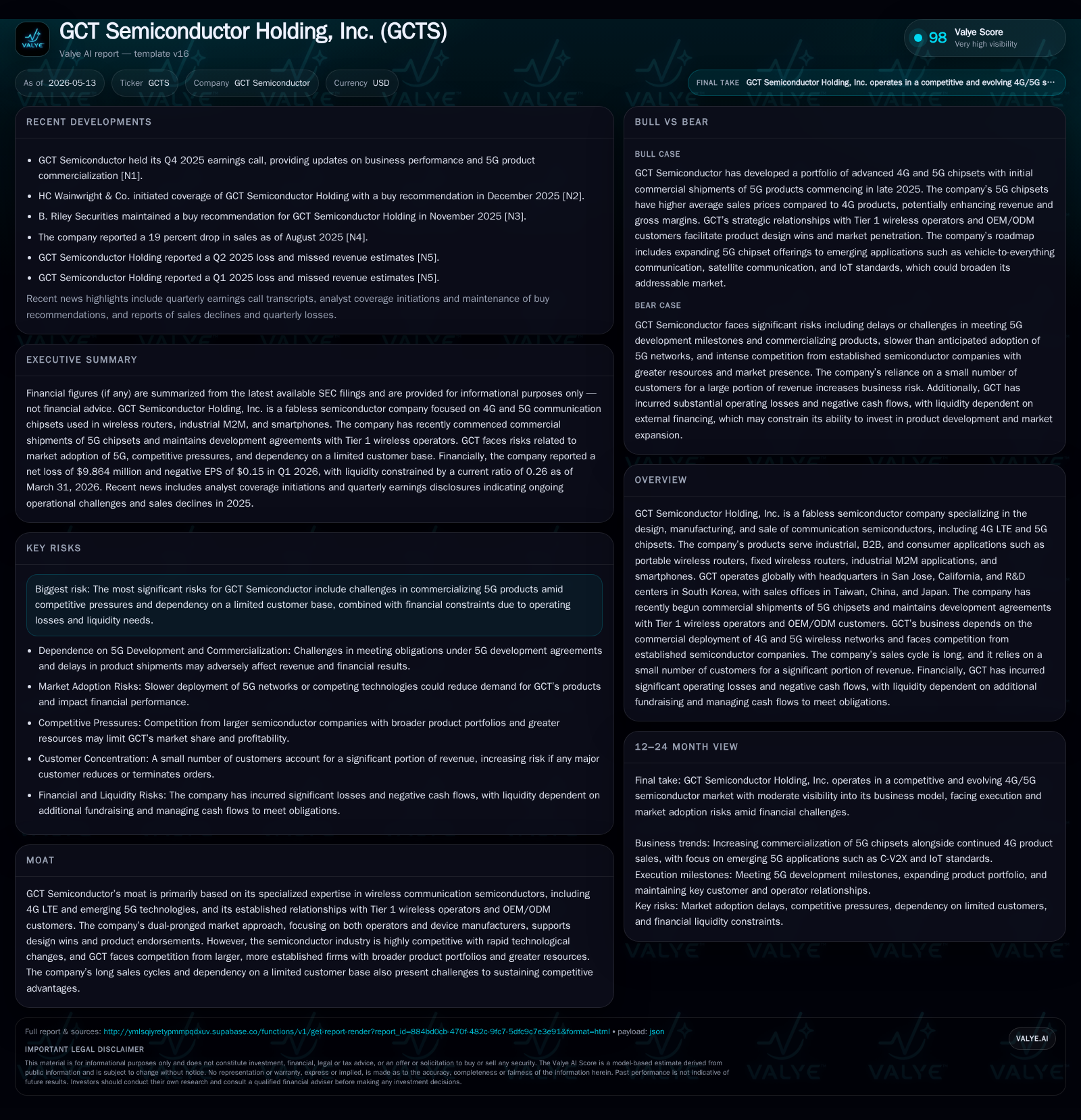
In its latest 10-Q filing for Q1 2026, GCT Semiconductor Holding, Inc. revealed continued progress in commercializing its 5G chipset technology, marking initial shipments to select customers. Despite this operational milestone, the company remains under pressure from ongoing operating losses and a constrained liquidity position, with a current ratio well below 1. GCT's fabless semiconductor business is heavily tied to the pace of 4G/5G network deployment and demands deep collaboration with Tier 1 wireless operators. The company’s competitive moat centers on specialized wireless communication semiconductors but is tempered by fierce competition from larger incumbents and evolving technology standards. Key growth drivers include scaling 5G product adoption across fixed wireless access and M2M segments, but risks around capital adequacy, sales cycle length, and market acceptance persist.
Recent Operating Update
In its Q1 2026 filing dated May 12, GCT Semiconductor reported the first commercial shipments of its newly developed 5G chipsets to select customers—a significant uptick from prior phases dominated by testing and qualification milestones under collaborative agreements with Tier 1 wireless operators [S2][S3]. This transition reflects advancement beyond R&D to initial revenue recognition stages aligned with product sales.
Despite this progress, GCT continues to record substantive operating losses stemming largely from elevated production-related costs such as mask sets, wafers acquisition, assembly, testing fees payable to third parties (given its fabless manufacturing model), as well as sustained R&D expenses critical for sustaining competitiveness in rapid wireless technology evolution [S1][F1].
The balance sheet indicates significant leverage concentrated in near-term maturities necessitating refinancing or operational cash flow improvements imminently [F1][S2].
Business Model
GCT Semiconductor operates as a fabless semiconductor entity focusing on design and sales rather than fabrication of communication chips. Its revenue streams stem principally from selling wireless communication chipsets catering to industrial, B2B, and consumer markets including portable/fixed wireless routers, smartphones, and machine-to-machine (M2M) applications predominantly based on LTE and emerging 5G standards [S1].
The firm monetizes its products through contractual development agreements combined with direct chipset sales to OEMs/ODMs. These agreements impose stringent milestone delivery requirements tied to design wins and commercialization rights with prominent carriers—a critical ingredient shaping revenue realization timing.
Operating margins hinge on several levers: wafer procurement costs largely dictated by foundry contract terms; assembly and test expenses; pricing dynamics pressured by intense competition; along with volume scale achieved during production ramp phases. Product mix shifts toward newer generation (5G) solutions have yet to fully offset legacy product declines.
Industry Structure and Competitive Position
Within the highly fragmented yet consolidation-prone semiconductor space for wireless communications devices, GCT occupies a specialist niche centered on mid-tier chipset designs enabling connectivity within various device types. Its key value proposition leverages deep protocol expertise in LTE/5G combined with long-standing relationships spanning Tier-1 carriers and device manufacturers primarily across Asia-Pacific markets.
Competitively, the company faces robust pressure from entrenched semiconductor suppliers boasting expansive product portfolios supporting multi-standard communications plus greater economies of scale—capabilities enabling aggressive pricing strategies difficult for smaller players to match without sacrificing margin sustainability [S25].
While GCT’s dual-market focus (operators + OEMs) facilitates broader ecosystem integration supporting customer retention through design wins and embedded solutions endorsements, its reliance on limited customers enhances counterparty risk. Furthermore, rapid technological obsolescence alongside evolving standards mandates continuous R&D investment to remain relevant.
Growth Drivers
Growth fundamentally depends on accelerating the adoption curve of the company's next-generation communication solutions aligned with the global rollout of 5G infrastructure:
- Expansion into fixed wireless access segments exploiting rising demand for broadband alternatives outside fiber reach,
- Capturing share within mobile broadband offerings supplied through partner OEM smartphone/device suppliers,
- Targeting burgeoning industrial IoT/M2M deployments necessitating low-latency reliable connectivity enabled by tailored semiconductor integration.
Operationally measured indicators include backlog expansion defined by signed contracts delivering milestone payments; volume ramp in commercial shipment batches; renewed design wins; progressive qualification status across partner ecosystems; pricing/mix improvements favoring higher-margin newer tech components.
Additionally, development partnerships with Tier-1 operators underpin credibility essential for entering new regional markets or device categories while facilitating feedback loops optimizing technical specifications enhancing product-market fit.
Risks / Watchpoints / Growth Constraints
Key risks shadowing GCT's forward path center on:
- Prolonged commercialization timelines or execution hiccups delaying volume shipment schedules undermining revenue projections,
- Financial strain limiting capacity to sustain necessary investment levels in wafer procurement or innovation,
- Customer concentration constraining revenue breadth exposing operations to substantial order volatility,
- Competitive displacement by larger rivals offering integrated platforms or superior cost structures weakening pricing power,
- Dependence on volatile supplier foundry relationships subject to capacity constraints or price surges,
- Potential intellectual property litigation risks inherent in rapidly shifting technology landscapes impacting product availability or incurring costly settlements.
These factors collectively impose considerable uncertainty regarding sustainable profitability achievement given current operating loss posture and capital structure profile [S21][F1].
What to Watch Next
Investors and analysts should monitor:
- Quarterly updates detailing shipment volume growth trends for newly launched 5G chipsets,
- Progress against stipulated milestones within operator development agreements signaling readiness for broader market rollout,
- Cash burn trajectory vis-à-vis financing activities indicating runway duration or need for additional capital raises,
- Updates on supply chain arrangements mitigating wafer assembly bottlenecks,
- Developments around new customer acquisitions or diversification beyond current major clients,
- Any shifts in competitive landscape including technological alliances or new entrants disrupting pricing structures.
Explicit guidance disclosure remains limited but management commentary during earnings calls or filings may provide directional clarity around timing expectations for breakeven cash flow operations or scaling inflection points.
Financial Profile Summary
Latest financial snapshot
| Metric | Value | Period |
|---|---|---|
| Cash & equivalents | $7.2mm | |
| 2026-03-31 | ||
| Total debt | $57.7mm | |
| 2026-03-31 | ||
| Net debt | $50.5mm | |
| 2026-03-31 | ||
| Current assets | $19.0mm | |
| 2026-03-31 | ||
| Current liabilities | $74.5mm | |
| 2026-03-31 | ||
| Current ratio | 0.26x | |
| 2026-03-31 |
Source: SEC companyfacts cache [F1].
Calculated as Total Debt minus Cash & Equivalents
Operating losses exceed $36 million annually as per latest available data reflecting ongoing investment phase. The balance sheet indicates significant leverage concentrated in near-term maturities necessitating refinancing or operational cash flow improvements imminently [F1][S2].
This analysis synthesizes current SEC filings along with strategic considerations inherent to GCT Semiconductor’s industry context without providing investment advice or price targets.
Disclaimer: This report is for informational purposes only and does not constitute an offer or solicitation to buy or sell securities. It reflects publicly available data as of the referenced dates without speculative forecasts.
Disclaimer: This is research-only, informational analysis and not investment advice. It may include AI-generated interpretation and general industry context. Always verify important details using primary sources.

Comments