
Better Home & Finance's Digital Platform Drives Mortgage Growth Amid Market Volatility
BETR’s latest quarter underscores strategic refocus on U.S. operations and expansion of its AI-powered Tinman platform to capture mortgage origination opportunities despite a volatile macro environment.
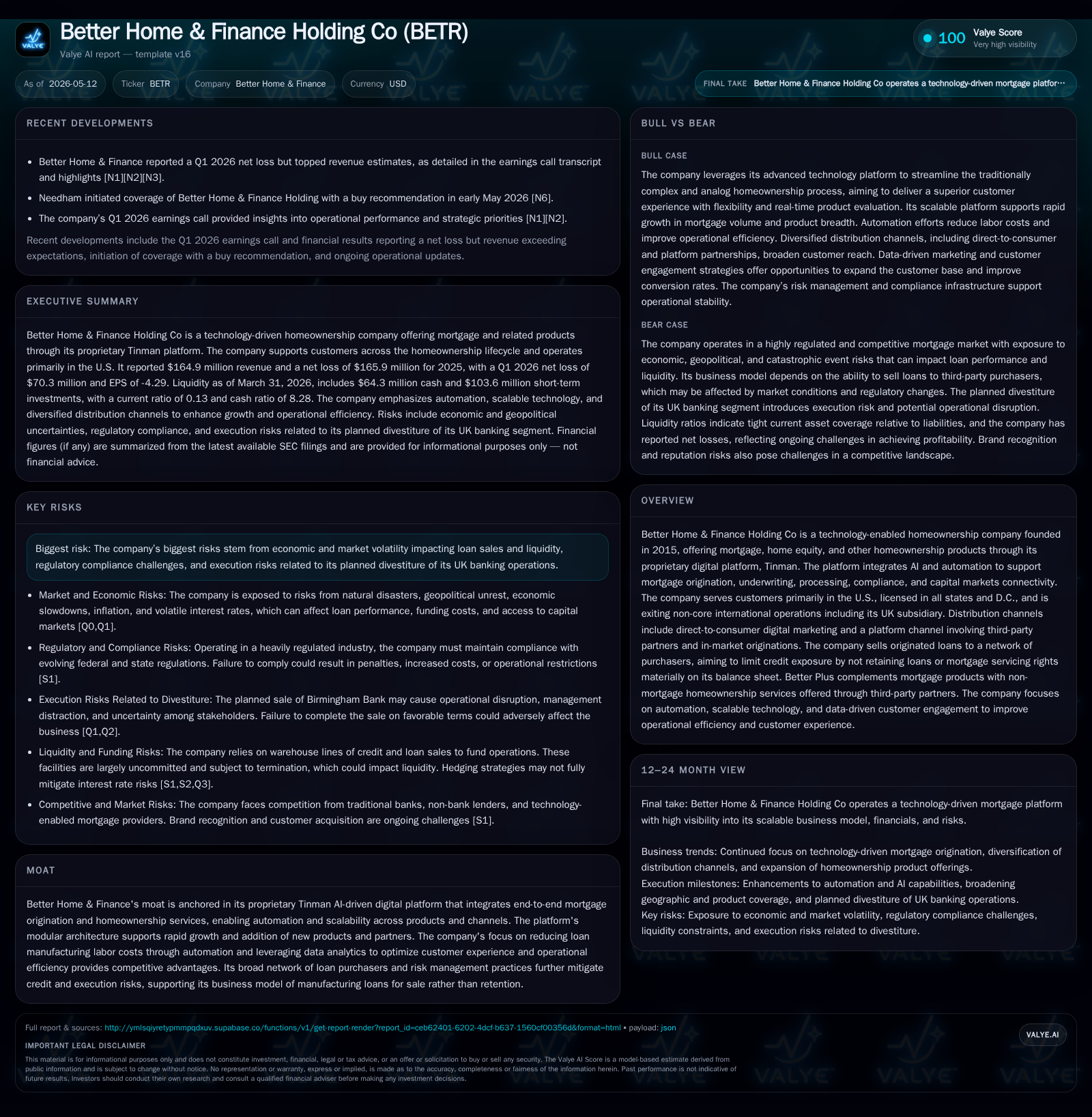
In its May 2026 quarter, Better Home & Finance Holding Co highlighted progress in divesting its UK banking subsidiary, sharpening focus on its core U.S. mortgage technology business powered by the Tinman AI platform. This strategic narrowing aligns with ongoing investments to improve automation, underwriting precision, and third-party partner channels. While the company benefits from accelerating funded loan volume and revenue growth driven by digital origination scale, it remains exposed to interest rate-driven demand shifts and operational risks related to talent retention and regulatory compliance. Monitoring Birmingham Bank divestiture progress and gain-on-sale margins will be critical indicators of execution and financial trajectory.
Latest Quarterly Operating Update: Focus on UK Exit and Technology Leverage
Better Home & Finance’s (BETR) latest Form 10-Q filed May 11, 2026 emphasizes a strategic pivot marked by the planned divestiture of Birmingham Bank, its UK-based banking subsidiary, sharpening operational focus on its U.S.-centric mortgage technology business [S2][S3]. This exit from international banking operations reduces geographic complexity and capital allocation demands. The company retains full licensing and market footprint across all U.S. states and D.C., concentrating resources on scaling its proprietary Tinman digital platform.
Despite headwinds from volatility in mortgage markets triggered by fluctuating interest rates and geopolitical factors affecting capital markets liquidity, BETR continues investing heavily in technology enhancements bolstering automation and analytics capabilities within Tinman. Management’s discussion highlights sustained pipeline growth supported by Tinman’s ability to integrate consumer direct originations with third-party partner channels seamlessly [S2]. The divestiture efforts potentially unlock capital while allowing management to allocate expenditures towards platform innovation.
Better Home & Finance’s Business Model and Product Offering
Founded in 2015 as a technology-first homeownership company, Better Home & Finance builds its revenue model around an end-to-end digital mortgage origination ecosystem powered by Tinman — an AI-based platform automating underwriting, processing, compliance verification, pricing optimization, and secondary marketing connectivity [S1]. Tinman's modular architecture enables rapid scaling across multiple loan products including purchase mortgages, refinancing options, and home equity offerings.
Revenue stems predominantly from gain-on-sale margins rather than retaining servicing rights or loans long-term on balance sheet — reflecting a classic "loan manufacturing" approach that limits credit exposure [S1][S5]. Loan purchasers within an established network buy finished loans funded via short-term warehouse lines. By selling loans promptly post-closing, BETR mitigates balance-sheet risk while relying on fees and margin differentials for profitability.
Distribution channels are dual-pronged: direct-to-consumer digital marketing efforts drive borrower traffic into Tinman-enabled portals; concurrently platform partnerships extend reach through third-party originators who source mortgages leveraging BETR’s automated backend infrastructure [S1][S2]. Analytics integrated throughout the process improve underwriting performance, lowering delinquency compared to industry norms by leveraging thousands of data points verified via API calls against external data providers.
Competitive Landscape and Industry Dynamics in Technology-Enabled Mortgage Origination
The U.S. mortgage origination market is fiercely competitive involving fintech disruptors pioneering fully digital lending models alongside entrenched traditional banks aggressively enhancing their digital capabilities. BETR's moat lies in Tinman’s proprietary AI-driven automation that compresses loan manufacturing labor costs while enabling rapid adaptation to varying state regulations through robust compliance tracking modules [S1][N8].
Interest rate levels continue to be a pivotal headwind shaping loan volumes industry-wide; elevated or volatile rates suppress refinancing demand while pressuring purchase affordability. Gain-on-sale margin volatility accompanies these volume shocks as buyers adjust credit appetite accordingly.
Growth Catalysts: AI Platform Adoption, Channel Expansion, and Product Diversification
Growth momentum rests heavily on increasing adoption of Tinman by both direct consumers and expanding third-party partner channels feeding originations into the system. Funded Loan Volume surged by approximately 32% YoY in calendar year 2025 reaching $4.7 billion versus $3.6 billion prior year; revenue growth exceeded volume gains at roughly +52%, indicating improved mix or expanded margin capture amidst scale effects [S1][F1].
Platform enhancements aim at automating manual underwriting steps extensively through continuous AI refinements reducing human intervention — translating into lowered loan manufacturing cost per transaction alongside improved throughput speed [N1][N2]. The launch of complementary product lines such as home equity services broadens wallet share per customer over their ownership lifecycle.
Expanding strategic partnerships broadens addressable market by integrating other originators into the Tinman ecosystem — adding diversified distribution without commensurate incremental fixed costs emphasizes scalability inherent in software-led models [S2][N8].
Risks and Constraints: Market Volatility, Regulatory Challenges, and Talent Retention
BETR faces significant macro risk stemming from interest rate fluctuations which depress volumes drastically as seen across the sector; gain-on-sale margins are directly impacted by secondary market conditions complicating earnings predictability [S1]. Externally sourced warehouse lines funding short-term loan production dependencies carry renewal risk—lines are mostly uncommitted with conditions that could abruptly limit availability representing key liquidity vulnerabilities [S11][S28].
Regulatory compliance remains intricate given presence in all U.S. jurisdictions with evolving state-specific rules necessitating continuous investment in monitoring systems embedded within Tinman; any lapses could trigger fines or operational suspensions adversely affecting reputation or financing covenants [S12].
Notable internal challenges include considerable attrition among senior management members eroding institutional knowledge crucial for executing complex technology projects and regulatory navigation; this talent churn rivals steep retention challenges common in tech-heavy fintech firms exacerbated by past workforce reductions and negative media coverage around leadership legal disputes involving the CEO—these litigations pose reputational risks that may divert management focus and resource allocation away from growth priorities [S1][N7][S26].
Looking Ahead: Milestones and Key Metrics to Monitor
Near-term investors should track finalization details regarding Birmingham Bank divestiture—timing and terms will reveal impact on capital structure flexibility as well as potential one-time charges or gains affecting earnings profile [S2][S3]. Sustainable execution validating growth in funded loan volumes during Q2 reported earnings along with stable or improving gain-on-sale margins will serve as tangible indicators of demand resilience amid rate volatility.
Monitoring pace of onboarding new channel partnerships utilizing Tinman will indicate whether distribution scale benefits offset market headwinds while product rollouts beyond core mortgage origination can provide cross-selling expansion examples enhancing lifetime customer value metrics [N8]. Employee retention statistics within critical teams could serve as early warning for execution disruption risks.
Brief Financial Profile and Liquidity Snapshot
As of March 31, 2026 quarter-end, BETR held $64.3 million in cash & equivalents providing a buffer amid working capital pressure though current ratio stood at a low 0.13 indicating insufficient short-term asset coverage versus immediate liabilities—a reflection of intense funding cycle dynamics typical in mortgage origination firms with reliance on warehouse credit facilities for loan funding rather than holding loans long term [F1].[S5]
Annualized revenue reached $164.9 million for calendar year ended December 2025 driven largely by scale gains but net losses persisted at $165.9 million driven by elevated costs related to tech investment, regulatory compliance infrastructure buildout, legal expenses linked to ongoing litigations, along with employee retention challenges weighing on operational continuity [F1].[S1]
While losses remain substantial owing to aggressive expansion strategy financed through borrowing facilities renewed annually under restrictive covenants limiting liquidity flexibility, the shift towards concentrating solely on the U.S.-based digital mortgage platform signals potential for capital discipline improvement allowing narrowing focus on an eco-systemic homeownership solution optimized through proprietary AI.
This analysis is based solely on information publicly disclosed in SEC filings up to May 12th, 2026 and selected news sources without offering investment advice or price predictions.
Disclaimer: This is research-only, informational analysis and not investment advice. It may include AI-generated interpretation and general industry context. Always verify important details using primary sources.

Comments