
Microvast Expands Capacity and Shifts Toward Western Markets in Q1 2026
Microvast reported operational growth and geographic diversification in its latest quarter, highlighting capacity expansion efforts despite liquidity and customer concentration risks.
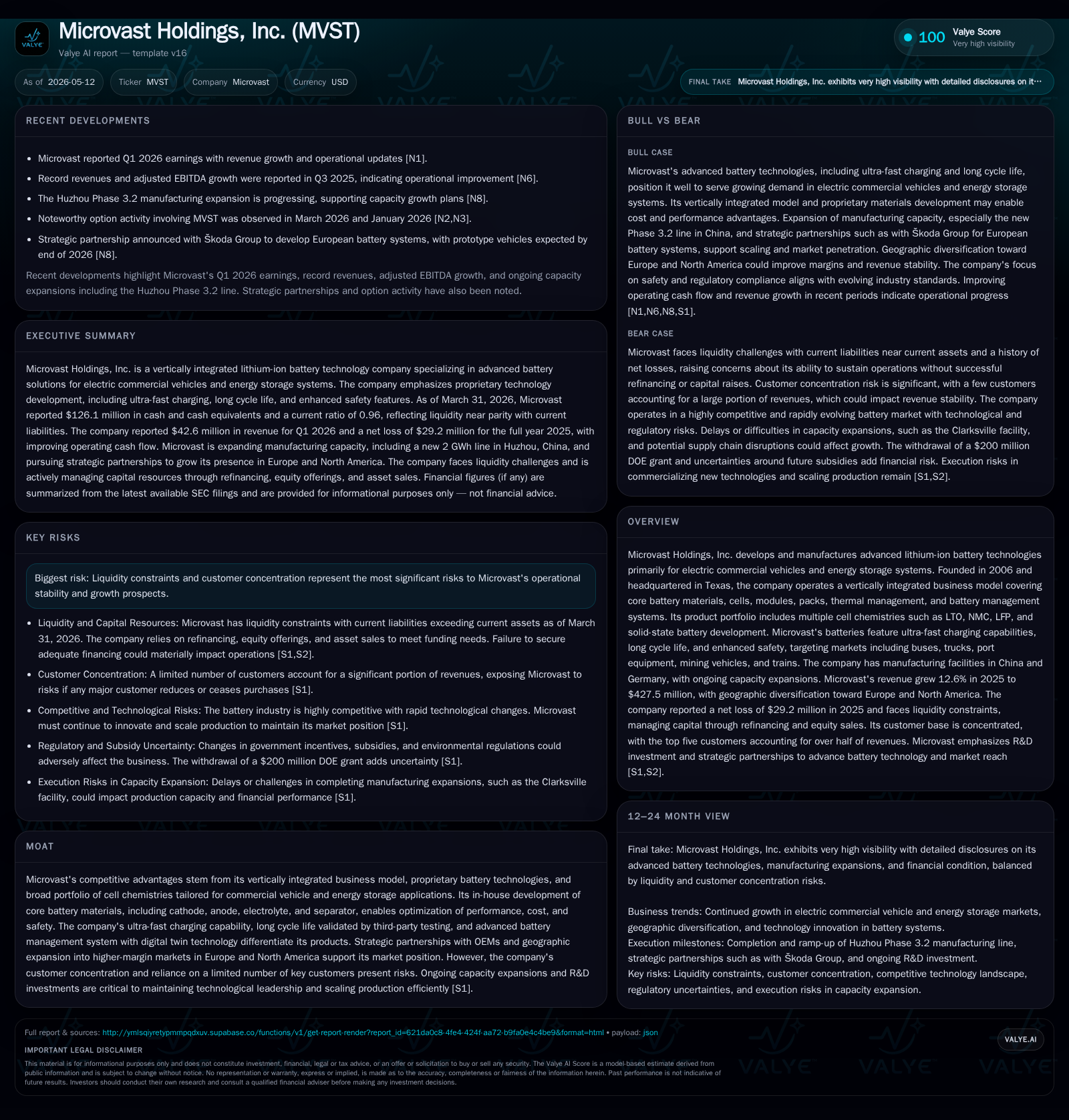
In Q1 2026, Microvast Holdings showcased a strategic shift with increased revenue contribution from North America and Europe, supported by ongoing manufacturing capacity expansions, particularly at its Clarksville facility. The company’s vertically integrated battery technology stack enables its focus on ultra-fast charging solutions tailored for commercial electric vehicles and energy storage systems. Despite promising demand drivers linked to market penetration in higher-margin Western regions and innovation in cell chemistries, Microvast faces near-term challenges from liquidity constraints and reliance on a concentrated customer base. Upcoming milestones include the anticipated closing of a Florida asset sale and the completion of key production ramps that will be critical to sustaining growth and capitalizing on market opportunities.
Q1 2026 Operating Update: Geographic and Capacity Developments
Microvast Holdings’ Q1 2026 10-Q filing delivered a pivotal update emphasizing both operational progress and strategic geographic realignment [S2]. The company reported broad revenue growth propelled by surging demand in North America—up an extraordinary 173.2% year-over-year—and solid gains in Europe at +12.9%, signaling a clear pivot from its historical Asia-Pacific dominance toward a more balanced global footprint [S1]. This shift aligns with Microvast’s concerted efforts to penetrate higher-margin Western commercial electric vehicle (EV) markets.
Concurrent with this geographic diversification, Microvast disclosed significant manufacturing capacity expansion initiatives. The Tennessee-based Clarksville facility is transitioning its output focus toward lithium iron phosphate (LFP) cells tailored for energy storage system (ESS) applications—departing from the initially intended 53.5Ah cell format [S1,S3]. Despite facing mechanical liens from contractors related to construction delays arising from financing constraints, management underscored active engagement with suppliers to resolve these issues [S13].
This dual emphasis on expanding capacity while recalibrating product mix reflects Microvast’s pragmatic recognition of shifting market demands and regulatory incentives in the U.S. and Europe, where customers prioritize performance characteristics such as safety, fast charging capability, and cycle longevity over pure cost competitiveness prevalent in China.
Microvast’s Vertically Integrated Battery Technology Model
At its core, Microvast operates a fully vertical integration strategy that encompasses proprietary control over all critical battery system layers—from raw materials (cathode, anode, electrolyte, separator) through cell assembly to modules, packs, thermal management systems, and intelligent battery management systems leveraging digital twin technology [S1].
This comprehensive technological stack serves as a differentiator enabling optimization across performance metrics vital for commercial EVs and ESS markets: ultra-fast charge rates reducing vehicle downtime; enhanced safety exceeding standard lithium-ion chemistry benchmarks; and long cycle life confirmed by third-party validation.
The vertically integrated approach also facilitates cost control by internalizing material synthesis while allowing rapid iteration of cell chemistry formulations including LTO (Lithium Titanate Oxide), NMC (Nickel Manganese Cobalt), LFP (Lithium Iron Phosphate), alongside ongoing solid-state development programs [S1]. This technological breadth positions Microvast strategically against competitors who may focus on limited chemistries or outsource core material supply.
Competitive Positioning in the Commercial EV and Energy Storage Markets
Within the competitive landscape of specialized lithium-ion battery producers targeting commercial transportation electrification—buses, trucks, mining vehicles—as well as energy storage system integrators, Microvast distinguishes itself by marrying proprietary chemical innovations with integrated digital battery management tools.
OEM partnerships remain foundational; however, exposure to a limited number of marquee customers creates revenue concentration risks that magnify operational volatility [S1]. The geographic expansion into Europe and North America offers access to more technology-driven buyers with greater willingness to pay premiums for advanced features compared to commodity-driven price sensitivity encountered in China where local manufacturers dominate.
Raw material price fluctuations remain an industry-wide challenge. While vertical integration mitigates some margin erosion exposures through internal sourcing flexibility, third-party dependencies persist for certain components sourced predominantly from Asia. Additionally, evolving environmental regulations—such as forthcoming EPA hazardous waste mandates for lithium batteries entering effect by 2027—impose compliance costs that must be managed carefully [S16].
Growth Drivers: Capacity Expansion, Geographic Diversification, and Technology Innovation
Microvast’s revenue growth trajectory is anchored in several interrelated drivers:
Capacity Expansion: Completion of strategic manufacturing lines notably the Clarksville plant’s transition to LFP cells for ESS is projected to unlock operating leverage through improved fixed cost absorption [S2,S12]. The Huzhou Phase 3.2 expansion in China also contributes greater throughput potential.
Geographic Diversification: Accelerated penetration into European and North American markets supports expectations for higher average selling prices driven by differentiated technology rather than pure cost competition [S11,S20]. This strategy addresses market-specific preferences such as robust safety certifications and extended warranties.
Technology Innovation: Sustained R&D investment underpins continual enhancements ranging from ultra-fast charging capabilities to improved digital BMS functionalities including advanced prognostics using digital twins [S21]. These innovations align with evolving OEM requirements aiming for minimized operational downtime.
Concrete KPIs reflective of these drivers include expanding order backlogs primarily concentrated among long-term transit partners based in Europe ($196 million as disclosed) alongside growing percentage contributions from non-Asia markets driving revenue composition shifts [S6,S11].
Risks and Constraints: Liquidity, Customer Concentration, and Market Adoption
Despite operational momentum, Microvast contends with material near-term risks:
Liquidity Constraints: The latest balance sheet snapshot reveals cash & equivalents of approximately $126 million against total debt near $13 million; however, current liabilities of nearly $444 million exceed current assets ($426 million), resulting in a current ratio below unity at 0.96—a marker of working capital tightness potentially constraining operational flexibility [F1].
Customer Concentration: Revenue remains heavily dependent on a limited set of OEM customers which introduces vulnerability to sudden order fluctuations or contractual renegotiations [S1,S2].
Operational Execution: The Clarksville expansion delays attributable partly to financing gaps have triggered contractor liens requiring active resolution efforts; failure here could stall delivery schedules or inflate costs [S13].
Regulatory Dynamics: Changes or reductions in government incentives such as U.S. Inflation Reduction Act benefits or E.U.’s Green Deal subsidies could dampen overall demand for electric commercial vehicles thereby indirectly pressuring battery sales volume [S16].
Supply Chain Dependencies: Reliance on external suppliers for certain raw materials without diversification risks disruptions amid geopolitical tensions or trade restrictions impacting Asia-sourced components [S1].
Key Milestones to Monitor: Production Ramp-up, Order Book Growth, and Capital Structure Updates
Looking forward into Q2 2026 and beyond, several milestones will be critical barometers:
Asset Divestiture Closing: Anticipated sale of the Lake Mary Florida facility expected not only to bolster balance sheet liquidity but also fund ongoing U.S.-based expansions without diverting core operations resources [S4].
Clarksville Facility Completion: Progress updates will signal the company’s ability to overcome financial execution hurdles—crucial for scaling ESS product assembly domestically.
Order Backlog Fulfillment: Tracking order intake cadence among key European transit customers offers insight into demand sustainability.
Capital Raising Activities: Engagements around equity offerings or refinancing options remain key given existing short-term borrowing maturities and working capital demands [S6,S8].
Latest Financial Snapshot Supporting Operational Context
Latest financial snapshot
| Metric | Value | Period |
|---|---|---|
| Cash & equivalents | $126mm | |
| 2026-03-31 | ||
| Total debt | $13mm | |
| 2025-12-31 | ||
| Net debt | $-113mm | |
| 2025-12-31 | ||
| Current assets | $426mm | |
| 2026-03-31 | ||
| Current liabilities | $444mm | |
| 2026-03-31 | ||
| Current ratio | 0.96x | |
| 2026-03-31 |
Source: SEC companyfacts cache [F1].
As of Q1-end March 31, 2026, Microvast’s liquidity position reflects substantial cash reserves relative to debt; however elevated current liabilities underscore tight short-term funding conditions necessitating careful cash management [F1].
Disclaimer: This report is prepared solely for informational purposes based on publicly filed SEC documents and recent corporate disclosures without offering investment recommendations or advice.
Disclaimer: This is research-only, informational analysis and not investment advice. It may include AI-generated interpretation and general industry context. Always verify important details using primary sources.

Comments