
Super Micro’s Q3 2026 Performance Highlights Regulatory, AI Demand Dynamics
Strong AI-driven demand fuels Super Micro’s Q3 results amid ongoing export control challenges shaping operational risks and market positioning.
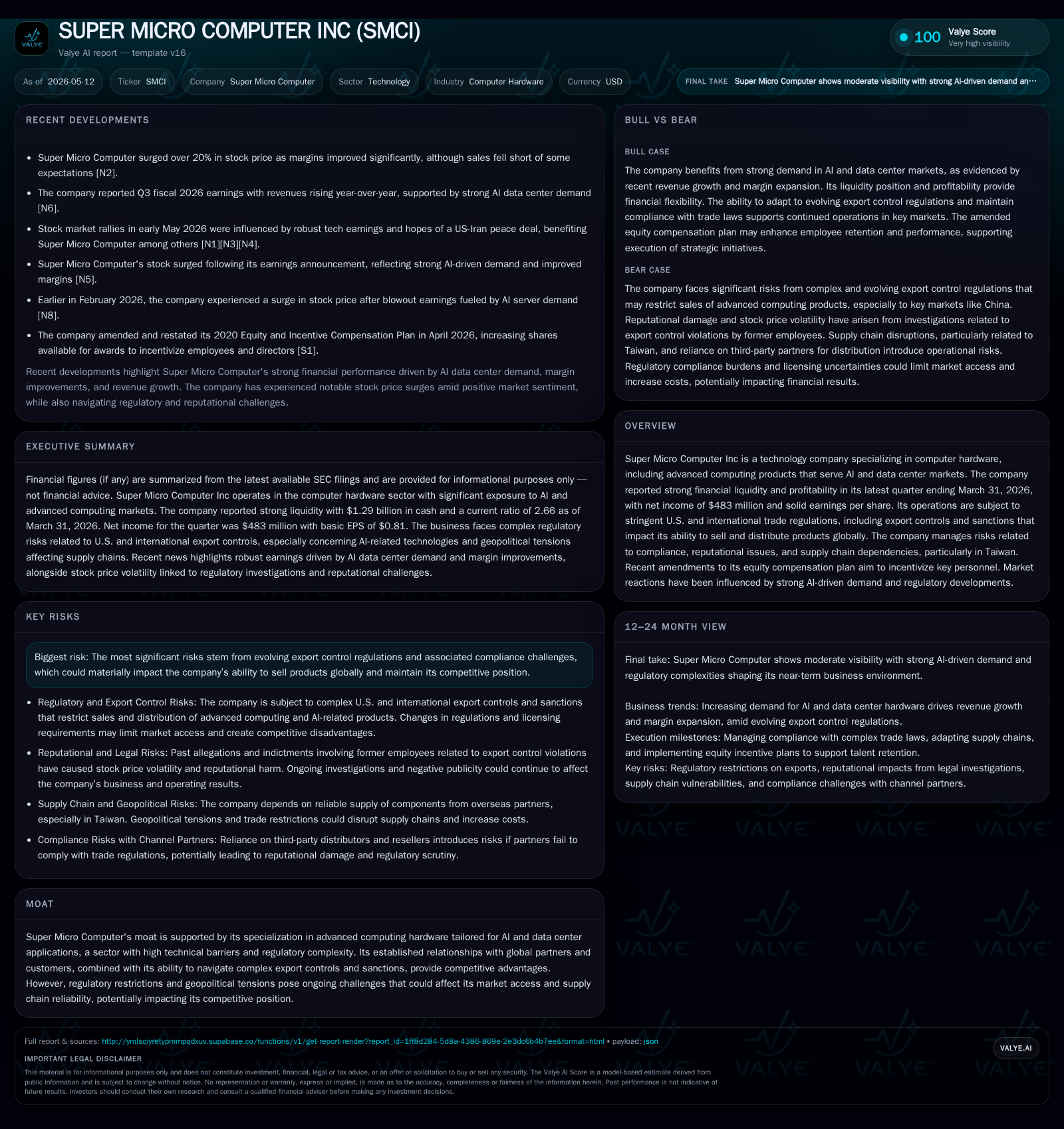
Super Micro Computer Inc reported a robust Q3 2026 with net income of $483 million driven by accelerated AI data center demand and margin expansion. However, its growth trajectory is moderated by complex U.S. export controls and an ongoing governmental investigation linked to former employees’ alleged misconduct. The company’s advanced computing solutions, tailored for AI workloads, position it well within a competitive sector constrained by regulatory barriers and geopolitical supply chain dependencies. Recent equity compensation plan amendments reflect strategic efforts to retain talent critical for innovation amid these headwinds.
Q3 2026 Operating Update: Earnings Beat Amid Compliance Complexity
Super Micro Computer Inc’s latest quarterly filing (10-Q dated May 11, 2026) delivered a compelling snapshot of operational strength amid challenging external factors [S2]. Net income reached $483 million with earnings per share exceeding analyst estimates, propelled principally by surging demand for AI-optimized data center hardware [N5]. Gross margins improved noticeably despite persistent cost pressures tied to compliance initiatives required by the complex export control regime under which the company operates [S2]. Market response was favorable after the earnings release, highlighting investor confidence in its AI growth exposure [N2]. This performance was accompanied by a reaffirmation of ongoing cooperation with U.S. authorities concerning an export control investigation involving former employees indicted in March 2026 [S4],[S5]. While the company itself is not a defendant, the reputation impact has been nontrivial and continues to weigh on stock volatility.
Further operational updates include an approved amendment to Super Micro's equity incentive compensation plan at the April 2026 Annual Meeting designed to retain key talent critical for advancing innovation in hardware solutions [S15]. This strategic move aligns management incentives directly with delivering on market opportunities amid regulatory uncertainties.
Business Model and Product Quality: Advanced Computing for AI and Data Centers
Super Micro's core revenue stream derives from designing, manufacturing, and selling high-performance server systems specialized for artificial intelligence workloads and large-scale data center deployments [S2]. These products incorporate cutting-edge semiconductors such as NVIDIA A100 and H100 GPUs—components tightly integrated within complex computing architectures optimized for AI model training and inference acceleration.
The company's business model hinges on combining highly customizable configurations with rapid technological integration cycles demanded by hyperscalers, enterprises, and government clients. This specialization creates technical barriers to entry supported by customer trust in product reliability and an ability to comply with nuanced client requirements related to performance, security certifications, and regulatory adherence. Maintaining rigorous quality standards amid rapid innovation advances is vital for sustaining competitive economics in this niche sector.
Industry Structure: Competitive Pressures, Regulatory Barriers, and Supply Dependencies
The computer hardware segment serving AI data centers is effectively oligopolistic but complicated by significant regulatory overlays. Major peers include Dell Technologies, HPE, Lenovo’s server division, alongside chipset providers like NVIDIA whose components are embedded in end solutions. However, unlike commodity server vendors, Super Micro differentiates through highly engineered solutions tailored towards next-generation AI workloads.
US trade laws increasingly restrict export markets especially targeting China (including Hong Kong), Russia (from which SMCI ceased sales since early 2022), and expanding restrictions into Eastern Europe and Middle East regions [S5],[S6]. These import-export controls are administered by multiple agencies including OFAC and BIS with onerous licensing regimes that complicate global sales strategies [S11],[S12]. The competitive disadvantage emerging from these export restrictions contrasts with some competitors less exposed or diversified geographically.
Supply chain vulnerability primarily stems from reliance on overseas partners concentrated in Taiwan—a geopolitical flashpoint whose stability remains uncertain [S6],[S17]. Any disruption to semiconductor or component availability would materially impact production schedules given limited alternate sourcing options. Channel partners' adherence to trade compliance also remains an operational challenge given potential indirect violations affecting reputation.
Growth Drivers: AI Deployment Trends and Strategic Incentives
Structurally advantaged growth arises from accelerated adoption of large language models (LLMs) and enterprise AI applications necessitating continual refresh cycles of specialized hardware [N2]. Each new wave of model complexity demands exponentially more compute capacity—a dynamic fueling demand for SMCI’s customized server platforms integrating advanced GPUs.
Internally, management has emphasized workforce retention through amendments to equity-based incentive plans approved at the recent Annual Meeting adding 15 million new shares allocable under the plan [S15]. These incentives are critical to sustaining innovation velocity against a backdrop of aggressive industry competition where skilled engineering talent drives feature differentiation.
Moreover, industry-wide regulatory tightening around AI technologies may create additional barriers shielding incumbents able to rapidly adapt compliance frameworks from nascent entrants.
Risks and Constraints: Export Controls, Reputation, and Supply Chain Vulnerabilities
The foremost risk stems from escalating US export controls with periodic revisions that further limit permissible destinations for key advanced computing products including GPUs integral in SMCI offerings [S11],[S14],[S16]. These evolving restrictions impose licensing burdens that are time-consuming and may restrict market access unpredictably.
While SMCI itself is not implicated legally in the March 2026 indictment alleging conspiracy by select former employees related to export control violations with Chinese customers via third-party brokers [S4],[S5],[S13], the reputational damage has materially affected investor sentiment and could hamper customer confidence longer term. Misconduct risks extend beyond individuals due to dependency on partner compliance where imperfect controls can trigger enforcement scrutiny or negative publicity.
Geopolitical tensions around Taiwan threaten supply continuity critical for maintaining production cadence; shifts necessitating relocation or dual sourcing would entail significant transition costs reducing near-term operational efficiency [S6],[S17]. Additionally, inability to swiftly obtain export licenses might result in delayed sales fulfillment or inventory obsolescence if technology cycles outpace regulatory approvals.
Collectively these factors introduce uncertainty around sustainable revenue growth speed despite underlying robust end-market dynamics.
What To Watch Next: Guidance, Regulatory Developments, and Market Signals
Investors should closely monitor SMCI’s forthcoming quarterly guidance updates expected following Q3 disclosures for signs of management confidence amidst compliance headwinds [S2],[S3]. Progress or resolution updates regarding governmental export investigations will be critical given their outsized impact on perception despite absence of direct liability.
Attention should also be paid to announcements of new customer contracts or renewals particularly those signaling expanded penetration into hyperscale AI providers or international markets surviving current restrictions [N7],[N9]. Given that government policies may shift rapidly as geopolitical climates evolve, any adjustment in licensing regimes or sanction lists affecting SMCI’s usable market will materially influence near- and medium-term growth trajectories.
Finally, tracking any further amendments or expansions of incentive programs can serve as proxy signals about internal prioritization of innovation investment and retention strategies supporting long-term competitiveness.
Latest Financial Snapshot
Latest financial snapshot
| Metric | Value | Period |
|---|---|---|
| Cash & equivalents | $1290mm | |
| 2026-03-31 | ||
| Current assets | $21.6bn | |
| 2026-03-31 | ||
| Current liabilities | $8.1bn | |
| 2026-03-31 | ||
| Current ratio | 2.66x | |
| 2026-03-31 |
Source: SEC companyfacts cache [F1].
| Metric | Value (USD) |
|---|---|
| Cash & Equivalents | 1.29 B |
| Total Debt | 7.23 M |
| Current Assets | 21.57 B |
| Current Liabilities | 8.12 B |
| Current Ratio | 2.66 |
As of March 31, 2026, Super Micro maintains a strong liquidity profile highlighted by $1.29 billion in cash equivalents versus minimal debt levels ($7.23 million total debt), resulting in a robust current ratio of approximately 2.66 reflecting solid short-term financial flexibility [F1],[S2].
Disclaimer: This is research-only, informational analysis and not investment advice. It may include AI-generated interpretation and general industry context. Always verify important details using primary sources.

Comments