
Traeger’s Q1 2026 Update Reflects Project Gravity Progress Amid Supply Chain and Trade Challenges
Traeger reports ongoing operational optimizations and trade-related risks while leveraging its IoT-enabled grilling platform to expand market penetration.
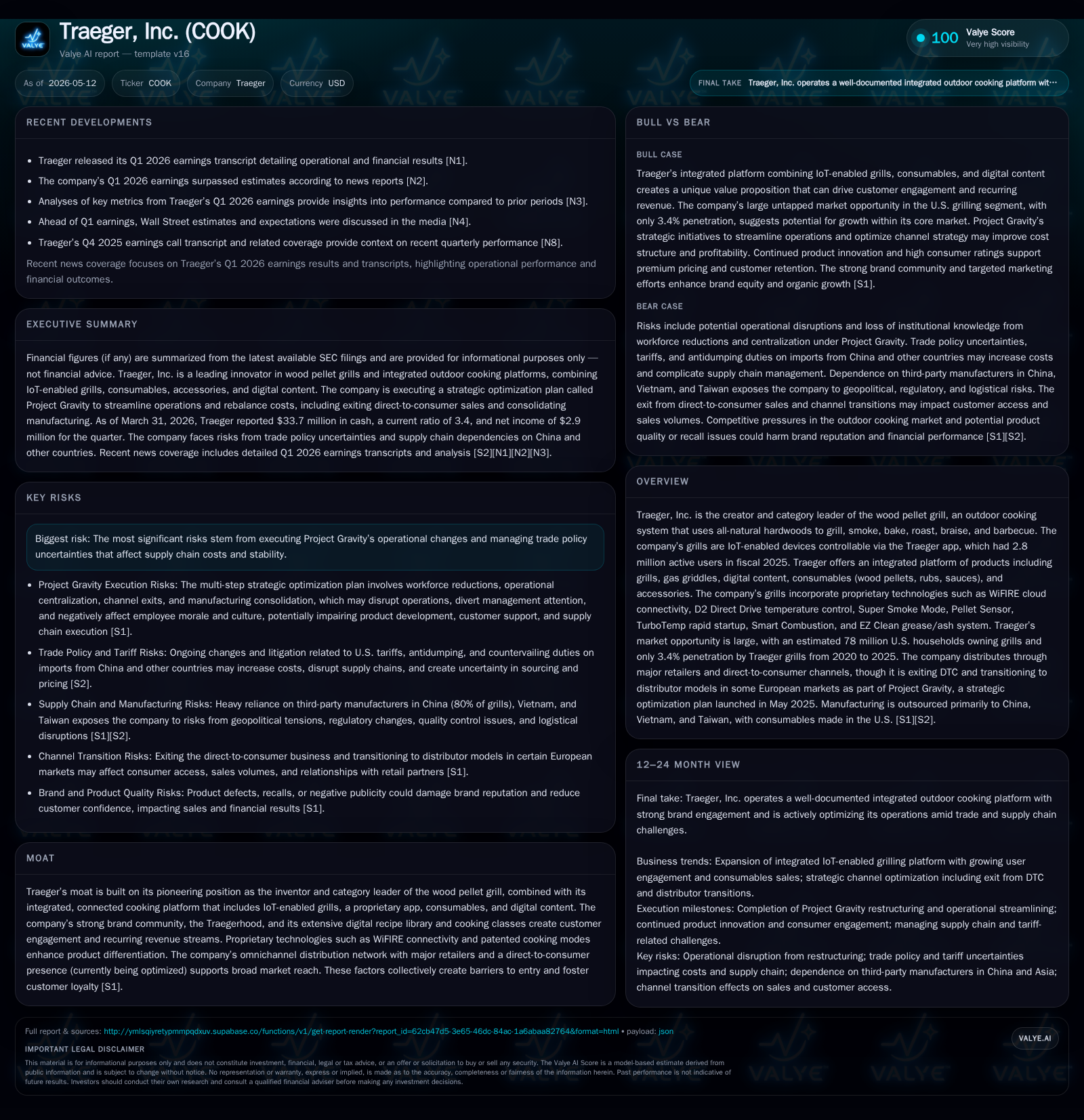
Traeger’s latest quarterly report highlights continued execution of Project Gravity aimed at streamlining operations and shifting sales strategies, including exiting direct-to-consumer in favor of retail partnerships. Despite headwinds from tariff uncertainties and restructuring costs, Traeger reinforces its leadership in the wood pellet grill category, supported by a loyal consumer community and integrated connected cooking ecosystem. The company faces critical near-term challenges around supply chain costs, trade policy litigation, and operational disruptions but retains significant growth runway given low market penetration and strong product differentiation.
Recent Operating Update
Traeger’s Q1 2026 filing (May 11) provides key operational insights amidst executing its multi-step strategic optimization initiative dubbed Project Gravity [S2], [S3]. The company continues to streamline organizational structure, centralize business units such as MEATER into Salt Lake City infrastructure, exit the direct-to-consumer (DTC) sales model—redirecting Traeger.com customers toward retail dealers—and consolidate pellet mills. These moves aim to rebalance costs while preserving customer reach through an omnichannel retail approach. Traeger recorded $24.9 million in restructuring expenses for fiscal year 2025 related to these initiatives and expects substantial completion by the end of fiscal 2026 [S1].
This quarter also spotlights escalating trade policy risks affecting input costs. Following a Supreme Court ruling invalidating tariffs imposed via IEEPA, the government introduced new global Section 122 tariffs subject to legal challenge. For Traeger specifically, U.S. Customs has asserted antidumping/countervailing duties on certain drip tray components sourced from China—charges Traeger is actively disputing [S2]. Such regulatory turbulence adds a layer of uncertainty over gross margin stability.
While near-term volumes are pressured by these transitions and cost inflation, Traeger's leadership reiterates commitment to reinforcing its core connected wood pellet grill platform bolstered by proprietary technologies like WiFIRE cloud connectivity and D2 Direct Drive temperature control [N1], [N2], [S1].
Business Model
Traeger's revenues are primarily driven by sales of its wood pellet grills—IoT-enabled outdoor cooking devices that use all-natural hardwood pellets to provide versatile cooking modes including grilling, smoking, baking, roasting, braising, and barbecuing [S1]. Customers pay upfront for durable grills that incorporate patented innovations such as Super Smoke Mode for enhanced flavor, TurboTemp rapid startup for convenience, Pellet Sensor for fuel monitoring, Smart Combustion for combustion efficiency, and an EZ Clean grease/ash system simplifying maintenance.
Crucially, Traeger monetizes recurring revenue streams from consumables including wood pellets sold under license along with rubs and sauces that complement the grilling experience. This integrated platform strategy not only enhances customer lifetime value but also leverages network effects through its flagship mobile app which had 2.8 million active users in fiscal 2025 [S1]. The app controls grills remotely via WiFIRE connectivity and provides curated digital content like recipes and cooking lessons fostering a vibrant brand community known as the "Traegerhood." This ecosystem creates switching costs and loyalty advantages against competitors.
The transition away from DTC e-commerce toward retail partnerships realigns the company’s go-to-market approach by focusing on mass retail networks such as Ace Hardware, Home Depot, Amazon, and Best Buy [S1]. Although this may temporarily suppress direct margins due to retailer pricing structures and channel economics changes, it offers scale benefits and simplifies fulfillment logistics.
Industry Structure and Competitive Position
Outdoor grilling is a mature but evolving market with an estimated 78 million U.S households owning some type of grill device; Traeger's segment penetration was only around 3.4% considering approximately 2.7 million grills sold across five years ending in 2025 [S1]. This signals a substantial addressable market yet ample runway for category growth through product innovation and expansion into adjacent outdoor cooking modalities.
Competition spans standard gas grills from household brands to other wood pellet grill manufacturers offering lower-cost alternatives or variations in technology integration [S18]. Competitors possess advantages in size, broader product portfolios, marketing budgets, supplier relationships, global distribution networks, brand recognition beyond niche grilling enthusiasts, and financial resources allowing aggressive pricing.
However, Traeger defends its moat with proprietary technological pillars like WiFIRE connectivity enabling cloud control of temperature profiles remotely—a notable differential in making outdoor grilling accessible for casual consumers while appealing to expertise-seeking pitmasters [S18]. Coupled with patent-protected cooking modes and consumables cross-selling aligned with a robust digital community engagement model (apps + content), Traeger creates experiential lock-in uncommon in commoditized grill markets.
Growth Drivers
Category Expansion via Innovation
The looming opportunity stems from the relatively low household penetration versus overall grilling prevalence; growth drivers include:
- Introduction of new connected grilling technologies expanding functionality or user experience.
- Development into adjacent outdoor cooking devices such as gas griddles further broadening addressable market segments.
- Consumables growth from pellets plus branded rubs/sauces increasing recurring revenues tied directly to installed grills.
- Digital engagement via the Traeger app enhancing customer stickiness through continuous content updates and remote control capabilities.
Channel Optimization Under Project Gravity
Centralizing manufacturing sites aims to improve supply chain efficiencies while transitioning away from less scalable DTC channels toward high-volume mass retail partners promises improved distribution reach without doubling fulfillment complexity [S1], [S2]. This could drive higher unit volume growth once operational kinks resolve.
International Strategy Shift
Shifting certain European markets from direct models to distributor partnerships shifts operational risk profiles while unlocking potentially faster regional scaling leveraging distributor footprint expertise [S1].
Risks / Watchpoints / Growth Constraints
Operational Disruption & Execution Risk
Project Gravity involves complex workforce reductions alongside channel redirections which inherently risk operational hiccups disrupting product availability or quality affecting customer satisfaction scores adversely [S1]. The transition could delay achieving expected cost savings or dilute brand perception if managed poorly.
Trade Policy Exposure & Cost Inflation
Ongoing litigation around tariff implementation plus newly imposed Section 122 duties create acute volatility in import costs primarily for components sourced internationally—pressure potentially compressing margins or forcing price increases competing with lower-end rivals [S2].
Product Liability & Quality Perception Risks
Real or alleged safety incidents (e.g., grill-originated fires) or elevated warranty claims could materially harm brand reputation forcing costly recalls/legal settlements given past $15 million settlement examples tied to liability matters reported recently [S12].
Capital Structure Constraints
Despite maintaining adequate liquidity as evidenced by a strong current ratio (3.4x), net leverage remains elevated ($370 million net debt) constraining capital flexibility [F1]. The company must prudently manage debt maturities amidst potential economic headwinds limiting refinancing options or raising borrowing costs further [S9], [S14].
Competitive Dynamics & Pricing Pressure
Aggressive moves by larger competitors with deeper pockets could erode margin structure through discounting or capturing shelf space forcing Traeger to invest more heavily in brand building or R&D at the expense of short-term profitability.
What to Watch Next
- Timely execution milestones within Project Gravity including finalizing pellet mill consolidations and completing channel realignments by end of fiscal 2026 as planned [S1].
- Legal outcomes related to Section 122 tariffs appeal processes potentially affecting input costs beginning late summer or early fall seasons crucial for high-volume grill sales [S2].
- Monitoring of consumer response metrics on shifted channel strategies via retailer sell-through data versus prior DTC volume trends possibly disclosed during upcoming earnings calls [N1], [N2].
- Any announced innovations extending IoT/grilling software capabilities or new product launches expanding beyond core pellet grills signaling future growth vectors.
- Debt covenant compliance updates tied to refinancing efforts ahead of credit facility maturities in June 2026 for revolving credit tranches may highlight liquidity risk evolutions given heavy indebtedness levels reported end-2025 [F1], [S9].
- Competitive activity especially pricing adjustments or product introductions from major outdoor cooking brands affecting market share dynamics.
Financial Snapshot (Q1 Ending March 31, 2026)
Latest financial snapshot
| Metric | Value | Period |
|---|---|---|
| Cash & equivalents | $34mm | |
| 2026-03-31 | ||
| Total debt | $403mm | |
| 2025-12-31 | ||
| Net debt | $370mm | |
| 2025-12-31 | ||
| Current assets | $214mm | |
| 2026-03-31 | ||
| Current liabilities | $63mm | |
| 2026-03-31 | ||
| Current ratio | 3.4x | |
| 2026-03-31 |
Source: SEC companyfacts cache [F1].
The balance sheet shows sufficient liquidity with significant working capital buffer but notable leverage requiring focus on cash flow generation post-restructuring completion for debt service stability [F1].
Operating income remains negative as of year-end December 2025 (-$97.7 million) with accumulated deficits mounting over time (-$804 million total), illustrating continued investment-heavy positioning despite gradual margin improvement targets articulated by management [F1], [S1].
Disclaimer
This analysis is based solely on public SEC filings up through May 12, 2026 (, [F1]) complemented by recent news excerpts (). It does not constitute investment advice nor recommend any purchasing or selling actions regarding securities mentioned. All forward-looking statements reflect management expectations subject to inherent risks detailed herein.
Disclaimer: This is research-only, informational analysis and not investment advice. It may include AI-generated interpretation and general industry context. Always verify important details using primary sources.

Comments