
AST SpaceMobile Advances Satellite Cellular Broadband with Strong Partnerships
Q1 2026 reveals operational progress in AST SpaceMobile’s satellite deployment and expanding carrier network partnerships critical to its global direct-to-device cellular broadband vision.
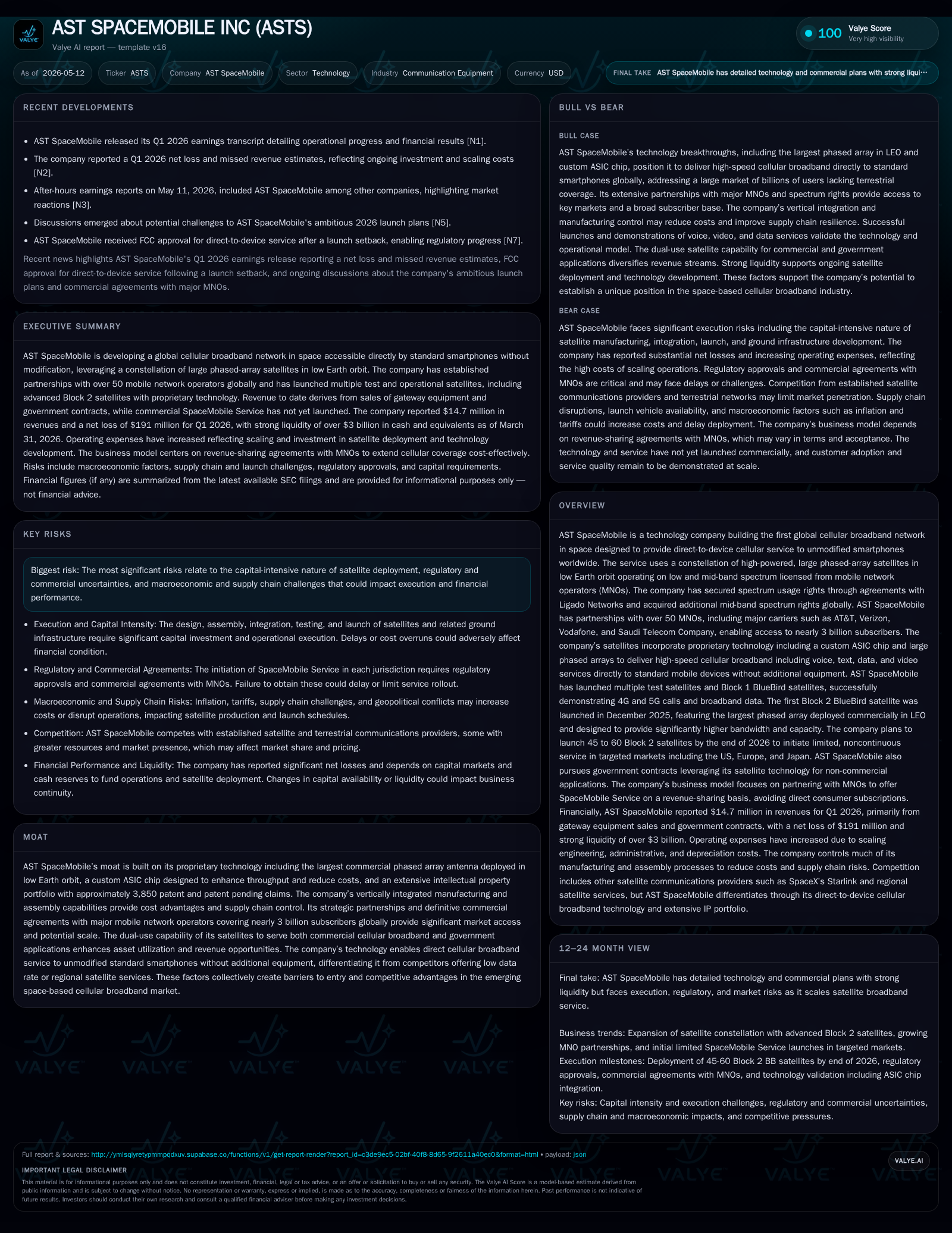
In its latest May 11, 2026 10-Q filing, AST SpaceMobile reported early-stage commercial rollouts and ongoing constellation buildout with strategic collaborations involving over 50 mobile network operators globally. The company’s unique technology combining patented large phased-array antennas and custom ASICs enables direct satellite connectivity to unmodified smartphones, creating a differentiated position in the communication equipment industry. While capital-intensive deployment and supply chain uncertainties pose execution risks, AST’s robust spectrum portfolio and expanding carrier agreements underpin a pathway to scale high-speed satellite cellular broadband beyond terrestrial coverage limitations. Liquidity remains strong with $3 billion in cash versus minimal debt as of Q1 2026.
Latest Operational Update: What the Q1 2026 Filing Reveals
The company continues producing Block 2 satellites—advanced payload iterations aimed at enhancing throughput and coverage—with several units nearing shipment readiness [S3]. Launch cadence remains targeted at approximately one orbital insertion every one to two months during calendar year 2026, aiming for roughly 45 satellites operational by year-end [S1],[S10]. This constellation size is considered a foundational threshold to begin scaling meaningful coverage footprint.
Business Model and Technology Differentiators
AST SpaceMobile’s business model revolves around delivering direct-to-unmodified smartphone connectivity via a constellation of large phased-array satellites operating in low Earth orbit (LEO) using licensed low- and mid-band spectrum,[S1]. Revenues are generated primarily through selling gateway infrastructure to MNOs alongside licensing the proprietary SpaceMobile Service that extends network reach beyond terrestrial cell towers into remote or underserved geographies.
The key technical differentiator is AST’s vertically integrated technology stack: the largest commercially deployed phased array antenna in LEO combined with a purpose-built custom ASIC chip enables efficient high-power broadband cellular transmission at scale. This advanced hardware facilitates support for standard consumer mobile devices (2G/4G LTE/5G) without requiring handset modifications or additional user equipment—crucial for ease of adoption.
This solution allows MNO partners to extend their coverage without capital-intensive ground infrastructure builds, creating a win-win where AST governs space-based assets while carriers retain customer billing relationships under revenue-sharing contracts. Dual-use functionality further broadens potential revenue streams by addressing government communications demand alongside commercial cellular broadband [S1].
Competitive Landscape and Partnerships Driving Market Access
AST occupies a unique niche combining satellite technology with traditional cellular operator ecosystems. Unlike incumbent fixed satellite broadband providers requiring specialized terminals or data-only connections, AST delivers seamless mobile voice/data connectivity directly to consumer devices.
Its moat is reinforced by formalized partnerships with over 50 leading MNOs worldwide—including AT&T, Verizon, Vodafone, Bell Canada, and Saudi Telecom—collectively serving nearly three billion subscribers,[S1]. These relationships provide unparalleled market access and establish high switching costs due to integration within existing carrier infrastructure.
Competitors deploying low Earth orbit constellations typically target internet-of-things or broadband terminals rather than ubiquitous unmodified smartphone compatibility. Thus, AST’s ability to leverage licensed spectrum rights combined with operator alliances carves out an under-served strategic position distinct from both terrestrial carriers and pure-play satellite internet competitors.
Spectrum Assets and Regulatory Positioning
Critical to effective satellite cellular delivery is exclusive access to sufficient licensed mid-band spectrum for reliable signal quality. AST has secured significant spectrum holdings through multiple channels: usage rights granted by Ligado Networks for up to 45 MHz of U.S. and Canadian lower mid-band spectrum plus an acquisition of international S-Band rights totaling up to 60 MHz globally via ITU priority licenses [S1].
This spectrum portfolio provides considerable flexibility allowing the constellation to deliver high-throughput cellular broadband without contention—a vital economic moat given ongoing scarcity and regulatory hurdles associated with mid-band allocations. The FCC’s recent greenlight on direct-to-device services post-launch setbacks further validates AST’s positioning within the complex global regulatory environment governing satellite communications [N9].
While ambitious spectrum deals entail integration and compliance risk plus reliance on prolonged regulatory approvals across jurisdictions, these rights anchor AST’s capacity planning and underpin anticipated service reliability.
Growth Drivers: Scaling Satellite Cellular Broadband
The main growth vectors flow from progressing constellation deployments coupled with expanding commercial contracts:
- Constellation Buildout: Achieving near-term target of ~45 BlueBird satellites in orbit (Block 1 & progressing Block 2 units) increases geographic coverage footprint substantially [S10]. Higher constellation density boosts continuous user coverage zones essential for MNO subscriber activation.
- MNO Partner Expansion: Broadening partnerships beyond existing carrier base will enlarge end-user addressable market—expected pipeline includes government sector contracts leveraging dual-use capabilities [S2],[N1].
- Service Rollouts: Incremental launch markets enable live demonstration of voice/data/video services over-spacemobile network linked directly to customer devices without gateway terminals—a disruptive proposition aimed at unlocking new subscribers previously out of range.
- Technology Upgrades: Progression from Block 1 prototypes to more scalable Block 2 configurations promises improved cost per bit metrics via enhanced throughput ASIC designs and manufacturing processes enabling economies of scale.
These factors combine structurally rather than cyclically; demand derives from longstanding coverage gaps inaccessible via terrestrial infrastructure due to geographic or economic constraints. Average revenue per user (ARPU) uplift potential resides in richer bundled offerings enabled by extended network reach paired with minimal upfront carrier capex.
Risks and Execution Challenges to Monitor
Despite promising advances, significant risks remain:
- Capital Intensity: Satellite manufacturing, launch services, ground infrastructure development require substantial upfront cash—AST’s burn rates remain elevated as deployments accelerate without commensurate revenue scale yet realized [S2].
- Supply Chain & Geopolitical Factors: Global inflation pressures coupled with tariffs threaten material cost stability; manufacturing footprint exposures including Israeli operations subject operational continuity risks amidst regional tensions [S2,S1].
- Technology Execution Risk: Delays or failures in planned launches or on-orbit operations could result in impairments such as the previously announced Block 2 BB7 write-off impacting near-term financials [S2].
- Regulatory Uncertainty: Protracted approval cycles could delay spectrum use or cross-border service introductions critical for global expansion.
- Customer Adoption Pace: Dependency on MNO uptake timing; slow contract closures or limited subscriber ramp could constrain revenue growth trajectory.
Mitigating these challenges requires disciplined capital allocation strategies complemented by diversified financing programs including equity offerings and convertible notes completed earlier this year [S1,S13].
Upcoming Milestones and What Investors Should Watch
Critical forward-looking benchmarks include:
- Continued cadence of orbital launches targeting one satellite insertion every one to two months throughout calendar year 2026 aiming for ~45 deployed units by year-end [S10],[N1].
- Announcements of new commercial agreements expanding MNO partnership base beyond present ~50 operators serving close to three billion subscribers [N1],[S2].
- Regulatory progress updates concerning FCC approvals or international licenses enabling broader geographic service overlays.
- Demonstration of expanded live commercial service footprints delivering voice/data/video directly via unmodified consumer smartphones corroborating scalability claims.
- Potential awards or extensions of government contracts leveraging dual-use capabilities enhancing revenue diversification.
Monitoring these KPIs provides tangible evidence on execution momentum towards building a commercially viable space-based cellular broadband ecosystem.
Financial Overview: Liquidity, Capital Structure, and Cash Runway
Latest financial snapshot
| Metric | Value | Period |
|---|---|---|
| Cash & equivalents | $3.0bn | |
| 2026-03-31 | ||
| Current assets | $3.2bn | |
| 2026-03-31 | ||
| Current liabilities | $171mm | |
| 2026-03-31 | ||
| Current ratio | 18.47x | |
| 2026-03-31 |
Source: SEC companyfacts cache [F1].
As of March 31, 2026 quarter-end:[F1] This robust liquidity profile reflects prudent capital raises including February’s $1.075 billion convertible notes issuance at favorable fixed coupon terms (2.25% until maturity in 2036) plus equity-at-the-market sales yielding ~$80 million in Q1 proceeds [S1,S13]. The firm maintains minimal traditional debt exposure relative to cash reserves providing ample runway amid costly constellation assembly phases.
Net losses persist driven by continued investment ahead of meaningful revenue scale—a typical profile for space infrastructure ventures engaged in multi-year heavy R&D cycles before harvesting recurring service income streams.[F1]
Overall balance sheet strength supports aggressive scale-up plans but warrants close monitoring against evolving macroeconomic headwinds affecting supplier costs or capital markets access.
This analysis is based on currently available SEC filings as of May 11, 2026 ([S1],[S2],[S3]) supplemented by recent equity market commentary ([N1],[N2]). It aims solely to provide a grounded operating view rooted in substantive disclosures without offering investment recommendations.
Disclaimer: This is research-only, informational analysis and not investment advice. It may include AI-generated interpretation and general industry context. Always verify important details using primary sources.

Comments