
indie Semiconductor’s Q1 2026 Results Highlight Profitability Challenges Amid Automotive Semiconductor Innovation
Q1 2026 filings reveal stable revenue growth but persistent operating losses as indie advances automotive edge sensor semiconductors.
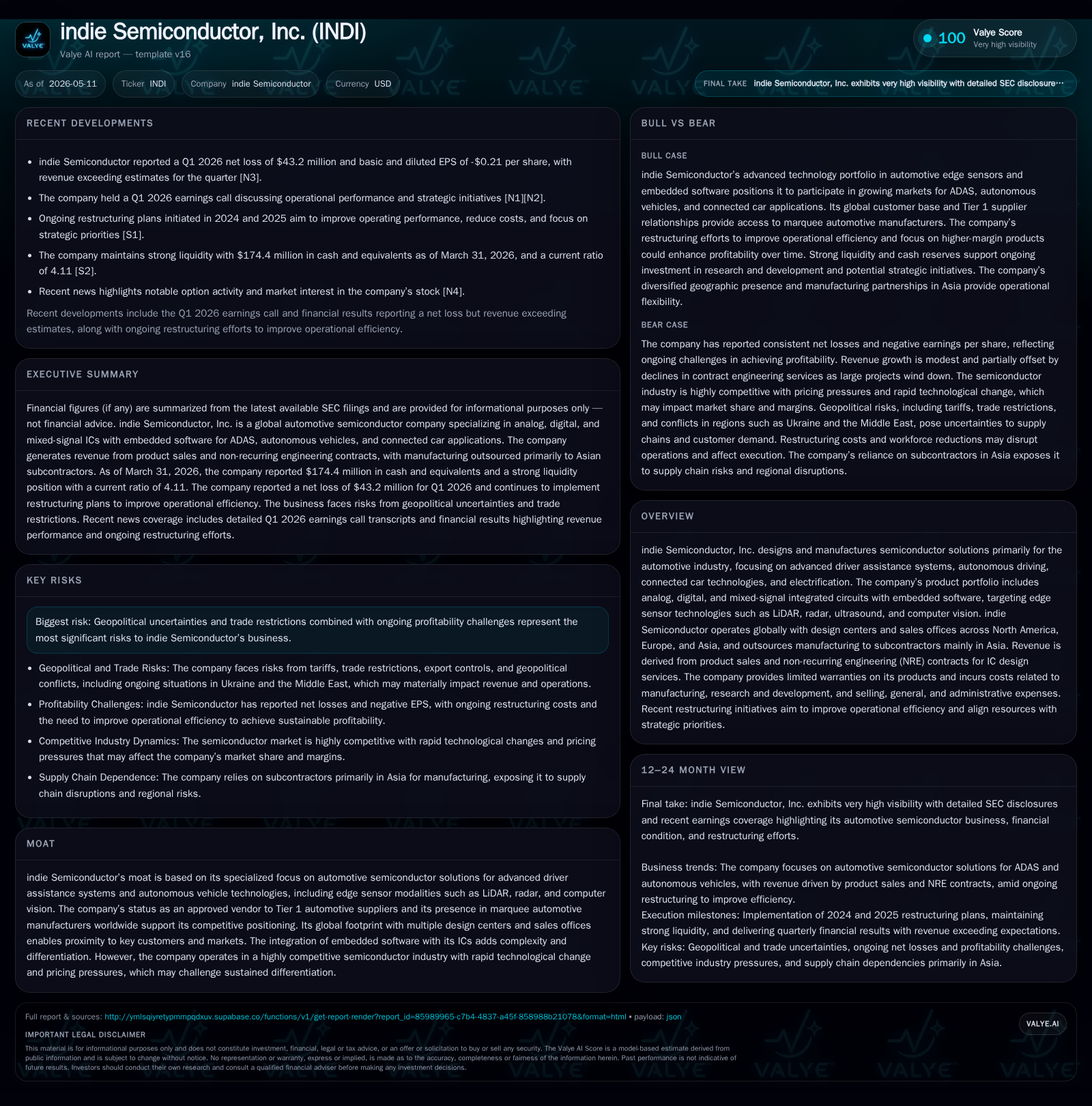
indie Semiconductor, Inc.'s latest quarterly results showcase solid revenue performance with product sales and NRE contracts driving the business, yet the company continues to face significant operating losses. Focused on semiconductor ICs for automotive ADAS and autonomous systems, indie leverages a global design footprint and multiple recent acquisitions to build edge sensor technology platforms including LiDAR and radar. The competitive landscape remains intense with pricing pressure and rapid tech evolution challenging margins. Critical risks include geopolitical trade uncertainties and ongoing profitability pressures. Key milestones to watch include design win progress, NRE contract executions, and margin inflections amid capacity scaling.
Latest Operating Update
As of the first quarter ended March 31, 2026, indie Semiconductor reported continued top-line progress with total revenue marginally surpassing previous quarters driven by a combination of product shipments and non-recurring engineering (NRE) services contracts. However, operating income remains negative in the latest quarter as substantial costs associated with research and development (R&D), manufacturing support, and SG&A persist in reflecting the company's aggressive investment posture. Notably, the Q1 earnings call highlighted a beat on revenue estimates despite reporting an operating loss consistent with prior periods [S2][N3][N1].
This latest filing confirms that while indie maintains momentum in customer engagements increasing their semiconductor content per vehicle—especially essential in Advanced Driver Assistance Systems (ADAS) and autonomous driving applications—the path to profitability remains obstructed by production scale challenges and competitive pricing pressures.
Business Model
indie Semiconductor’s core business revolves around designing advanced analog, digital, and mixed-signal integrated circuits (ICs) embedded with proprietary software. The company primarily targets the automotive sector focusing on edge sensor technologies crucial for ADAS, autonomous vehicles, connected car functionalities, user experience enhancements, and vehicle electrification [S1][S22].
Revenue streams bifurcate between product sales—namely semiconductors sold under commercial supply agreements—and NRE contracts which involve bespoke IC development tailored to customer specifications. Revenues fluctuate based on product lifecycle stages, design win traction among OEMs and Tier 1 suppliers, semiconductor content penetration per vehicle platform, competitive pricing dynamics influenced by market share shifts, and regulatory requirements shaping automotive safety standards.
The embedded software layer within the company’s IC offerings creates differentiation by providing enhanced functionality at the device level—such as facilitating complex sensor fusion from LiDAR, radar, ultrasound arrays, and computer vision cameras—which are becoming industry standard for next-generation vehicle architectures.
Industry Structure and Competitive Position
indie operates within a highly specialized segment of the semiconductor industry: automotive semiconductors targeting safety-critical sensing modalities. The competitive environment is intense owing to rapid technological changes mandated by advancing autonomous driving requirements coupled with aggressive pricing tactics from both legacy semiconductor conglomerates and emerging specialized chipmakers.
Being an approved vendor to Tier 1 automotive suppliers globally affords indie strategic access to marquee OEM programs; however, customer switching costs are moderate given extensive qualification processes though not prohibitive once design wins are secured [S22]. The company’s global network of design centers—from Silicon Valley to Europe to Asia—enables close coordination with multinational customers enhancing innovation speed and localized support.
Recent acquisitions such as emotion3D bolster indie's software competency essential for processing high-bandwidth sensory inputs into actionable control signals inside vehicles—complementing its established IC portfolio. These moves reflect a strategic imperative to integrate hardware-software stacks fully as competitive edge sensors evolve from component level products toward comprehensive system solutions [S13][S22].
Growth Drivers
- Increasing semiconductor content per vehicle: With evolving regulations mandating higher levels of automation safety features such as ADAS upgrades across mass-market models worldwide, indie stands to benefit structurally from growing chip volumes per new vehicle.
- New design wins in electric and autonomous platforms: The shift toward EVs intrinsically requires more sophisticated sensing and connectivity components; indie’s mixed-signal ICs combined with embedded software cater directly to these needs.
- Expanding edge sensing modalities: Broadening beyond radar into LiDAR and computer vision expands addressable markets as manufacturers seek multisensor fusion approaches.
- Strategic acquisitions: Recent integrations like emotion3D increase suite comprehensiveness enhancing customer value propositions.
- Global design center footprint: Access to international markets through local R&D offices ensures adaptability to regional regulatory demands fueling diversified revenue streams.
Collectively these drivers underpin a structural demand narrative anchored in global automotive electrification trends rather than cyclical auto market fluctuations alone.
Risks / Watchpoints / Growth Constraints
The company faces notable risks that could constrain growth or impact financial results:
- Geopolitical uncertainties: Export controls or tariffs affecting Asian subcontractors or customers risk disrupting supply chains critical for timely fulfillment of orders [S1].
- Profitability pressures: Despite revenue growth potential, sustained operating losses highlight execution risks concerning cost management especially amid competitive pricing challenges [F1].
- Technological obsolescence: Rapid innovation cycles necessitate continuous R&D investments; failure to keep pace could result in loss of design wins.
- Customer concentration: Dependence on Tier 1 suppliers exposes indie to demand variability linked to OEM program timing.
- Integration risks: Execution of acquisition synergies requires effective management of diverse global teams alongside cultural integration.
What To Watch Next
Investors should monitor several milestones indicative of operational health:
- Updates on NRE contract wins translating into volume production orders externally validated through backlog disclosures or partner announcements.
- Trends in gross margins signaling improved manufacturing efficiencies or pricing power over commodity inputs.
- Further acquisition activity aimed at expanding technology breadth or entering adjacent markets.
- Management commentary during quarterly calls on shipment ramp rates for newly launched IC platforms targeting newer ADAS levels or autonomous functions.
- Regulatory developments impacting automotive semiconductor content requirements globally which could accelerate adoption curves.
Financial Snapshot Summary (Q1 2026 Ended March 31)
Latest financial snapshot
| Metric | Value | Period |
|---|---|---|
| Cash & equivalents | $174mm | |
| 2026-03-31 | ||
| Total debt | $428mm | |
| 2026-03-31 | ||
| Net debt | $253mm | |
| 2026-03-31 | ||
| Current assets | $327mm | |
| 2026-03-31 | ||
| Current liabilities | $80mm | |
| 2026-03-31 | ||
| Current ratio | 4.11x | |
| 2026-03-31 |
Source: SEC companyfacts cache [F1].
| Metric | Value (USD) | Period End |
|---|---|---|
| Cash & Equivalents | $174.4 million | |
| 2026-03-31 | ||
| Total Debt | $427.6 million | |
| 2026-03-31 | ||
| Net Debt | Approx $253.2 million | |
| 2026-03-31 | ||
| Current Assets | $327.2 million | |
| 2026-03-31 | ||
| Current Liabilities | $79.6 million | |
| 2026-03-31 | ||
| Current Ratio | 4.11 | |
| 2026-03-31 |
The balance sheet reveals robust liquidity supported by a strong current ratio well above unity providing near-term operational flexibility despite net leverage driven by capital-intensive R&D efforts. The capital structure includes outstanding long-term notes partially repurchased recently aiding interest cost management [F1][S15].
Operating expenses remain weighted heavily toward research initiatives consistent with the company’s strategy to maintain technological leadership albeit contributing to extended timelines before profitability thresholds are met.
This analysis is based solely on information publicly available through SEC filings up to May 11, 2026 (), contemporaneous news reports (), and current financial snapshot data ([F1]). It is intended purely as an objective industry and company assessment without investment recommendations or forecasts.
Disclaimer: This is research-only, informational analysis and not investment advice. It may include AI-generated interpretation and general industry context. Always verify important details using primary sources.

Comments