
Intellia Therapeutics Advances CRISPR Pipeline with Phase 3 Progress and Capital Strength
Recent quarterly updates signal key clinical and commercial milestones while maintaining strong liquidity to support near-term growth.
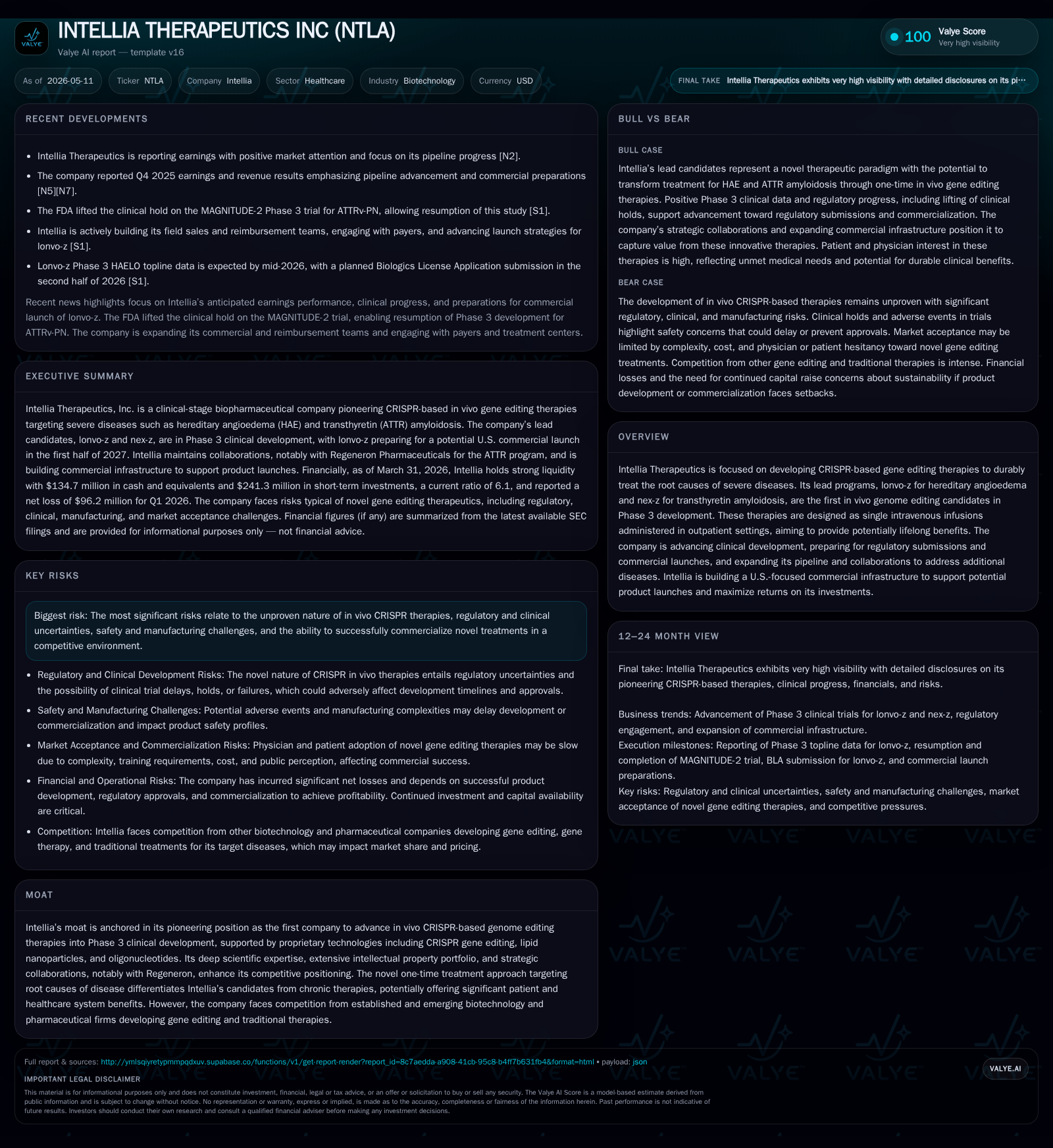
In its latest quarterly filing, Intellia Therapeutics reported continued advancement of its pioneering in vivo CRISPR gene editing candidates, particularly lonvo-z for hereditary angioedema (HAE) and nex-z for transthyretin amyloidosis (ATTR). The company is on track to seek regulatory approval and launch lonvo-z in early 2027, supported by a robust cash position boosted by a recent $195 million equity raise. Intellia’s differentiated one-time gene editing therapies targeting root causes position it uniquely within the biotechnology landscape. However, regulatory risks, clinical uncertainties, and commercialization execution remain key challenges that will shape its trajectory.
Recent Operating Update
Intellia Therapeutics’ latest quarterly report dated May 11, 2026 [S2] underscores significant operational progress as it advances two lead in vivo CRISPR gene-editing candidates through pivotal Phase 3 studies. The company reported initiating a rolling biologics license application (BLA) filing for lonvo-z (NTLA-2002), its treatment for hereditary angioedema (HAE), backed by compelling Phase 3 topline results demonstrating substantial reduction in attack frequency [N7]. This milestone situates lonvo-z for potential approval and commercial launch targeted in the first half of 2027 [S1], marking Intellia as the first to clinically validate systemic in vivo genome editing therapies at late stages.
Concurrently, Intellia has resumed Phase 3 studies for nex-z (NTLA-2001), addressing transthyretin amyloidosis (ATTR), including cardiomyopathy (ATTR-CM) and polyneuropathy variants (ATTRv-PN), following FDA lifting of clinical holds [S2]. The ongoing MAGNITUDE and MAGNITUDE-2 studies represent critical volume drivers aiming at expanding the company’s therapeutic footprint.
Further strengthening its financial runway, Intellia closed a $195 million public offering in April 2026 [S3], supplementing its balance sheet which reflected $467 million in current assets against $76 million in current liabilities as of March-end quarter [F1]. This liquidity supports both the high-cost late-stage trials as well as scaling commercial infrastructure necessary for anticipated product launches.
Business Model
Intellia operates within a specialized niche of biotechnology focused on revolutionary gene editing using CRISPR/Cas9 technology delivered via proprietary lipid nanoparticle (LNP) systems. Its revenue generation currently derives predominantly from collaboration revenue streams, upfront licensing fees, research funding reimbursements, and milestone payments tied to program advancements rather than from marketed products [S1].
The strategic value proposition centers on developing one-time systemic intravenous infusions designed to durably treat the root causes of genetic diseases — potentially replacing chronic therapies with curative genomic alterations. This approach reduces patient burden by eliminating frequent dosing and aims to produce sustained therapeutic effect after a single administration.
Product candidates such as lonvo-z for HAE and nex-z for ATTR amyloidosis exemplify this. These therapies utilize precise genome editing machinery delivered systemically to target liver-produced proteins implicated in disease pathogenesis. By knocking down or correcting genetic mutations at source, they offer disruptive potential within specialty medicine.
Operational expense profiles remain R&D-heavy reflective of clinical development emphasis but increasingly incorporate commercial costs aligned with upcoming launches [S1]. Collaboration partnerships — notably with Regeneron — enhance resource leverage while providing shared expertise and risk diversification. Intellectual property rights centered on CRISPR technologies and delivery innovations underpin competitive moat.
Industry Structure and Competitive Position
The biotechnology industry segment focused on gene editing is dynamic with intense competition both from established pharmaceutical companies investing heavily in gene therapy platforms as well as emerging biotech firms also pursuing CRISPR or alternative gene editing modalities. Key differentiators include depth of scientific expertise, quality of delivery vectors like LNPs ensuring effective cellular uptake without viral vectors, scalability of manufacturing processes, and ability to demonstrate clinical efficacy with acceptable safety profiles.
Intellia benefits from being first-mover among pure-play developers advancing systemic in vivo CRISPR therapies into Phase 3 testing. Its proprietary LNP platform paired with Cas9 technology enables outpatient IV dosing — an advantage over other modalities requiring viral vector delivery or invasive procedures. Strategic alliances add technical muscle and accelerate pipeline expansion.
Nonetheless, competitors such as Editas Medicine, Beam Therapeutics, CRISPR Therapeutics collaborating with Vertex Pharmaceuticals, along with traditional rare disease biologic manufacturers represent threats capable of launching rival products or leveraging superior resources for rapid scale-up. Regulatory scrutiny specific to gene editing raises barriers but equally intensifies focus on safety demonstrating trustworthy differentiation.
Growth Drivers
Several pillars underpin Intellia’s growth trajectory:
- Advancement of Lead Candidates: Successful completion of pivotal Phase 3 trials for lonvo-z and nex-z with favorable efficacy/safety will enable regulatory submissions globally leading to market entry.
- Regulatory Filings & Approvals: Rolling BLA submission for lonvo-z marks transition toward commercialization; regulatory clearance timing across jurisdictions will catalyze revenue ramp.
- Commercial Infrastructure Expansion: Building sales force focused initially on U.S. specialist centers aims to capture targeted patient populations efficiently post-launch.
- Pipeline Diversification: Leveraging core CRISPR platform to develop additional candidates addressing other high unmet need genetic diseases broadens future revenue streams.
- Collaborations & Partnerships: Ongoing alliances facilitate access to external innovation sources reduce capital requirements while amplifying reach via co-development deals.
- Market Education & Adoption: As novel one-time gene-editing therapies enter clinics demand dynamics evolve; payer engagement on pricing & reimbursement will further influence uptake velocity.
Risks / Watchpoints / Growth Constraints
Despite compelling science and pipeline momentum, several risks temper near-to-mid-term outlook:
- Clinical & Regulatory Uncertainty: In vivo CRISPR remains nascent; unpredictable adverse events or trial delays could impede approvals or necessitate additional costly investigations [S2].
- Manufacturing & Scalability Challenges: Producing complex LNP-formulated gene editors at commercial scale with consistent quality entails technical hurdles impacting timelines and cost structures.
- Competitive Threats: Peer groups advancing alternative gene therapy or novel biologics may capture market share or impose pricing pressures undermining Intellia’s commercialization prospects.
- Pricing & Reimbursement Environment: Ongoing shifts in healthcare cost control laws internationally may limit reimbursement levels making high-value one-time treatments harder to position economically [S24].
- IP Litigation Exposure: Active patent disputes such as the BlueAllele Corp suit introduce legal costs and potential constraints impacting proprietary claims over core technologies [S1].
- Capital Dependence Until Profitability: Continued negative operating income requires access to equity/dilutive financing if product revenue generation lags expectations.
What to Watch Next
Key upcoming milestones will shape Intellia’s pathway:
- Complete enrollment and readouts from MAGNITUDE/MAGNITUDE-2 Phase 3 trials evaluating nex-z efficacy/safety.
- FDA review progress on the lonvo-z BLA submission including regulatory feedback and approval timing indications.
- Execution quality around commercial infrastructure hiring/training ahead of projected HAE product launch mid-2027.
- Additional pipeline progress updates including preclinical candidate nominations leveraging CRISPR-LNP systems.
- Outcomes related to pending intellectual property litigation outcomes altering freedom-to-operate landscape.
- Further financial reports illustrating R&D spending trends versus cash burn vis-à-vis capital infusion cadence post-April equity raise.
Financial Profile Overview
Latest financial snapshot
| Metric | Value | Period |
|---|---|---|
| Cash & equivalents | $135mm | |
| 2026-03-31 | ||
| Current assets | $466mm | |
| 2026-03-31 | ||
| Current liabilities | $76mm | |
| 2026-03-31 | ||
| Current ratio | 6.1x | |
| 2026-03-31 |
Source: SEC companyfacts cache [F1].
As detailed in the latest quarterly report through March 31, 2026 [F1][S2], Intellia reported robust liquidity metrics supporting ongoing operations through late-stage trial completion:
Operating income remained negative reflecting investment intensity at this clinical stage (-$441 million for full year ended December 31, 2025) [F1]. Recent equity issuance added ~$195 million net proceeds supporting near-term growth initiatives [S3]. Research and development expenses continue representing the largest spend category complemented by gradually rising general administration costs aligned with commercialization preparations [S18]. Collaboration revenues contribute intermittently via license payments but product sales revenue is not yet reported given absence of marketed therapies.
This analysis is grounded solely on SEC filings dated up to May 11, 2026, company facts data [F1], and relevant public disclosures without speculative projections or investment recommendations.
Disclaimer: This is research-only, informational analysis and not investment advice. It may include AI-generated interpretation and general industry context. Always verify important details using primary sources.

Comments