
Dyne Therapeutics Advances Clinical Pipeline with Robust Cash Position in Q1 2026
Dyne Therapeutics reported continued clinical progress in genetic muscle disease therapies while maintaining strong liquidity to fund development.
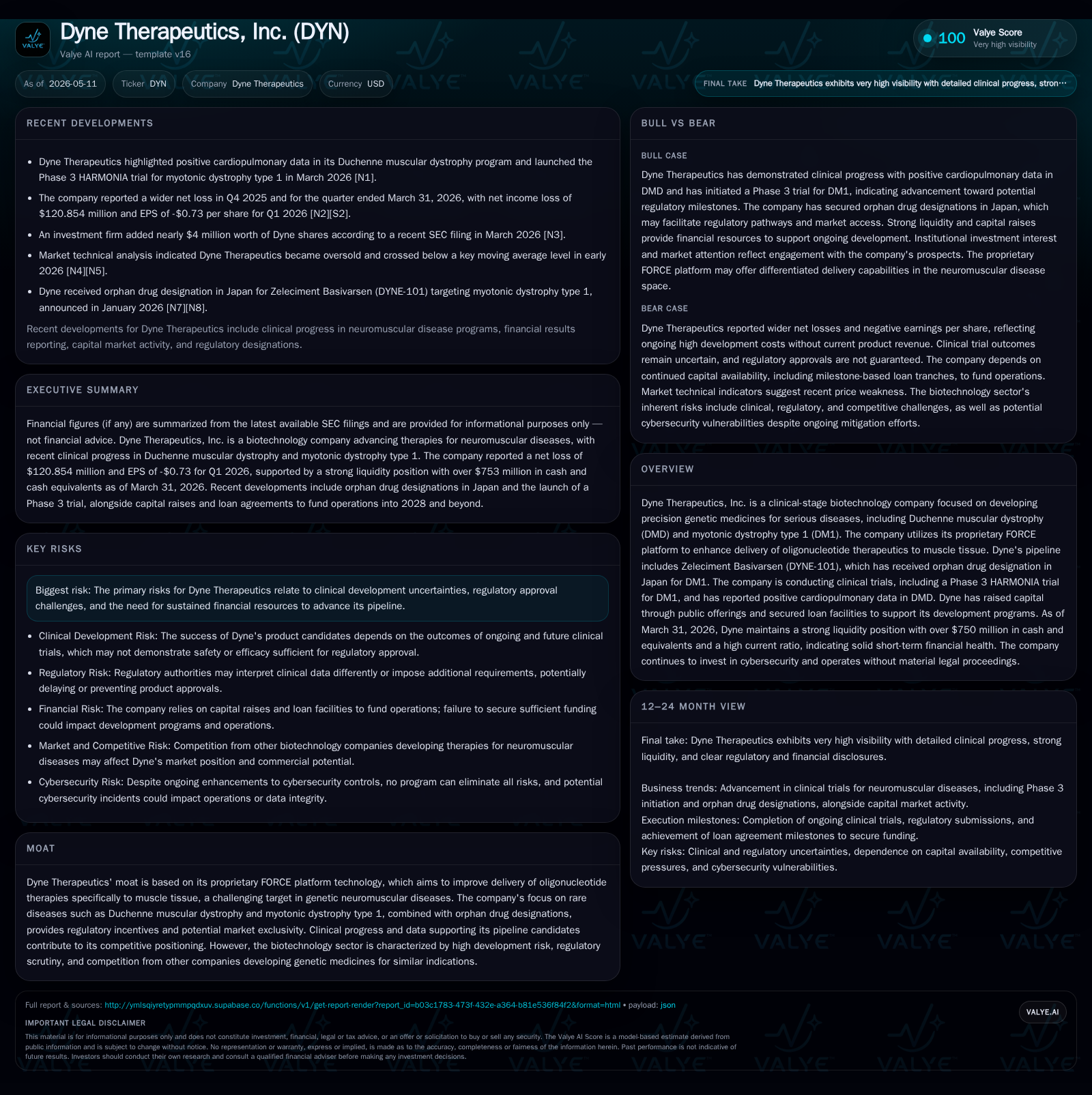
In its latest quarterly filing, Dyne Therapeutics highlighted positive clinical updates from its Duchenne muscular dystrophy program and reinforced a strong cash runway exceeding $750 million. The company’s proprietary FORCE platform underpins its pipeline of oligonucleotide therapeutics targeting rare neuromuscular diseases, leveraging orphan drug incentives to navigate regulatory challenges. Industry competition and clinical execution remain key risks as Dyne pursues pivotal trials and potential commercialization. Close monitoring of upcoming Phase 3 trial milestones and regulatory interactions will provide critical insight into its growth trajectory.
Recent Operating Update
Dyne Therapeutics reported Q1 2026 results on May 11, revealing key operational highlights anchored by continued clinical momentum and a robust balance sheet [S2][S3]. The quarter included progress in their Duchenne muscular dystrophy (DMD) program with positive cardiopulmonary data emerging from ongoing trials. Equally notable was the advancement of its myotonic dystrophy type 1 (DM1) program into Phase 3 with the HARMONIA trial initiation—a critical developmental stage underscoring Dyne's transition toward late-stage clinical validation.
Financially, Dyne ended March 31, 2026, with $753.1 million in cash and equivalents against total debt of $150 million [F1], reflecting a net cash position exceeding $600 million. This liquidity strength supports the company’s estimated cash runway extending into early 2028 [S28]. Current assets stood at over $1 billion with liabilities below $52 million, yielding an extremely healthy current ratio near 19.9x [F1]. This strong financial position enables sustained investment in R&D and capital expenditures necessary for complex genetic medicine development.
Operational disclosures emphasize that Dyne is focused on executing its clinical strategy while managing risks related to trial enrollment timelines and regulatory pathways [S12]. No new material legal proceedings were reported [S19], and cybersecurity efforts are ongoing given heightened regulatory scrutiny [S26].
Business Model and Product Relevance
Dyne Therapeutics operates as a clinical-stage biopharmaceutical company specializing in precision genetic medicines targeting severe muscle-related diseases that lack effective treatments. The company generates value primarily through developing proprietary therapeutic candidates based on its FORCE platform—a novel delivery mechanism designed to facilitate targeted uptake of oligonucleotide drugs into muscle tissue.
Revenue streams are anticipated to emerge from successful commercialization of pipeline candidates post-approval, though currently Dyne operates without product revenue given its development-stage status. Monetary inflows depend heavily on capital raises (equity offerings and loan facilities), milestone payments from partnerships if any, and eventual licensing royalties or direct sales depending on commercial strategy.
The FORCE platform represents the company's strategic asset: it addresses a key bottleneck in nucleic acid therapy development—the efficient delivery to skeletal and cardiac muscles. By enhancing therapeutic concentration specifically within muscles while minimizing off-target effects, FORCE aims to improve efficacy and safety profiles relative to competing modalities.
The product pipeline includes Zeleciment Basivarsen (DYNE-101), granted orphan drug designation in Japan for DM1 treatment—an important market exclusivity lever supporting premium pricing potential and regulatory incentives. Its DMD program focuses on exon-skipping antisense therapies like DYNE-251 (z-rostudirsen), which have demonstrated statistically significant improvements in dystrophin expression and functional endpoints during early-phase trials.
Customer adoption remains contingent on regulatory approval success, payer acceptance of pricing models for rare disease medicines, as well as physician acceptance driven by compelling clinical benefit-risk profiles. Given Dyne’s focus on rare neuromuscular conditions with limited existing treatments, unmet medical need forms a structural demand foundation that may offer defensible pricing power.
Industry Structure and Competitive Position
Dyne operates within the specialized biotechnology segment addressing genetic neuromuscular diseases—a marketplace characterized by intense R&D complexity, relatively small patient populations per indication but significant per-patient therapy valuations due to rarity.
The industry is highly competitive with players ranging from established pharmaceutical giants investing in gene therapies to other biotech firms developing antisense oligonucleotides or RNA-based medicines. Key competitive factors include platform differentiation, clinical efficacy/safety outcomes, payer negotiations, manufacturing scalability, and regulatory milestones.
Dyne's proprietary FORCE platform aims to carve out a differentiated niche by overcoming major delivery challenges that limit competitor therapies’ effectiveness. Orphan drug designations reinforce market exclusivity timelines critical for recouping development investments here. However, competition remains fierce given multiple modalities pursuing similar indications such as exon skipping therapies or novel gene editing approaches.
Partnerships or alliances could enhance Dyne's market position by providing complementary capabilities like commercialization expertise or expanded geographic reach; no major alliances are explicitly disclosed yet but remain an industry dynamic worth monitoring.
Growth Drivers
- Advancement of Phase 3 Trials: The ongoing HARMONIA Phase 3 for DM1 is a pivotal growth milestone; positive outcomes would validate clinical programs and open pathways toward approval.
- Clinical Data Readouts: Upcoming interim results from both DMD and DM1 studies provide inflection points influencing investor sentiment and future licensing/commercial discussions.
- Regulatory Incentives: Orphan drug status grants enhanced exclusivity benefits; successful navigation through FDA/PMDA guidance can accelerate timelines.
- Expansion of Pipeline: Leveraging the FORCE platform for additional indications beyond current neuromuscular diseases represents long-term upside potential.
- Capital Deployment Efficiency: Effective use of existing ~$750 million cash reserves allows extended R&D investment without immediate dilution or fundraising pressure.
- Payer & Market Preparation: Early engagement strategies and health economics evidence generation can facilitate reimbursement acceptance upon approval.
Risks / Watchpoints / Growth Constraints
- Clinical Development Uncertainty: High failure risks persist due to complexity of gene therapies; negative or inconclusive trial data could stall progress and impair capital access.
- Regulatory Hurdles: Approval processes for novel therapies remain stringent; unanticipated delays or requirements might increase time-to-market costs.
- Commercial Execution Risks: Transitioning from R&D to commercial operations demands effective marketing infrastructure; lack thereof could impair uptake.
- Financing Dependence: Although cash rich currently, prolonged timelines or cost overruns may necessitate additional fundraising potentially dilutive or restrictive.
- Competitive Pressure: Advancements by rival modalities could erode market share or reduce pricing power if they prove clinically superior.
- Manufacturing Scalability: Scaling complex biologics manufacturing is challenging; any supply chain disruptions could impact launch readiness.
- Patient Recruitment Challenges: Enrolling sufficient patients for rare disease trials is inherently difficult; recruitment delays could push back milestones.
What to Watch Next
Key upcoming developments include detailed interim data releases from Phase 2/3 programs—especially for the DM1 HARMONIA trial—and enrollment pace updates impacting timing assumptions. Regulatory interactions or filings such as IND amendments or Fast Track designations warrant close monitoring for forward guidance implications.
Additionally, announcements regarding partnerships or expanded pipeline applications using FORCE technology would signal strategic growth paths. Observers should also track capital deployment effectiveness alongside updated liquidity forecasts following Q2 earnings disclosures.
Financial Profile
Latest financial snapshot
| Metric | Value | Period |
|---|---|---|
| Cash & equivalents | $753mm | |
| 2026-03-31 | ||
| Total debt | $150mm | |
| 2026-03-31 | ||
| Net debt | $-603mm | |
| 2026-03-31 | ||
| Current assets | $1021mm | |
| 2026-03-31 | ||
| Current liabilities | $51mm | |
| 2026-03-31 | ||
| Current ratio | 19.92x | |
| 2026-03-31 |
Source: SEC companyfacts cache [F1].
As of March 31, 2026, Dyne Therapeutics held $753.1 million in cash & equivalents with total debt at approximately $150 million resulting in net cash of about $603.1 million [F1]. Current assets dwarf liabilities ($1.02 billion vs. $51 million), yielding a very high current ratio near 19.9x [F1] indicative of ample short-term liquidity coverage.
The company continues operating at a substantial net loss reflecting typical biotech developmental expenses: operating income was negative $468 million year-end December 31, 2025 [F1], aligning with expectations for pre-commercial entities investing heavily into R&D.
Debt facilities originated mainly via amended loan agreements with Hercules Capital provide structured capital while offering interest-only periods until mid-late next decade conditional upon meeting development milestones [S28]. This conservative leverage approach mitigates refinancing risk during the critical clinical phase advancement window.
Overall financial health supports sustained operational funding despite significant R&D outlays but underscores the importance of execution milestones ensuring capital efficiency going forward.
This report is an industry-focused analysis based on publicly available SEC filings and news sources as of May 11, 2026. It serves informational purposes without providing investment advice or recommendations.
Disclaimer: This is research-only, informational analysis and not investment advice. It may include AI-generated interpretation and general industry context. Always verify important details using primary sources.

Comments