
Blue Acquisition Corp/Cayman Advances Toward Business Combination Amid Liquidity Challenges
Latest quarter reveals liquidity squeeze ahead of planned business combination targeting energy-independent US manufacturers and data centers.
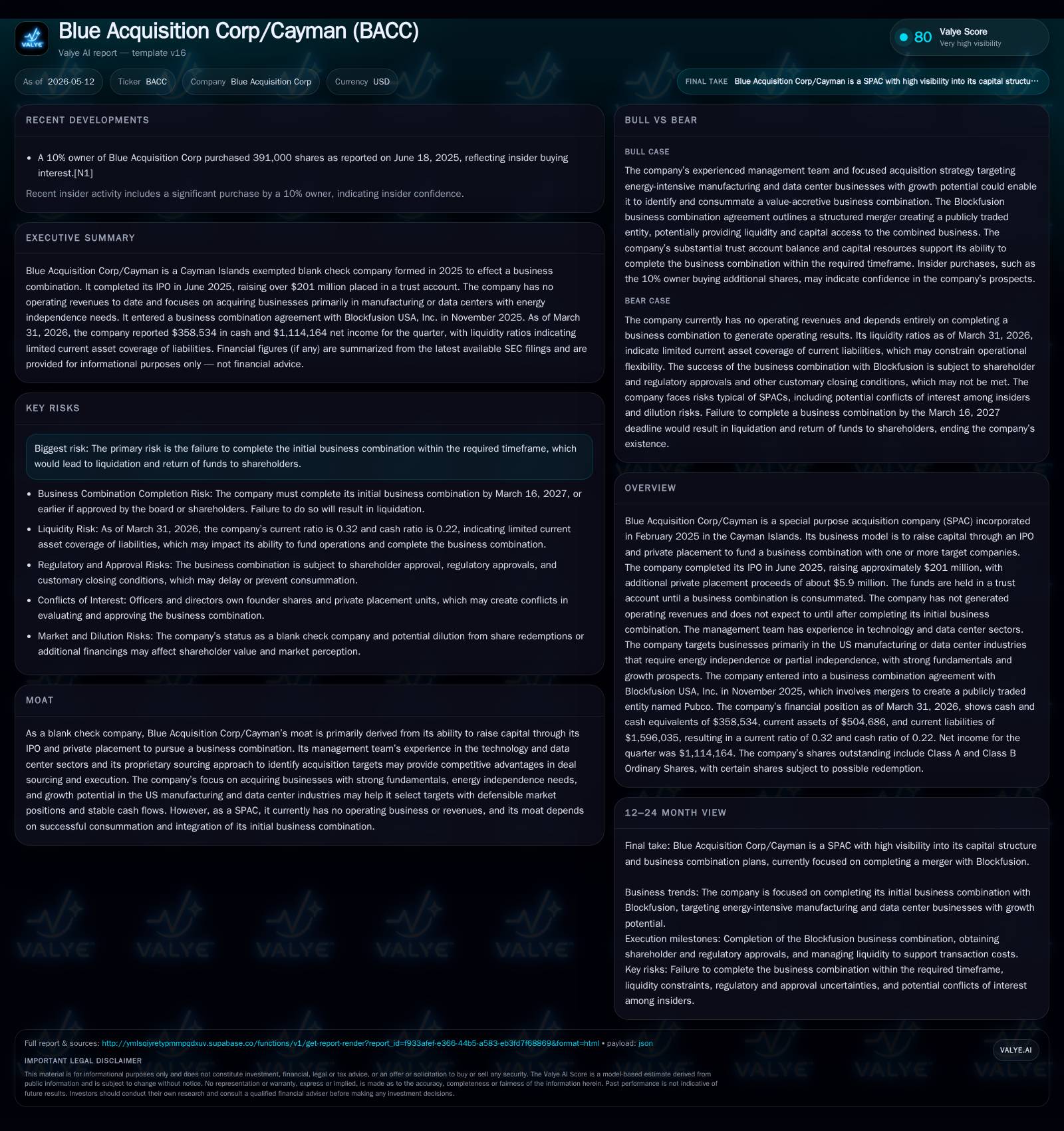
Blue Acquisition Corp/Cayman, a Cayman-domiciled SPAC focused on acquiring US manufacturing or data center businesses emphasizing energy independence, reported in its Q1 2026 filing significant liquidity constraints with cash at $358K and a working capital deficit exceeding $1 million. The company has yet to consummate its initial business combination but is engaged in proxy filings to secure shareholder approval. Its business model relies on successful deal closure within the next year, leveraging management experience in tech and data center sectors. Key risks include failure to complete the transaction within the mandated timeframe that triggers liquidation. The SPAC’s moat is limited but enhanced by specialized industry focus and proprietary sourcing strategy.
Recent Operating Update
In its Q1 2026 Form 10-Q filed on May 11, 2026, Blue Acquisition Corp disclosed that it holds only $358,534 in cash as of March 31, 2026, while facing a sizable working capital deficit of approximately $1.09 million [S2][F1]. This highlights ongoing liquidity challenges as the company incurs costs related to pursuing its initial business combination. Management plans to rely on potential working capital loans from sponsors or affiliates if needed but acknowledges substantial doubt about continuing as a going concern beyond one year without closing a transaction [S2]. Alongside this, the company filed a Form 8-K on May 7, signaling progress toward obtaining necessary shareholder approvals for an impending business combination transaction [S3]. These developments confirm that Blue Acquisition Corp remains actively engaged in finalizing its merger plans ahead of its March 16, 2027 deadline.
Business Model
Blue Acquisition Corp serves as a special purpose acquisition company (SPAC), incorporated in February 2025 in the Cayman Islands specifically to raise capital through an IPO and private placements for effecting one or more business combinations [S1]. It completed its IPO in June 2025, raising about $201 million by selling Public Units priced at $10 each, alongside approximately $5.9 million from Private Placement Units purchased mainly by its sponsor entities [S1][S10]. The gross proceeds are deposited into a Trust Account managed by a trustee and guarded until released upon closing a successful initial business combination or liquidation events [S10].
Currently the company has no operations or revenue streams because it has not yet acquired an operating business. Its entire economic engine depends on consummating an initial business combination that meets approved criteria and provides value to shareholders after accounting for redemptions and offering costs.
The management team is responsible for sourcing acquisition targets primarily within US manufacturing or data center sectors with energy independence requirements—either full or partial [S23]. Their approach emphasizes identifying companies with solid fundamentals including leadership credentials, market position, barriers to entry, diversified customer base, profitability potential relative to energy costs, and capacity for expansion amidst rising energy concerns. The team applies a proprietary sourcing strategy leveraging sector expertise to avoid highly competitive auction processes typical of traditional IPOs or private equity buyouts [S1][S4].
Through execution of this model, Blue Acquisition Corp aims to acquire businesses capable of generating stable free cash flow supported by scalable organic growth augmented by future strategic acquisitions [S4][S23]. Post-merger capital structures seek prudent leverage targeting below three times EBITDA normalized earnings giving flexibility for sustained investment [S4].
Industry Structure and Competitive Position
As a SPAC concentrating on US-based manufacturing and data centers demanding energy independence solutions, Blue Acquisition operates within industries undergoing significant transformation driven by sustainability imperatives and regulatory changes incentivizing green technology integration.
Manufacturing entities increasingly pursue self-generated renewable power solutions or partial independence to mitigate rising utility costs and enhance operational resilience. Data centers also face pressure to reduce carbon footprints while ensuring uninterrupted power availability that supports digital infrastructure scaling.
Competition among acquirers in these sectors includes other SPACs targeting similar themes, strategic corporate buyers focusing on technological upgrades, and private equity investing in energy transition assets. Blue Acquisition leverages its founders’ experience specific to tech and data center deals plus a network-driven proprietary sourcing tactic conferring differentiation from broad-market bidders who rely on standard auction processes.
The SPAC structure inherently carries competitive disadvantages due primarily to time-bound investment mandates (with mandatory liquidation if no deal closes) and public market scrutiny around blank check companies impacting target seller perceptions. However, management seeks to mitigate these risks through targeted focus areas where technical expertise combined with capital access could unlock superior deal flow opportunities.
Growth Drivers
Growth prospects hinge almost entirely on successfully completing an initial business combination with one or more companies aligning tightly with the SPAC’s thematic strategy:
- Energy Independence Demand: Both targeted industries exhibit accelerating demand for solutions delivering cost-effective energy autonomy responding to inflationary energy cost environments and policy-driven clean energy adoption requirements.
- Scale and Consolidation Opportunities: The targeted segments show trends towards industry consolidation benefiting well-capitalized buyers able to execute bolt-on acquisitions enhancing scale economies.
- Managerial Expertise: Leveraging management’s sector insights can increase likelihood of sourcing undervalued or overlooked targets with value creation potential.
- Public Market Access: Completion of the business combination grants acquired firms public access enabling follow-on capital raises for expansion investments.
- Stable Free Cash Flow Focus: Targeting businesses with predictable cash flows aids valuation support post-merger providing room for value accretive growth capital deployment.
These drivers collectively support the idea that assuming consummation occurs timely; Blue Acquisition’s pipeline aligns structurally rather than cyclically supporting durable revenue foundations post-combination.
Risks and Growth Constraints
Key risks are predominantly execution-based:
- Failure to Complete Initial Business Combination: The most acute risk remains inability to close a qualifying acquisition before March 16, 2027—the hard deadline leading to mandatory liquidation and return of trust funds minus expenses; this would result in complete loss of future growth prospects [S1][S12].
- Liquidity Shortfalls: Current liquidity deficits pose operational funding challenges as additional working capital loans are discretionary from affiliates and no formal agreement exists confirming such replenishment formally [S2][S21].
- Market Perception: Blank check companies commonly face skepticism from sellers wary of perceived pricing risks or complexity delays inherent in SPAC deals possibly limiting access to top-tier targets [S16].
- Redemption Risks: Public shareholder redemptions upon announcement can reduce available funds for deal consideration thereby complicating transaction structuring.
- Regulatory Approval Delays: Pending SEC reviews following registration statements introduce timing uncertainties impacting closing cadence [S3].
- Limited Operating History: Lack of operating revenues limits financial validation metrics prior to deal closure making investor confidence conditional primarily on team reputation and acquisition quality claims.
What to Watch Next
Investors should monitor several milestone indicators defining Blue Acquisition Corp’s trajectory:
- Progress on shareholder meeting scheduling dates related to vote approval for proposed business combinations detailed in forthcoming proxy statements filed under Form S-4 as part of the Blockfusion transaction [S3][S21].
- Redemption requests volume among public shareholders post-proxy release which influences financing structure through impact on cash availability.
- Any updates regarding working capital loan extensions by sponsors or affiliates providing near-term liquidity relief critical before deal closure dates.
- Amendments or extensions sought concerning the Combination Period potentially signaling transactional delays.
- Announcements detailing finalized merger terms including valuation metrics underscoring strategic rationale aligned with thematic focus areas noted earlier.
- Audit opinions accompanying the prospective target company’s financial statements included in proxy materials reflecting GAAP or IFRS compliance aimed at supporting transparent investor assessment [S9][S23].
Financial Profile Summary
Latest financial snapshot
| Metric | Value | Period |
|---|---|---|
| Cash & equivalents | $358534 | |
| 2026-03-31 | ||
| Current assets | $504686 | |
| 2026-03-31 | ||
| Current liabilities | $1596035 | |
| 2026-03-31 | ||
| Current ratio | 0.32x | |
| 2026-03-31 |
Source: SEC companyfacts cache [F1].
Blue Acquisition Corp’s balance sheet reflects typical SPAC prudence with IPO proceeds sequestered safely within trust accounts until approved disbursement:
| Metric | Value (USD) | Period Ending |
|---|---|---|
| Cash & Equivalents | 358,534 | |
| 2026-03-31 | ||
| Current Assets | 504,686 | |
| 2026-03-31 | ||
| Current Liabilities | 1,596,035 | |
| 2026-03-31 | ||
| Current Ratio | 0.32 | |
| 2026-03-31 |
Operating income remains negative reflecting pre-acquisition phase expenses while net income figures from prior years stem primarily from non-operational gains related to IPO activities rather than recurring operations [F1].[F1]
Liquidity pressures are evident given the current ratio significantly below unity along with management's disclosure expressing doubts about sustaining operations beyond twelve months without transaction success or sponsor loans injection [S2][S21]. Fund placement within the trust remains intact as required under SEC regulations governing SPACs mitigating risk exposure but limits available funds outside typical disbursements related strictly to offering costs or organizational expenses until combination completion occurs.
This report synthesizes public SEC filings up through May 11, 2026. It focuses strictly on grounded operational disclosures without speculating beyond documented evidence. No investment recommendations are provided herein.
Disclaimer: This is research-only, informational analysis and not investment advice. It may include AI-generated interpretation and general industry context. Always verify important details using primary sources.

Comments