
Camber Energy Advances Commercial Validation of Patented Grid Safety and Waste Treatment Technologies Amid Heavy Liabilities
Latest quarterly disclosures highlight ongoing technology validation while financial constraints pose operational risks.
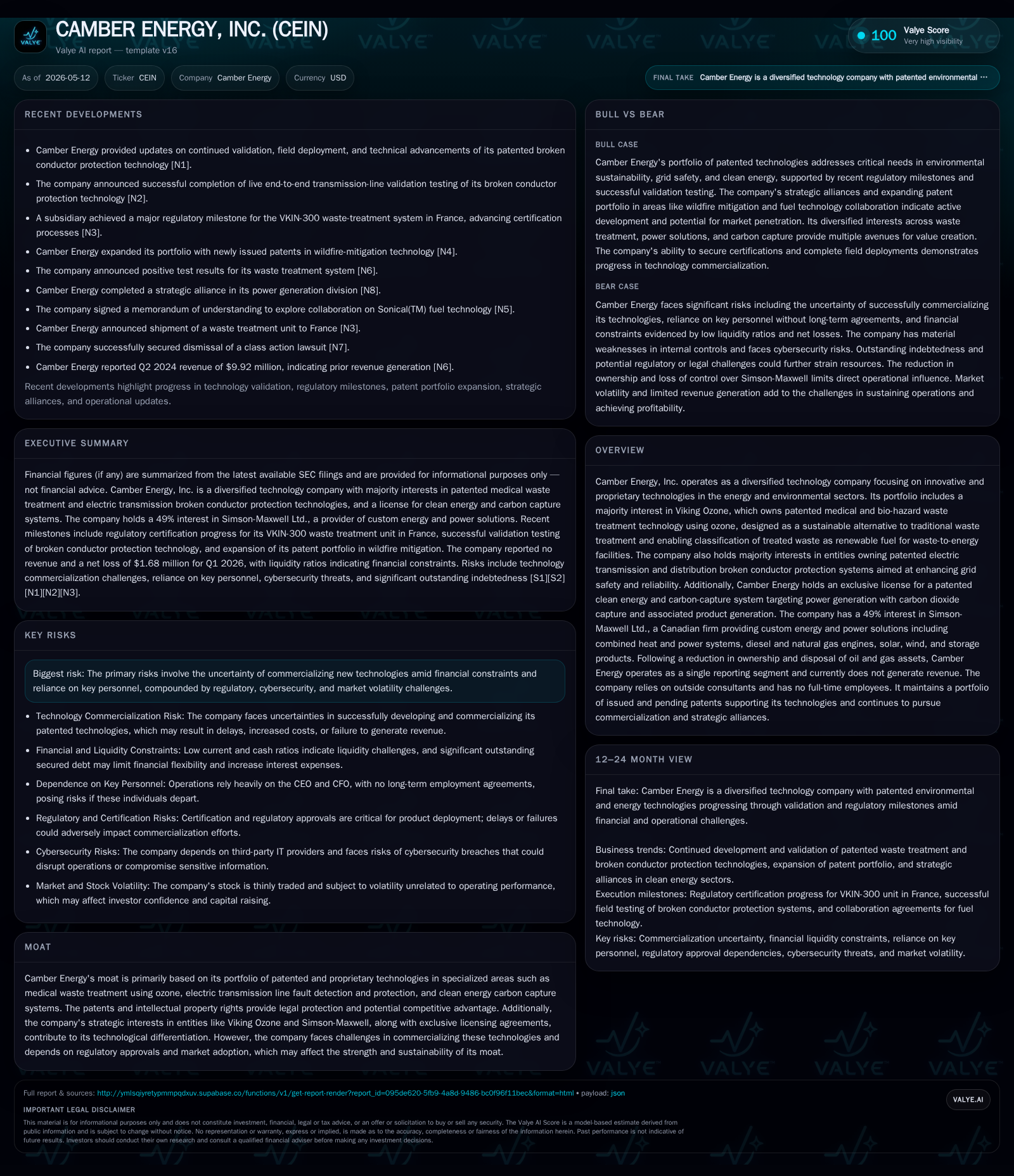
Camber Energy, Inc. reported in its May 2026 quarterly filing that it continues advancing field trials and certification processes for its proprietary broken conductor protection and medical waste ozone technologies. Despite technological progress, the company faces severe liquidity pressure illustrated by a current ratio of 0.16 and substantial liabilities exceeding current assets. Camber's business model revolves around commercializing patented clean-tech solutions in energy transmission safety, waste treatment, and carbon capture. Growth drivers include certification milestones, field deployments with government customers, and strategic licenses, but these are tempered by significant commercialization challenges and financial risks.
Recent Operating Update
Camber Energy’s latest quarterly report filed on May 11, 2026 ([S2]) provides an update primarily focused on ongoing developmental milestones for its core patented technologies rather than revenue growth or profitability improvements. Notably, in April 2026 ([S3]), Viking Ozone Technology (a majority-owned entity) secured a $500,000 promissory note at 10% interest due in April 2027 from an accredited investor to fund its continued commercialization efforts for the VKIN-300 medical waste pre-treatment unit.
The quarter also saw a critical advance in the practical deployment of Camber’s electric grid safety offering: Viking’s distribution-level Broken Conductor Protection Technology (BCPT) was installed at a U.S. government substation ([S7]). The technology successfully detected a simulated open conductor fault during initial testing and activated appropriate relay trip logic—validating functionality under controlled conditions. Further live environment testing is planned imminently.
These developments illustrate tangible progress from lab-stage innovation toward real-world application across Camber’s patented portfolio.
Business Model
Camber Energy operates as a diversified technology company focused on proprietary innovations in sectors intersecting energy infrastructure resilience, environmental sustainability, and clean energy solutions ([S1]). It no longer retains legacy oil & gas assets or generates revenue from prior power generation segments after recent divestitures ([S5]). Instead, it concentrates resources on three main intellectual property-driven verticals:
Medical and Bio-hazardous Waste Treatment via Ozone: Through its majority stake in Viking Ozone, Camber owns patents including U.S. Utility Patent No. 11,565,289 validating an ozone-based medical waste processing system that aims to provide an emissions-friendly alternative to incineration or chemical techniques while enabling treated waste classification as renewable fuel for waste-to-energy applications ([S1],[S19],[S22]).
Electric Transmission & Distribution Broken Conductor Protection Systems: Majority interests in entities controlling patented technology aimed at detecting breaks or faults instantaneously on electrical lines to shut off power swiftly avoid fires or outages and contribute to grid hardening initiatives ([S1],[S19],[S23]). This includes separate patent portfolios specializing in transmission-level systems (Viking Protection) and distribution-level systems (Viking Distribution) ([S23],[S9]).
Clean Energy Carbon Capture & Bottoming Cycle Power Systems: Exclusive licensed patents allow proprietary power generation configurations integrating carbon dioxide capture alongside auxiliary output products like distilled water or diesel exhaust fluid ([S1],[S20]).
Revenue generation is intended through licensing agreements, direct sales or deployment contracts principally targeting commercial utilities, government infrastructure operators, and regulated waste processing facilities who pay for access to advanced safety or environmental compliance technologies.
Margins depend heavily on successful scale-up from prototype trials to reliable full-scale deployment; intellectual property protection creates entry barriers but is not an assurance of wide adoption given incumbent competition and high technical entry costs.
Industry Structure and Competitive Position
Camber occupies niches within broader industries undergoing rapid transformation driven by regulatory pressures for cleaner environmental solutions and infrastructure reliability enhancements:
The medical/biohazardous waste treatment market demands innovative alternatives due to stricter environmental standards that restrict burning/incineration; ozone treatment offers advantageous sustainability positioning though incumbents wield established customer relationships.
The electric utility sector increasingly invests in grid resiliency technologies amid growing wildfire risk and blackout prevention mandates; broken conductor detection remains emerging technology with few direct competitors possessing comparable patented multi-parameter monitoring algorithms deployed by Viking subsidiaries.
The clean energy carbon capture sector is marked by intense technological diversity with high capital intensity; exclusive licenses grant Camber access to unique bottoming cycle power systems combining decarbonization with cogeneration—yet commercialization depends heavily on backing from power producers incentivized by subsidies or carbon pricing programs.
While Camber benefits from solid patent protection and diversified technology bets across growth industries with structural tailwinds toward sustainability and grid modernization, it does not currently have scale or established revenue streams typical of incumbents. Its competitive moat rests largely on intellectual property strength rather than operational execution at this stage.
Growth Drivers
Key growth drivers revolve around reaching critical certification milestones enabling regulatory acceptance alongside demonstrable validations influencing customer adoption:
Certification Achievements: In late 2025 Viking Ozone’s VKIN-300 unit passed acceptance review by France’s LNE laboratory under one of the world’s strictest standards (NFX 30-503), positioning it closer to official conformity certificates required for European markets ([S19],[S22]). Success here could be replicated elsewhere globally.
Field Deployments: April 2026 installation and successful fault detection test of distribution BCPT at a U.S. government site represents significant technology proof-point that can drive confidence among utilities evaluating grid resiliency tools ([N1],[S7],[S8]). Expanding such pilots under live conditions will be critical for order conversion.
Strategic Licensing & Partnerships: Exclusive clean energy carbon capture licenses covering Canada and selected U.S. territories offer pathway toward integration with power generation facilities aiming to meet decarbonization goals ([S1],[S20]).
Intellectual Property Portfolio Expansion: Continuously broadening filings around fault detection methods enhance technological defensibility against competitors attempting market entry ([S9],[S23]).
Execution effectiveness across these vectors determines near-term revenue visibility since overall commercial traction remains early-stage.
Risks & Watchpoints
Despite engineering progress, multiple operational risks constrain prospects:
Financial Constraints: Extremely low current ratio (0.16) due to severe imbalance between $11.7 million current assets vs $72.9 million current liabilities points toward tight liquidity generating operational vulnerabilities should funding lapse or needed investments slow ([F1]).
Technology Commercialization Risk: Despite technical milestones the leap from tested prototypes to cost-effective deployable products accepted by mature utility customers involves extended timelines with possible setbacks including integration challenges or cost overruns ([S10],[N1]).
Regulatory Dependency: Certifications like French DASRI compliance are prerequisites for sales yet remain uncertain in timing despite positive evaluations; delays could hamper market entry windows ([S19],[S22]). Relatedly, reliance on government subsidies or incentives particularly for renewable fuel classification impacts project economics substantially ([S16]).
Competitive Pressures & IP Litigation: The evolving nature of electrical infrastructure safety tech invites competing solutions backed by bigger incumbents posing adoption hurdles plus risk of costly infringement claims impacting cash flows ([S16]).
Limited Personnel & Outsourcing Reliance: Absence of full-time employees relies heavily on outside consultants including for key management functions risking operational continuity challenges ([S6]).
Legal & Regulatory Uncertainty: Past SEC staff preliminary enforcement determinations against Viking raise potential distraction risk along with ongoing litigation although no material lawsuits were pending as of end FY25 ([S14],[S21],[S25]).
What to Watch Next
Critical near-term indicators include:
- Delivery of official certification under updated French waste management standards for VKIN-300 units signaling entry into European markets.
- Results from extended live testing phases of broken conductor protection technology at diverse utility sites demonstrating reliability under variable conditions.
- Updates on convertible debt maturities including FK Venture note due September 2026 detailing capital structure impact or equity conversion events potentially affecting ownership dilution [S3][F1].
- Progress toward finalizing licensing arrangements or sales agreements leveraging exclusive clean energy carbon capture rights.
- Disclosures regarding resolutions or developments related to SEC investigations into Viking subsidiaries which might influence perception or resource allocation.
Monitoring these will help gauge whether Camber transitions from development-stage IP holder into recognized supplier generating commercial revenues.
Financial Profile (Summary)
Latest financial snapshot
| Metric | Value | Period |
|---|---|---|
| Current assets | $12mm | |
| 2026-03-31 | ||
| Current liabilities | $73mm | |
| 2026-03-31 | ||
| Current ratio | 0.16x | |
| 2026-03-31 |
Source: SEC companyfacts cache [F1].
As of March 31, 2026 balance sheet metrics indicate challenging liquidity:
| Metric | Value (USD) | Period End |
|---|---|---|
| Current Assets | $11,725,822 | |
| 2026-03-31 | ||
| Current Liabilities | $72,941,980 | |
| 2026-03-31 | ||
| Current Ratio | 0.16 | |
| 2026-03-31 | ||
| Total Debt | ~$5.07M | Mid-2023 (best-effort) |
| Cash & Equivalents | $1.17M | End 2022 |
Operating results remain negative with prior-year net losses reflecting pre-revenue development spending.[F1]
The company’s capital structure includes convertible promissory notes bearing high-interest rates (e.g., FK Venture note at 10%) with conversion features that may dilute shareholders upon conversion before maturity ([S1][S3]). This debt burden further limits flexibility amidst ongoing investment needs needed for technical progress-to-market transition.
This analysis is based entirely on publicly available SEC filings through May 12th, 2026 and news releases cited herein without conjecture beyond documented facts or numbers. It is intended solely as an informed business evaluation without any investment recommendations or forecasts.
Disclaimer: This is research-only, informational analysis and not investment advice. It may include AI-generated interpretation and general industry context. Always verify important details using primary sources.

Comments