
Cronos Group Advances Acquisition and Brand Expansion in Q1 2026
Q1 2026 filings reveal extended acquisition timelines and strengthened brand portfolio, underscoring Cronos Group’s global cannabis strategy.
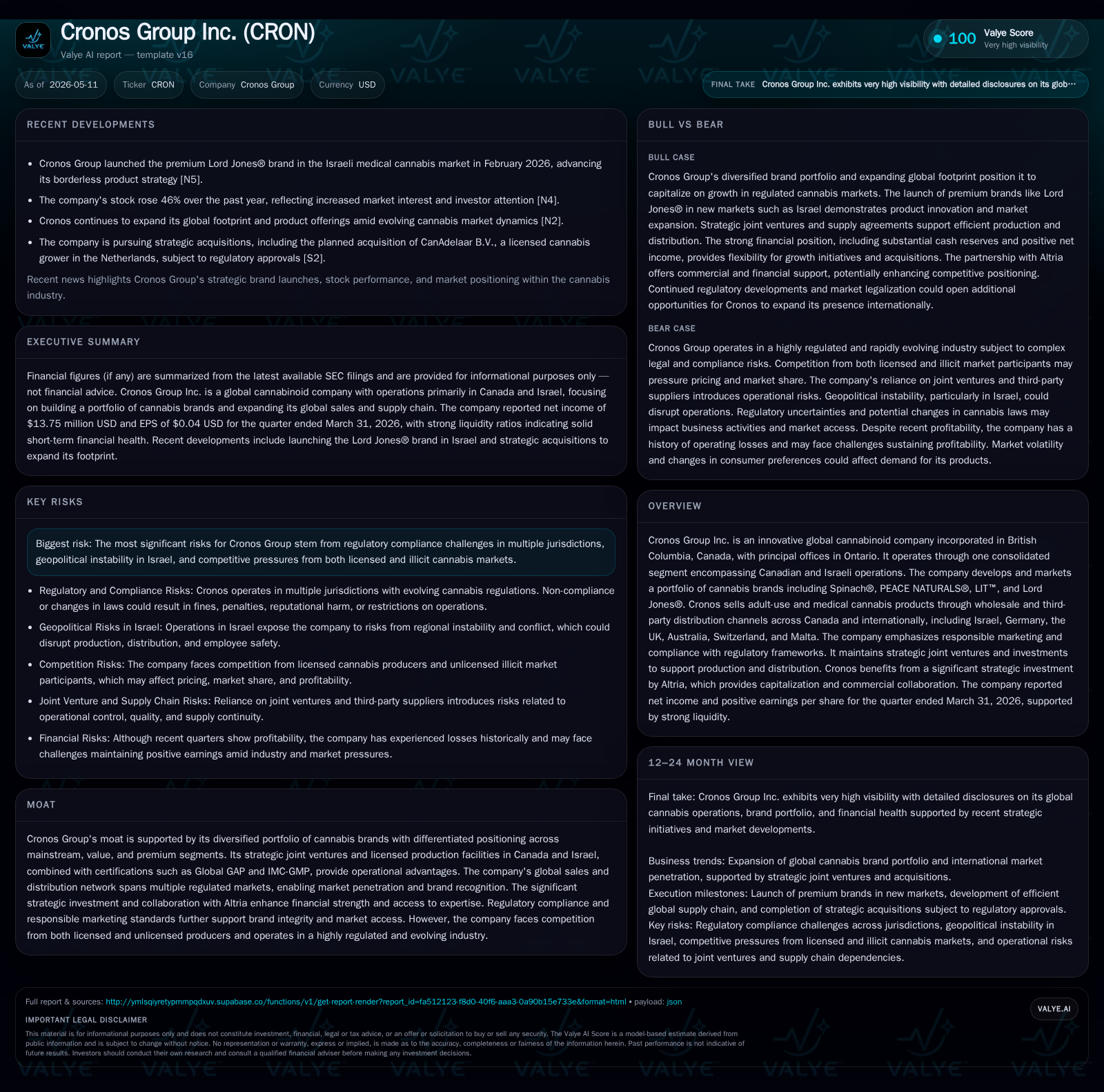
In its 10-Q for Q1 2026, Cronos Group extended the closing date for its CanAdelaar acquisition in the Netherlands, reflecting regulatory diligence ahead of expanding European operations. The company continues to develop a diversified portfolio of cannabis brands across multiple regulated markets, supported by operational certifications and strategic joint ventures. While competitive pressures and regulatory complexities remain key challenges, liquidity and backing from Altria position Cronos to capitalize on growth opportunities internationally.
Q1 2026 Operational Update: Acquisition Timelines and Strategic Impact
On May 11, 2026, Cronos Group Inc. filed its quarterly report (Form 10-Q) covering Q1 results alongside an event filing (Form 8-K) disclosing an amendment to its Share Purchase Agreement for acquiring CanAdelaar B.V., a licensed cannabis grower participating in the Dutch Controlled Cannabis Supply Chain Experiment [S2][S3][S6]. This amendment extends the long stop date of the transaction from June 9 to September 9, 2026, granting additional time to satisfy critical closing conditions such as obtaining Dutch regulatory approvals, confirming licensing status, and completing the Bibob background check—a rigorous vetting process enforced by Dutch authorities.
This extension underscores the cautious approach required when entering European cannabis markets governed by stringent regulations. Securing these approvals is pivotal for Cronos to expand its footprint in continental Europe organically through licensed cultivation rather than relying solely on imports or distribution partnerships. The CanAdelaar acquisition represents a strategic move toward vertical integration in a market anticipated to grow amid evolving cannabis legislation.
Business Model and Product Portfolio: Diversified Cannabis Brands and Markets
Cronos operates as a consolidated segment with principal activities in Canada and Israel [S1]. The company’s business revolves around producing and distributing cannabis products both for adult recreational use (primarily Canada) and medical applications (notably Israel). Canadian operations center on Peace Naturals Project Inc., which manages licensed production facilities at the Peace Naturals Campus in Ontario alongside its equity interest in Cronos GrowCo—a substantial source of cultivated cannabis under federal Cannabis Act licenses.
In Israel, operations span cultivation through production, distribution, and marketing of medical cannabis products certified under mandatory Israeli Ministry of Health standards such as IMC-GAP (Good Agricultural Practices), IMC-GMP (Good Manufacturing Practices), and IMC-GDP (Good Distribution Practices). These certifications reflect a disciplined quality assurance framework essential for medical markets.
Cronos’ brand portfolio demonstrates strategic segmentation: Spinach® targets mainstream consumers; PEACE NATURALS® delivers cost-efficient value options; LIT™ focuses on lifestyle-oriented adult-use demographics; and Lord Jones® caters to premium segments with established U.S.-based heritage now extended into Israel’s medical market since February 2026 [S1]. Revenue is generated primarily through wholesale distribution channels combined with third-party partnerships enabling broader geographic reach beyond domestic borders.
The integration of vertically licensed production facilities with diversified branded products supports revenue through volume scale while allowing pricing differentiation based on product mix. Adherence to global quality certifications bolsters product legitimacy amid competitive pressures.
Competitive Positioning in Regulated Cannabis Industry
The global cannabis industry is characterized by heavy regulation coupled with fragmented jurisdictional regimes requiring companies like Cronos to navigate overlapping compliance systems [S1]. Licensed producers compete intensely within regulated markets where barriers such as requisite licensing, GMP compliance, packaging rules, and advertising restrictions limit new entrants but also impose operational complexities.
Cronos leverages its joint ventures in Canada and Israel to augment production capacity efficiently while mitigating some risks associated with single-site dependency. These partnerships help solidify supply chain stability—important given agricultural volatility and regulatory inspection frequency.
A significant moat arises from Cronos’ relationship with Altria Group—a dominant tobacco conglomerate whose strategic investment not only provides financial capital but also access to extensive commercialization expertise including R&D collaboration, marketing infrastructure support, government relations leverage, and logistics optimization [S26]. This alliance helps buffer some competitive threats posed by vertically integrated licenced peers as well as unregulated illicit suppliers who often disrupt legal markets with lower-cost alternatives.
Brand differentiation across value tiers fosters customer retention by meeting diverse consumer preferences while regulatory compliance safeguards sustained market access.
Growth Drivers: Market Expansion, Brand Development, and Intellectual Property
Cronos’ growth strategy outlines four pillars: cultivating iconic brands that responsibly elevate consumers’ experience; establishing diversified global sales networks; optimizing supply chains; and advancing disruptive intellectual property [S1]. The pending acquisition of CanAdelaar will directly expand European production capabilities—once regulatory conditions are satisfied—opening access to the Dutch market’s emerging demand under the controlled experiment framework [S3].
Simultaneously, the launch of Lord Jones® formulations tailored for Israel’s medical segment exemplifies leveraging international brand equity to penetrate higher-margin segments globally. Other markets including Germany, the UK, Australia, Switzerland, and Malta are served through partnerships or distribution arrangements carrying PEACE NATURALS® and LIT™ brands.
Innovation through R&D efforts aims at proprietary cannabinoid product development offering formulation uniqueness that could disrupt typical offerings. Intellectual property protection remains a priority as evidenced by patent filings, trademark registrations, trade secrets protection protocols administered internally [S26].
Measurable KPIs likely focus on backlogs in CanAdelaar’s transaction progress milestones such as Bibob clearance outcomes; new market revenue contributions particularly from Lord Jones® in Israel; volume uplifts via expanded distribution; renewal rates with wholesale partners; pricing improvements due to premium product introductions; and margin enhancements stemming from economies of scale at Peace Naturals Campus.
Risks and Constraints: Regulatory Complexity, Geopolitical Factors, and Market Competition
Cronos operates within a multi-jurisdictional environment laden with evolving regulations that increase compliance cost burdens while introducing uncertainty about license renewals or operational constraints [S4]. Regulatory interpretations can shift unexpectedly requiring rapid adjustments.
Geopolitical instability affecting Israeli operations presents additional risk layers including potential import/export disruptions or adverse trade measures such as anti-dumping duties that could impact cross-border supply chains [S4].
Competition emanates both from fully licensed producers aiming for scale or niche dominance as well as persistent illicit cannabis sectors undermining price integrity. While licensed entities comply with expensive GMP-regulated manufacturing environments paying taxes/legal fees that drive costs higher, illicit markets evade scrutiny enabling aggressive pricing strategies that threaten retail adoption.
Agricultural operations inherent vulnerability remains due to climate risk factors or supplier reliance potentially constraining raw materials availability or inflating procurement costs [S1][S4]. Intellectual property enforcement challenges could weaken differentiation if competitors mimic key innovations without repercussions [S26].
Legal proceedings related to product liability claims or class actions around U.S. hemp-derived CBD products add expense uncertainties that cloud risk-adjusted valuation prospects [S5][S13].
Key Upcoming Catalysts to Monitor
Critical near-term developments focus heavily on regulatory clearance success for closing the CanAdelaar acquisition by the revised September 9 deadline [S3], an event that would formally establish Cronos’ licensed cultivation presence within one of Europe’s pioneering cannabis experiments.
Monitoring sales performance progression from Lord Jones® post-launch across Israeli medical channels provides early indicators of brand traction internationally. Tracking expansion initiatives into other regulated geographies—via either direct distribution or partnerships—and their revenue mix shifts will shed light on scale efficiency gains.
Progression of intellectual property filings or commercialization plans may signal potential future revenue streams if disruptive cannabinoid innovations prove compelling versus rivals. Regulatory changes across Canadian provincial frameworks or European policy adjustments remain vital watchpoints capable of materially influencing operating flexibility or cost structure dynamics.
Financial Snapshot: Balance Sheet Strength Supports Strategic Flexibility
Latest financial snapshot
| Metric | Value | Period |
|---|---|---|
| Cash & equivalents | $822mm | |
| 2026-03-31 | ||
| Current assets | $928mm | |
| 2026-03-31 | ||
| Current liabilities | $42mm | |
| 2026-03-31 | ||
| Current ratio | 21.87x | |
| 2026-03-31 |
Source: SEC companyfacts cache [F1].
Cronos maintains robust liquidity positions supportive of ongoing operational funding requirements despite enduring net losses reported previously [F1]. As of March 31, 2026 quarter-end:
- Cash & equivalents stood at approximately $821.9 million USD,
- Current assets totaled $927.9 million USD,
- Current liabilities were modest at $42.4 million USD,
- Producing a strong current ratio near 21.87 indicating exceptional short-term financial flexibility able to absorb working capital needs or investment outlays without stress [F1].
While profitability challenges persist given prior reported operating income deficits [F1], this balance sheet strength—augmented by Altria’s backing—provides a buffer against execution risks related to acquisitions or market expansion campaigns undertaken concurrently.
| Metric | Value (USD million) |
|---|---|
| Cash & equivalents | 821.9 |
| Current assets | 927.9 |
| Current liabilities | 42.4 |
| Current ratio | 21.87 |
This solid liquidity foundation enables continued investment into brand marketing initiatives, regulatory compliance expenditures linked to new market entries like Europe via CanAdelaar acquisition completion, research innovation pipelines around cannabinoid IP development, plus working capital support for expanding wholesale distribution volumes globally.
Disclaimer: This analysis is based exclusively on publicly available information up to May 11, 2026 including SEC filings referenced by document code. It does not constitute investment advice or recommendations regarding any securities mentioned herein.
Disclaimer: This is research-only, informational analysis and not investment advice. It may include AI-generated interpretation and general industry context. Always verify important details using primary sources.

Comments