
Grayscale GSUI ETF Initiates Staking as Market Liquidity Expands
The launch of staking and a redemption program in early 2026 marks a pivotal operational shift for GSUI, enhancing liquidity and offering investors new yield opportunities.
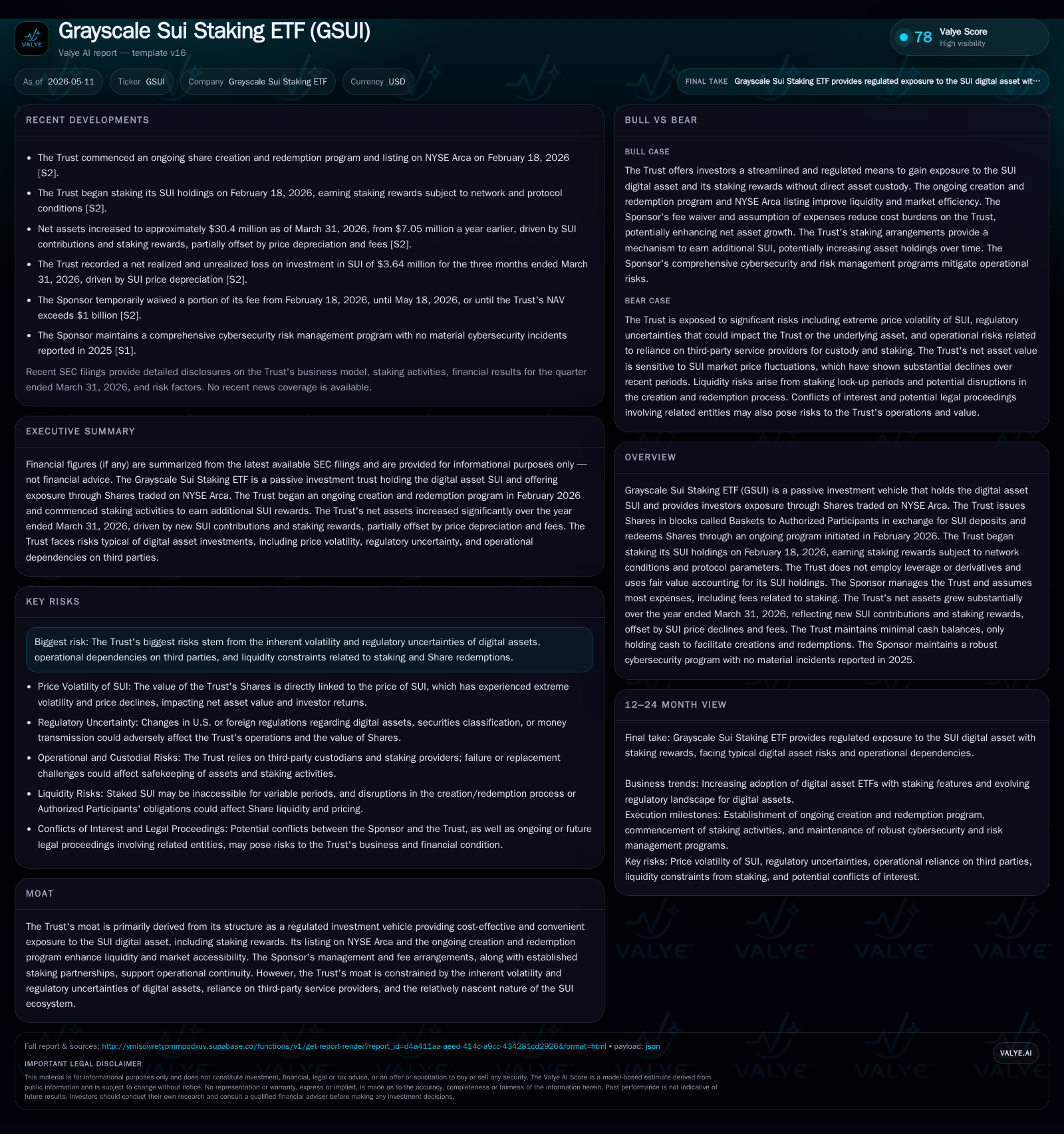
Grayscale Sui Staking ETF (GSUI) commenced staking operations on February 18, 2026, alongside instituting a continuous share creation and redemption mechanism listed on NYSE Arca. These developments have materially increased market liquidity, enabling more efficient investor access and driving substantial net asset growth despite prevailing SUI price volatility. The Trust’s business model centers on providing passive, regulated exposure to the SUI token with embedded staking rewards, positioned competitively amidst growing demand for transparent, regulated digital asset vehicles. Notwithstanding, GSUI faces persistent challenges tied to digital asset volatility, regulatory uncertainties, and operational reliance on third parties for staking execution.
Update on Recent Operating Developments: Q1 2026 Highlights
The Q1 2026 quarterly filing dated May 8 details a transformative phase for Grayscale Sui Staking ETF (GSUI). On February 18, 2026, the Trust initiated its staking program on the entire corpus of held SUI tokens. This strategic shift allows the Trust to earn "Staking Consideration"—additional SUI rewards—subject to prevailing Sui Network conditions and protocol reward rates. Concurrently, GSUI launched a redemption program permitting Authorized Participants to create or redeem Shares in Baskets of 10,000 units by delivering or receiving corresponding amounts of SUI. This development occurred alongside the Trust’s listing upgrade exposing it to NYSE Arca liquidity pools.
These twin initiatives mark a departure from GSUI's prior structure where no redemption program existed and Shares traded over OTCQB with wider premiums/discounts due to limited arbitrage mechanisms. Since then through March-end, net Assets Under Management ballooned significantly from roughly $7 million to over $30 million driven largely by institutional-sized creation orders equating to over 31 million additional deposited SUI tokens while simultaneously receiving approximately 45 thousand SUI in accrued staking rewards [S2][S3]. Despite this growth in net assets, the token price declined from approximately $1.40 per SUI at year-end to $0.88 by March quarter close leading to reported unrealized losses.
This full staking launch combined with creation/redemption capability represents a foundational evolution toward making GSUI a more accessible and liquid product for investors seeking regulated exposure to digital asset yields.
Business Model and Value Proposition of the GSUI Trust
GSUI functions purely as a passive investment vehicle managed by its Sponsor; it holds exclusively the underlying digital asset SUI and aggregates returns including any generated from staking activities. Shares represent fractional ownership interests designed so that their value closely tracks the fair value accounting-determined worth of all deposited SUI plus accumulated but unredeemed staking rewards less liabilities such as fees.
Share issuance occurs strictly in blocks called Baskets of 10,000 units transacted with Registered Authorized Participants who deposit equivalent values of SUI tokens. Redemptions likewise take place through these Authorized Participants removing Shares in Basket-denominated increments thereby releasing equivalent underlying tokens back into market circulation.
Critically, the Trust does not utilize leverage or derivatives which limits counterparty risk while adhering to fair valuation principles consistent with ASC Topic 820-10 guidance. This also distinguishes GSUI structurally from some competing vehicles that may employ synthetic exposures or derivative overlays.
The Sponsor absorbs most operating expenses upfront including custody and staking arrangement costs but has disclosed fee waivers effective through mid-May or until NAV passes $1 billion thus lowering investor drag during this nascent phase [S1][S2][S3]. This enhances cost-effectiveness when compared with direct ownership that involves higher custody complexity plus fragmented access to trust-worthy staking providers.
Overall GSUI aims to combine regulatory oversight with enhanced operational transparency delivering an efficient conduit for gaining all-in exposure to stakes plus price performance in one publicly traded share.
Competitive Context Within Digital Asset ETFs and Staking Products
Within the expanding ecosystem of crypto ETFs and digital asset yield products, GSUI occupies a specialized niche aiming at holding only native network tokens (here SUI) with actual on-chain staking activities embedded. Listing on NYSE Arca ensures compliance with generic listing standards supporting investor confidence via regulatory supervision as well as benefiting from established trading venues’ liquidity.
Authorized Participants serve as critical market makers enabling arbitrage that minimizes premium/discount deviations versus NAV—a vital feature especially given volatility inherent in blockchain-based assets that otherwise can impose significant tracking error risks.
However,the Trust relies heavily on third-party custodial solutions plus external staking service providers creating operator dependencies particularly around safekeeping protocols and timely execution of unstake scenarios—an area idle disruptions could impair representation fidelity or timely redemptions.
Compared directly against non-staking or actively managed crypto funds that often hold basket indexes of multiple coins or employ leverage strategies including futures derivatives GSUI’s pure-play single token approach combined with integrated staking creates distinct product clarity yet also concentrates single-asset risk.
Price formation transparency benefits from Index Price construction comprising multiple digital exchange platforms including Binance and Kraken among others affording real-time fair-value approximations critical for effective arbitrage mechanics post-NYSE listing.[S1][S7]
Key Growth Catalysts in Digital Asset Staking Exposure
Growth drivers for GSUI center fundamentally around scaling adoption of the underlying Sui protocol which governs total staked amounts versus circulating floats influencing yield levels and reward consistency delivered back into the Trust:
- As the network increases transaction volume and validators expand participation rates this generally elevates protocol-level rewards potentially increasing annualized returns reflected in compounded Share NAV enhancements.
- Institutional investors seeking vetted regulated gateways into crypto are increasingly attracted by product structures offering passive yield accumulation without exposure to direct custodial risk which positions GSUI well particularly if sustained fee waivers stimulate early AUM expansion.
- Ongoing inflows creating new Shares fueled first quarter asset jumps evidencing appetite coincident with recent public listing.
- Performance metrics including tracking error minimization via robust redemption mechanisms and reduced premium/discount spreads reinforce secondary market confidence crucial for scalable growth dynamics.[F1][S2]
- Future protocol upgrades improving unstaking liquidity windows would materially ease constraints currently limiting immediate redemption access supporting stronger investor engagement.
Risks and Constraints Facing GSUI Amid Volatility and Operational Dependencies
The primary watchpoints remain pronounced given digital asset inherent characteristics:
- Volatility: The continuing price swings of SUI materially impact NAV per Share where declines lead directly to unrealized losses irrespective of underlying operational performance threatening negative sentiment cycle.[S11][S14]
- Regulatory: Uncertainty looms around whether regulators might classify digital assets like SUI as "securities" imposing onerous compliance burden or risking fund termination events undermining investment continuity.[S13]
- Liquidity/Operations: Staking inherently locks-up portions of holdings possibly limiting immediate redemption availability introducing mismatches between Share liquidity versus underlying tokens requiring sophisticated management.[S14]
- Counterparty: Dependence on Custodians and third-party staking operators exposes counterparty risk including service failures or security breaches despite rigorous cybersecurity frameworks maintained by Sponsor.[S12]
- Legal/Litigation: Historical legal actions involving affiliated entities create reputational risk even if not directly implicating current Trust operations.[S7]
- Fee Structure: Post-waiver sponsor fee imposition effective May 18 will increase drag possibly impacting fund competitiveness if associated value propositions don’t sufficiently scale.
Forward-Looking Considerations for Investors and Stakeholders
Several milestones merit diligent monitoring:
- The imminent termination of Sponsor Fee waivers mid-May or conditional upon hitting $1 billion NAV will test Sponsor’s willingness vs fund economics under normal fee regimes potentially impacting net return profiles.[S3]
- Network changes affecting staking reward rates will directly influence accumulation speed affecting total return prospects.
- Tracking Premium/Discount spreads post-redemption launch will reveal efficiency gains in market arbitrage reflecting evolving liquidity conditions.
- Regulatory clarifications regarding digital asset classification could trigger operational adjustments requiring re-assessments on continuity risk levels.
- Any expansion or disruption affecting creation/redemption processes especially regarding unstake timing constraints might alter trustworthiness perceptions impacting inflows/outflows dynamics.[S15][S18]
- Sponsor communications clarifying distribution policies regarding accrued Staking Consideration will be relevant for income-focused stakeholders evaluating cash yield expectations.[S10]
Summarized Financial Snapshot and Expense Structure
In Q1 ended March 31, 2026, GSUI recorded a net realized/unrealized loss on investment in SUI amounting to approximately $3.6 million attributable largely to falling token prices over the period from ~$1.40 down to $0.88 per unit ([F1],[S8]). However,this was offset by sizable inflows totaling nearly $29.7 million in newly created Shares evidenced by deposits of over 31 million freshly introduced tokens along with about $44 thousand credited as accrued Staking Rewards adding balance-sheet support ([F1],[S2],[S3]).
Operating expenses remain minimal due primarily to Sponsor’s ongoing fee waivers mitigating standard management fee charges below the forthcoming threshold set at $1 billion NAV ([S3]). There is no leverage employed consistent with stated policy limiting downside financial risks arising from funding structures ([S2]).
It does not constitute investment advice or recommendations but aims to provide an informed perspective grounded in official disclosures concerning Grayscale GSUI ETF's business dynamics within the evolving digital asset sector.
Disclaimer: This is research-only, informational analysis and not investment advice. It may include AI-generated interpretation and general industry context. Always verify important details using primary sources.

Comments