
Universal Token Advances Real-World Asset Tokenization Platform with Strategic Regulatory Push
The latest quarterly filing from Universal Token highlights important progress in regulatory licensing and banking integration, key to its emerging RWA tokenization business.
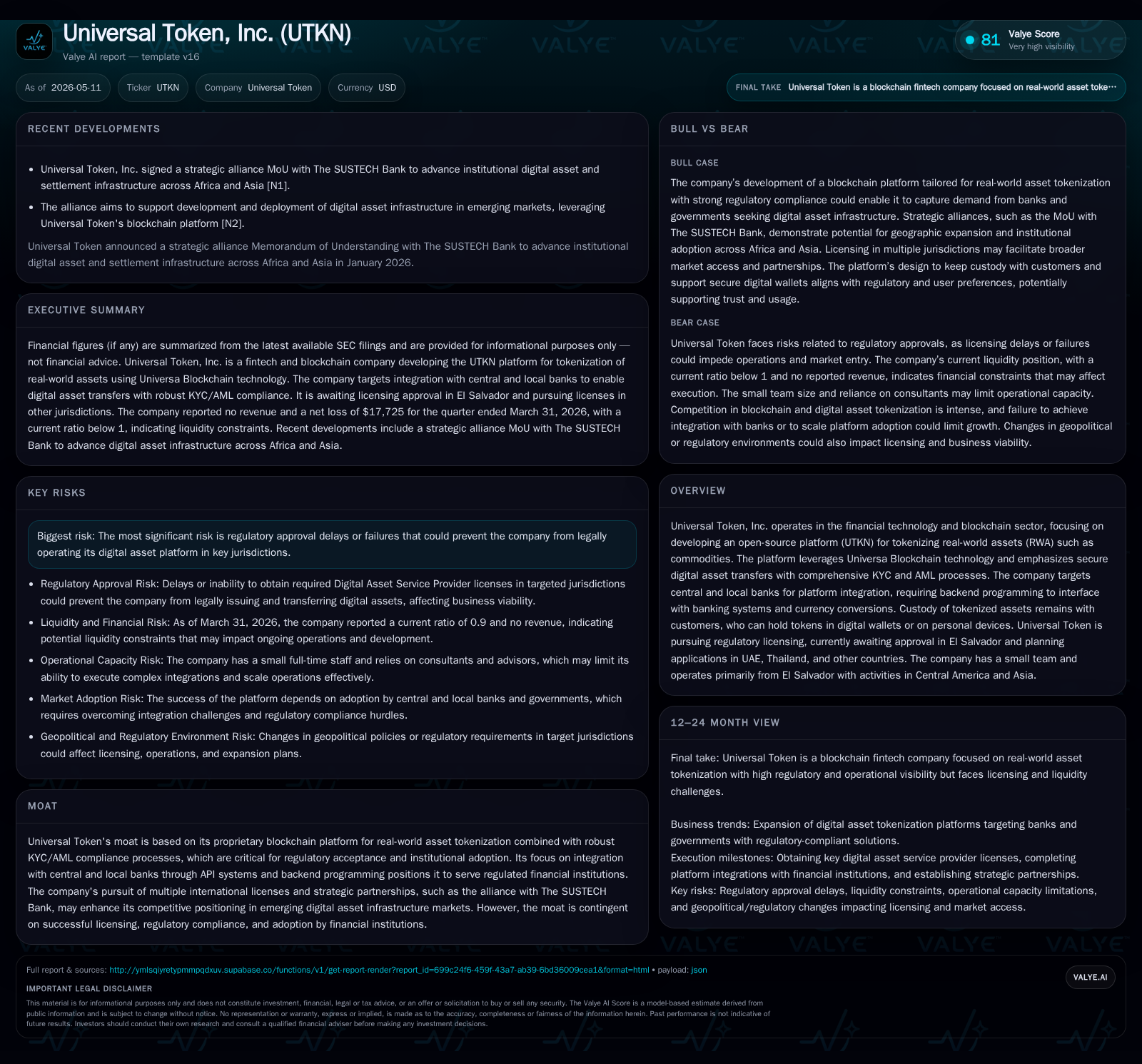
Universal Token’s Q1 2026 10-Q reveals measured but vital strides in regulatory license applications across multiple jurisdictions, including a pending approval in El Salvador and upcoming filings in UAE and Thailand. The company continues developing its open-source UTKN platform built on the Universa Blockchain, focusing on real-world asset tokenization tailored for institutional banking clients. While operating without revenues yet, Universal Token emphasizes backend API integration with central and local banks alongside comprehensive KYC/AML compliance as its core differentiation. Regulatory approvals remain the primary hurdle amid a liquidity position reflecting tight working capital. Going forward, license wins and bank onboarding will be crucial milestones signaling market acceptance and scaling potential.
Latest Quarterly Operating Update: Progress and Challenges
Universal Token’s latest quarterly report filed on May 11, 2026 [S2] confirms incremental progress towards commercializing its digital asset platform amid ongoing regulatory work. The company awaits formal licensing approval in El Salvador—a critical gateway market—and plans submissions for financial technology licenses in the UAE and Thailand within the near term. These milestones underscore Universal Token’s commitment to an internationally compliant operational framework essential for institutional adoption.
Technically, the firm continues advancing backend programming required to integrate its UTKN platform with central and local banking systems. The filing notes no reported revenues during the quarter as development and licensing activities dominate operational focus [S2]. However, these developments represent pivotal steps moving the company closer to market-ready status despite inherent timing uncertainties associated with regulatory engagement.
Universal Token’s Business Model: Tokenizing Real-World Assets with Institutional Focus
At its core, Universal Token operates an open-source platform grounded in Universa Blockchain technology designed explicitly for tokenizing real-world assets (RWA), such as commodities [S1]. The business model eschews direct asset management or speculative digital tokens; instead, it provides technical infrastructure enabling regulated financial institutions—primarily central and local banks—to tokenize underlying assets digitally.
Revenue generation targets institution-focused service fees tied to platform licensing, customization for bank-specific backend integration via APIs, and developer ecosystem support. Notably, custody remains decentralized—tokenized assets stay under client control either within digital wallets or personal devices—limiting Universal Token’s exposure while enhancing trust.
The platform also embeds extensive Know Your Customer (KYC) and Anti-Money Laundering (AML) processes by design. This comprehensive compliance stack monitors suspicious transactions to satisfy jurisdictional regulatory standards, a critical adoption prerequisite for banks wary of crypto volatility or regulatory crackdowns.
Competitive Positioning and Industry Context in Digital Asset Infrastructure
Within the fintech blockchain vertical focused on RWA tokenization, Universal Token occupies a uniquely regulated niche emphasizing institutional partnership over retail speculation. Its proprietary blockchain combined with a robust compliance framework stands as a defensive moat amidst competitors often challenged by uncertain regulatory stances or incomplete banking integrations.
While broadly digital asset platforms face systemic hurdles integrating legacy financial systems with distributed ledger technologies due to interoperability and security concerns, Universal Token’s explicit strategy to embed backend bank system APIs positions it favorably. This approach aligns with emerging regional regulators’ demands for transparent KYC/AML adherence.
Nonetheless, competition includes more established blockchain protocols that enjoy broader developer adoption but may lack tailored institutional compliance modules necessary for mainstream banking market penetration [S1]. Success thus hinges on navigating complex cross-border regulation while delivering scalable technical solutions.
Growth Drivers: Regulatory Licensing, Bank Integrations, and Geographic Expansion
Universal Token’s near-term growth trajectory is closely linked to securing requisite financial licenses enabling lawful operation within target jurisdictions [S2]. Pending approval in El Salvador represents a significant inflection point given the country’s progressive stance toward digital finance infrastructure.
Additional licensing efforts planned across the UAE and Thailand reflect a deliberate geographic diversification strategy aimed at tapping emerging markets exhibiting growing interest in blockchain-enabled asset digitization [S2]. Concurrently, strategic partnerships such as those hinted with The SUSTECH Bank aim to onboard regulated institutions onto the UTKN platform through API-based system integrations.
Further expansion of the open-source developer community will be pivotal in enhancing platform functionality and driving network effects essential for long-term scaling success.
Risks and Constraints: Regulatory Uncertainty and Capital Structure Challenges
Regulatory approval delays or outright failures constitute the most material risk factor confronting Universal Token. The company itself underscores this dependency by citing forward-looking statements warning about uncertainties inherent in multi-jurisdictional license procurement processes [S1][S2]. A failure to obtain timely approvals could significantly hamper operational feasibility or confine market reach.
From a financial perspective, as of March 31, 2026, companyfacts data reveal current assets of $6,898 USD versus current liabilities of $7,693 USD resulting in a current ratio around 0.9 – below the benchmark level indicating potential liquidity tightness [F1]. This balance sheet positioning signals constrained working capital relative to short-term obligations but stops short of evidencing severe distress given undisclosed cash burn rates or financing plans.
Hence ongoing monitoring of capital adequacy is warranted alongside regulatory developments since required investments continue until commercial revenue ramps up.
Key Milestones to Watch: Licensing Outcomes and Client Adoption Metrics
Looking ahead, pivotal near-term events include anticipated official licensing decisions from El Salvador authorities which would validate Universal Token’s compliance model and unlock commercial deployment opportunities [S2]. Further submissions expected in UAE and Thailand throughout 2026 will extend international footprint if successful.
Parallel milestones involve onboarding local or central banks capable of integrating UTKN tokens into their transactional ecosystems via API installations mentioned within recent disclosures [S2][S1]. Tracking developer ecosystem growth rates supplying enhancements or applications that leverage the open-source platform also provides proxy insight into community engagement essential for sustaining innovation velocity.
Public updates detailing contracts signed or proofs-of-concept executed would offer tangible evidence of demand traction beyond foundational technical buildout phases.
Financial Overview: Current Balance Sheet and Liquidity Status
Latest financial snapshot
| Metric | Value | Period |
|---|---|---|
| Current assets | $6898 | |
| 2026-03-31 | ||
| Current liabilities | $7693 | |
| 2026-03-31 | ||
| Current ratio | 0.9x | |
| 2026-03-31 |
Source: SEC companyfacts cache [F1].
| Metric | Value |
|---|---|
| Current Assets | $6,898 USD |
| Current Liabilities | $7,693 USD |
| Current Ratio | 0.9 |
At quarter-end March 31, 2026 [F1], Universal Token posted current assets totaling $6,898 USD against current liabilities of $7,693 USD yielding a current ratio below parity at approximately 0.9. No revenues have been reported year-to-date; operating expenses principally relate to product development and regulatory application costs highlighted in the filings [F1][S2].
This snapshot illustrates modest capital constraints consistent with an early-stage technology development firm heavily reliant on external financing rounds or strategic partnerships to sustain operations prior to generating meaningful top-line cash flows.
Disclaimer: This analysis aims to provide an informed review based solely on publicly available SEC filings up to May 2026 without any investment recommendation or advice. Financial figures are sourced strictly from cited reports without extrapolation beyond documented data.
Disclaimer: This is research-only, informational analysis and not investment advice. It may include AI-generated interpretation and general industry context. Always verify important details using primary sources.

Comments