
Neuraxis Advances PENFS Therapy Commercialization After Recent Market Moves
Neuraxis' latest quarterly updates highlight accelerating commercial traction for its neuromodulation therapies addressing pediatric functional abdominal pain.
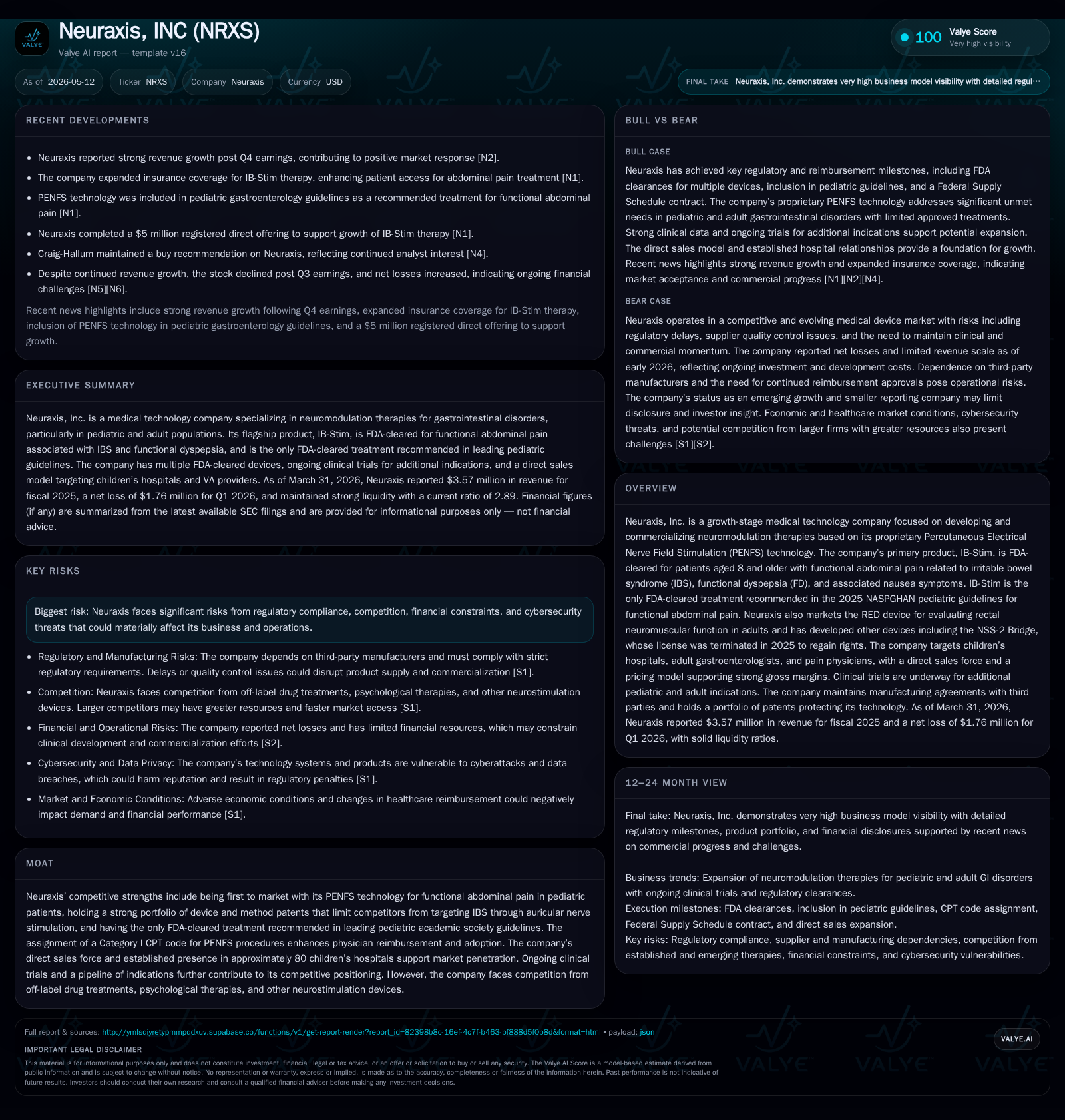
In its May 2026 10-Q, Neuraxis reported a significant rise in quarterly net sales to approximately $1.6 million, reflecting growing adoption of its FDA-cleared IB-Stim PENFS device. This growth is supported by strategic execution around reimbursement with the Category I CPT code effective January 2026 and a Federal Supply Schedule contract awarded in late 2025. While the company continues to run operating losses, its balance sheet shows $7.1 million in cash and modest debt, underlining manageable leverage amid capital needs. Neuraxis’ unique product portfolio and patent moat position it as a front-runner in pediatric neuromodulation for gastrointestinal disorders, with ongoing clinical trials driving expansion potential.
Recent Quarterly Operating Developments and Market Implications
Neuraxis’ latest Form 10-Q filing dated May 12, 2026, anchored the company’s near-term operational progress [S2]. Notably, Neuraxis disclosed preliminary unaudited Q1 net sales of approximately $1.6 million, a substantial increase from roughly $0.9 million in Q1 2025 [S3]. This jump reflects stronger commercial traction for its flagship IB-Stim device based on proprietary Percutaneous Electrical Nerve Field Stimulation (PENFS) technology targeting pediatric functional abdominal pain.
Gross profit was preliminarily reported at around $1.4 million with an operating loss of $1.7 million in Q1, consistent with expected scaling costs in sales and marketing efforts [S3]. Importantly, no material changes were reported concerning risk factors or liquidity challenges beyond what was previously outlined [S2]. The company’s ATM equity offering capacity of up to $6.27 million remains available as a financial flexibility lever [S3].
These forward steps coincide with executing key market access enablers such as the January 2026 implementation of Category I CPT code 64567 for PENFS procedures—a critical reimbursement milestone that standardizes physician billing and incentivizes adoption [S1]. Additionally, the December 2025 Federal Supply Schedule (FSS) contract positions IB-Stim favorably within the U.S. government healthcare procurement framework [S1].
Business Model and Product Portfolio: Core Technologies Driving Treatment Adoption
Neuraxis generates revenue primarily through the direct sale of its IB-Stim system to children’s hospitals and specialized gastroenterology and pain management providers targeting patients aged eight years and older with functional abdominal pain related to irritable bowel syndrome (IBS), functional dyspepsia (FD), and associated nausea [S1]. The device’s regulatory clearance as a Class II medical device by the FDA underscores its safety and efficacy credentials.
IB-Stim's standing is bolstered by exclusive endorsement as the only FDA-cleared treatment recommended in the influential North American Society of Pediatric Gastroenterology, Hepatology, and Nutrition (NASPGHAN) guidelines updated in May 2025 [S1]. This guideline inclusion acts as a strong prescription catalyst among pediatric GI specialists.
The company’s product mix also includes the RED device for assessing rectal neuromuscular function in adults—a diagnostic complement to their therapeutic offerings—and formerly licensed products such as NSS-2 Bridge whose rights were retaken post-2025 license termination [S1, S16]. Revenue mechanics revolve around measurable unit sales growth driven by provider adoption fostered via direct sales force engagement, training initiatives aligned with reimbursement optimization, and ongoing clinical validation supporting expanded indications.
Competitive Positioning and Industry Dynamics in Neuromodulation for GI Disorders
Neuraxis occupies a niche intersection between medical devices specializing in neuromodulation and gastrointestinal therapy sectors. Its competitive edge arises from pioneering PENFS technology application in pediatric GI conditions combined with a robust intellectual property portfolio restricting imitators from replicating auricular nerve stimulation methods employed for IBS symptoms [S1].
The assignment of an AMA Category I CPT code further solidifies clinical credibility and eases integration into payer reimbursement systems—a significant hurdle for novel neurostim devices given often fragmented insurance coverage policies [S1]. While competitors include off-label pharmaceutical interventions (e.g., antispasmodics or low-dose antidepressants), psychological approaches (CBT for IBS), and other non-invasive neurostimulation platforms without direct FDA clearance for this indication, Neuraxis benefits from first-mover advantage with a validated pediatric use case.
Supply chain considerations reveal dependency on two principal contract manufacturers without internal production capabilities—introducing risk but maintaining sufficient output levels currently aligning with demand growth trajectory [S12]. Regulatory vigilance mandates strict adherence to manufacturing quality standards under FDA QSR regulations ensuring safety compliance.
Growth Drivers: Regulatory Clearances, Reimbursement, and Clinical Pipeline
Key accelerants underpinning Neuraxis’ growth profile include:
- FDA Clearances: Sustaining approval status for IB-Stim alongside planned supplementary filings targeting adult GI indications builds a diversified addressable market.
- Reimbursement Facilitation: Category I CPT code 64567 effective from Jan 2026 incentivizes providers via relative value units (RVUs) crediting clinical time devoted to PENFS procedures [S1].
- Federal Supply Schedule Contract: Awarded late 2025, enabling IB-Stim deployment within federal health programs expands reach beyond traditional hospital segments [S1].
- Clinical Trials Pipeline: Ongoing studies evaluating PENFS efficacy across broader neuropathic pain and functional GI disorder spectrums anchor future market expansion opportunities via evidence-based label extensions.
- Guideline Endorsement: NASPGHAN endorsement uniquely positions IB-Stim as a standard-of-care option in pediatric GI therapeutic paradigms influencing prescriber behavior substantially.
Together these factors construct a reinforcing growth loop where clinical validation dovetails with payer acceptance and provider uptake.
Risks and Constraints: Regulatory, Competitive, Financial, and Litigation Exposure
Despite growth prospects, Neuraxis faces multi-dimensional risks detailed extensively across filings:
- Regulatory Compliance: As an FDA-regulated entity marketing Class II medical devices, any adverse event reporting lapses or manufacturing non-compliance could trigger costly sanctions or recalls impacting commercial continuity [S14].
- Competitive Pressures: Off-label drug therapies and psychological treatment alternatives remain entrenched first-line options; new device entrants or evolving reimbursement policies could erode market share over time [S15].
- Litigation: Historic legal actions involving allegations around billing practices have largely resolved but underscore potential financial/operational distraction risks; recent settlements included structured payments mitigating immediate exposure [S7,S13,S17].
- Financial Constraints: Persistent operating losses necessitate ongoing capital raises; while available ATM offering provides financial runway extension flexibility, capital markets volatility may impede timely funding at favorable terms [S3,S4,S6].
- Supply Chain Dependence: Reliance on limited contract manufacturers subjects production schedules to third-party disruptions risking inventory shortages during critical demand surges [S12].
- Cybersecurity/Data Privacy: Increasing regulation around patient data handling imposes compliance complexity with expensive breach risks under HIPAA/GDPR regimes potentially elevating operational costs [S20].
Managing these exposures prudently is essential to sustaining investor confidence and commercial momentum.
Key Upcoming Milestones and What Investors Should Monitor
Stakeholders should track several pivotal near-term indicators:
- Clinical Trial Readouts: Data releases from ongoing studies examining broader PENFS applications will be critical validation points influencing label expansion strategies.
- Regulatory Filings: Submission timelines for new indications domestically and abroad will affect international market penetration feasibility.
- Commercial Metrics: Sequential quarterly revenue trends post-CPT code rollout will provide tangible evidence of provider adoption pace and payer acceptance.
- Federal Supply Schedule Sales Uptake: Visibility into government contracting revenues via FSS channels will illuminate penetration depth within this segment.
- Cash Flow Management: Monitoring cash burn rates versus financing activities including ATM offering utilization will clarify financial runway sufficiency given ongoing operating losses.
Management commentary on these aspects during earnings calls or filings will be valuable directional signals.
Latest Financial Position and Liquidity Snapshot
Latest financial snapshot
| Metric | Value | Period |
|---|---|---|
| Cash & equivalents | $7mm | |
| 2026-03-31 | ||
| Current assets | $8mm | |
| 2026-03-31 | ||
| Current liabilities | $3mm | |
| 2026-03-31 | ||
| Current ratio | 2.89x | |
| 2026-03-31 |
Source: SEC companyfacts cache [F1].
A concise summary of Neuraxis’ financial standing as of March 31, 2026 is as follows [F1]:
| Metric | Value |
|---|---|
| Cash & Equivalents | $7.08 million |
| Total Debt | $166 thousand |
| Current Ratio | 2.89 |
| Latest Annual Revenue | ~$3.57 million |
The company maintains a strong liquidity position with cash far exceeding outstanding debt levels, yielding an ample current ratio close to three that provides operational flexibility amid scaling investments. However, Neuraxis continues incurring net losses attributable to R&D intensiveness inherent in nascent therapeutic device commercialization phases. Sustained profitability remains a medium-term target dependent on expanded market acceptance.
This analysis is based exclusively on information explicitly available from public SEC filings through May 12, 2026 () and companyfacts data ([F1]). No speculative forward-looking estimates or investment advice are provided herein.
Disclaimer: This is research-only, informational analysis and not investment advice. It may include AI-generated interpretation and general industry context. Always verify important details using primary sources.

Comments