
CareView Communications Confronts Liquidity Squeeze While Expanding Federal Footprint
CareView navigates critical liquidity constraints underpinned by credit agreement extensions while leveraging government contracts and a modular patient monitoring platform to target healthcare safety improvements.
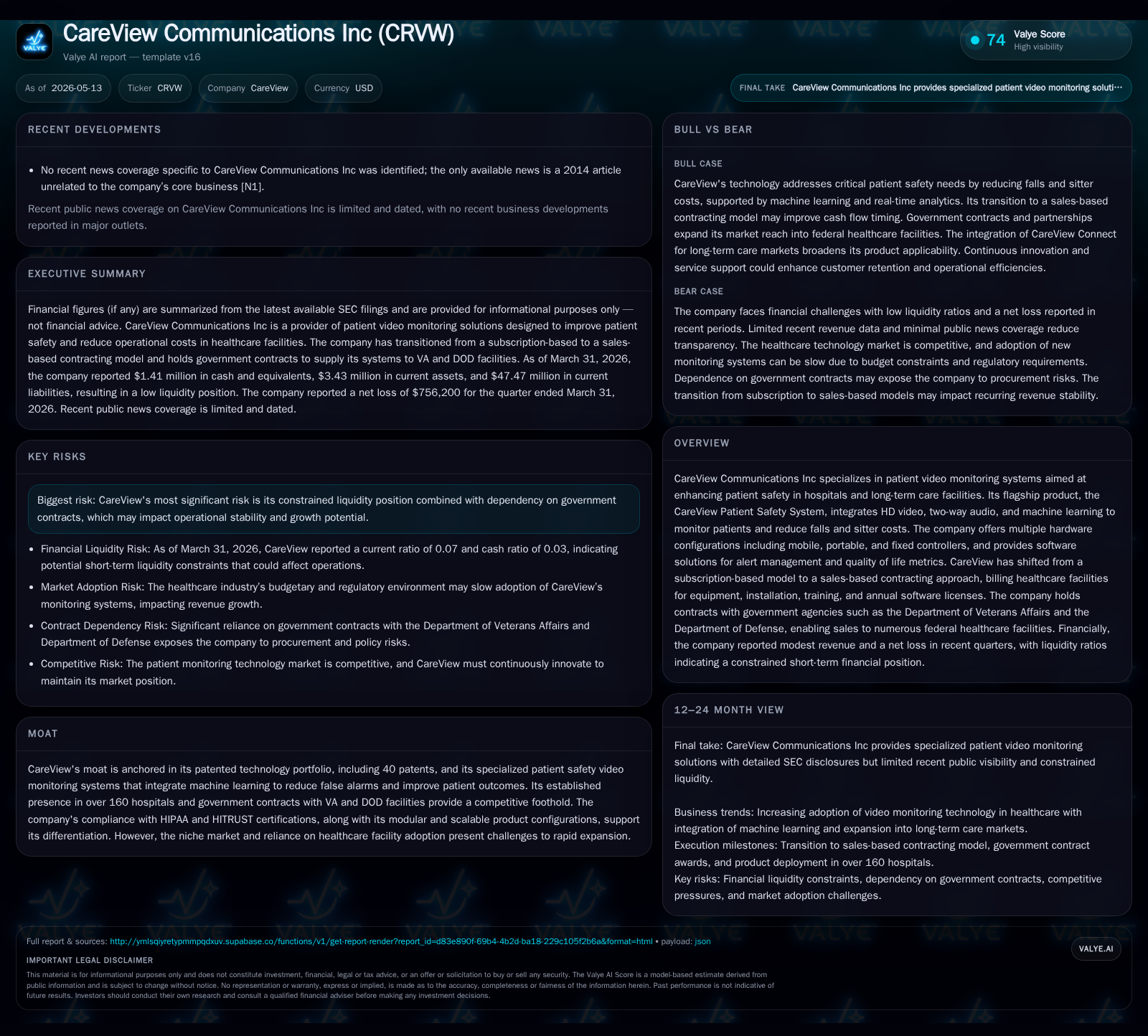
In its latest quarterly filing, CareView Communications disclosed an extension of its credit agreement maturity to June 30, 2026, underscoring pressing liquidity challenges with a current ratio of 0.07 and limited cash reserves. Operationally, the company continues to expand its footprint in federal healthcare facilities through specialized patient monitoring solutions that blend HD video, two-way audio, and machine learning-driven alarm management. CareView’s transition from subscription-based to sales-based contracts, notably through the HealthTrust GPO, supports recurring software licensing revenue embedded in equipment sales. The firm’s competitive moat rests on patented technology and compliance certifications that secure government contracts but also highlight risks tied to liquidity pressure and concentration in federal customers.
Latest Quarterly Developments and Operational Implications
CareView Communications’ most recent quarterly report dated May 13, 2026 [S2] marks a critical juncture focused squarely on its financial positioning amid continuing operational progress. The company announced a Fourteenth Amendment extending the maturity date of its credit agreement to June 30, 2026 [S3], providing only a narrow runway for addressing liquidity pressures. Financially reflected by a stark current ratio of just 0.07 [F1], CareView faces a sharp imbalance between current assets ($3.43 million) and current liabilities ($47.47 million) as of March 31, 2026 [F1]. Cash and equivalents stood at approximately $1.41 million [F1], crystallizing a tight liquidity profile that constrains near-term financial flexibility.
While this capital structure highlights significant leverage stress—supported cautiously by debt documentation primarily dated from earlier periods [F1]—the company remains operationally engaged with ongoing contract deployments and service delivery under its business model [S2]. The extended credit agreement remedies provide temporary relief but underscore urgent refinancing or capital-raising imperatives that will define execution viability beyond mid-2026.
CareView’s Patient Monitoring Model: Technology and Contract Evolution
CareView operates in a specialized niche offering patient safety video monitoring systems tailored for hospital environments and long-term care facilities. Its flagship CareView Patient Safety System integrates high-definition video capture with two-way audio communication interfaces coupled with machine learning algorithms that power advanced alarm management — reducing false positives that commonly plague clinical video surveillance setups.
The product suite includes modular hardware configurations: mobile units suited for flexible deployment; portable systems for bedside monitoring; and fixed installations engineered for continuous oversight [S1]. This versatility allows tailored applications fitting diverse institutional workflows.
A crucial strategic shift undertook since late-2020 is the transition from pure subscription models to sales-based contracting arrangements executed through HealthTrust Group Purchasing Organization (GPO) agreements.[S1] Under these contracts, rather than solely generating recurring revenue from subscriptions, CareView bills healthcare providers for equipment acquisition plus installation and training while embedding annualized software license fees within these sales contracts—blending upfront capital inflows with steady-state recurring revenue components.
This contracting structure eases adoption hurdles by framing purchases as capital investments combined with operational license costs. It has facilitated expansion into federal government channels notably via Department of Veterans Affairs (VA) and Department of Defense (DoD) contracts which collectively span deployment across more than 160 hospital facilities. Such government engagement enhances revenue visibility through multi-year contract frameworks while reinforcing regulatory compliance standards critical in healthcare IT ecosystems.
Competitive Landscape and Industry Dynamics in Healthcare Safety Systems
CareView’s competitive moat is materially anchored by its intellectual property comprising around 40 issued patents covering technological innovations in patient video monitoring systems, including proprietary machine learning techniques for false alarm reduction—a longstanding pain point limiting usability of conventional nurse call or sitter replacement technologies.
Additionally, the firm’s HITRUST certification alongside rigorous HIPAA compliance provides vital trust credentials essential for penetration into tightly regulated clinical environments where data security cannot be compromised. These factors collectively erect barriers against commoditized entrants or generalized surveillance offerings lacking specialization.
Despite such differentiation advantages within this niche market segment, industry dynamics remain challenging. Adoption rates within healthcare institutions are subject to elongated decision cycles driven by budgetary constraints, risk aversion toward new tech platforms impacting clinical workflows negatively if poorly integrated, and increasing demands for demonstrable ROI in terms of fall reduction or sitter labour savings [S1]. Furthermore, the specialized nature limits scale compared to large healthcare IT vendors offering broader EHR or clinical workflow platforms; however, this narrower focus mitigates direct pricing competition yet caps rapid growth velocity.
Drivers Expanding Demand for Patient Monitoring Solutions
Several structural tailwinds underpin incremental demand for CareView's monitoring technology:
- Government Facility Expansion: Continued focus on deploying advanced patient safety technologies across VA and DoD hospitals sustains contract pipeline momentum supported by stable federal budgets earmarked for veteran care enhancements [S1].
- Demographic Trends: Aging U.S. population increases reliance on long-term care settings where fall prevention constitutes a critical safety metric driving adoption of automated monitoring solutions.
- Technological Advancements: Improvements in machine learning models elevate alarm accuracy enabling nursing staff to prioritize interventions effectively thus lowering labor costs traditionally associated with constant sitter presence.
- Healthcare Cost Containment Pressure: Hospitals face rising scrutiny over patient safety outcomes directly linked to reimbursement levels incentivizing investment in technologies that demonstrably reduce falls or adverse events.
With cash reserves at about $1.4 million juxtaposed against concentrated current liabilities nearing $47.5 million [F1], the extremely low current ratio signals limited operational cushion affecting supplier relationships or capacity for incremental investment [S2],[F1]. While amendment extensions provide breathing room until June-end 2026 [S3], success hinges on timely refinancing or new financing sources combined with sustained revenue generation.
Moreover, CareView exhibits meaningful concentration risk rooted in reliance on government contracts principally with VA and DoD agencies whose budgets inherently carry susceptibility to annual appropriations variability or political shifts impacting procurement timing. Delays or reduced award volumes directly affect backlog visibility and revenue cadence given the specialized nature restricting rapid customer diversification.
Finally, evolving regulatory landscapes regarding data privacy or reimbursement criteria could compel costly product reengineering or undermine competitive positioning if advancements by rivals surpass CareView’s patented offerings [S1]. Failure to maintain technological leadership risks customer attrition particularly amongst price-sensitive public sector buyers.
Upcoming Catalysts and Monitoring Points for Execution Progress
Looking ahead through mid-2026, key milestones will revolve around managing capital structure pressures alongside growth execution:
- Credit Maturity Refinancing: The extended loan maturity set at June 30 calls attention to timely negotiation outcomes regarding extension terms or alternative financing sources necessary to avert distress scenarios [S3].
- HealthTrust GPO Contract Expansion: Progress in upselling existing governmental members or onboarding new hospital groups via expanded contracts would enhance recurring licensing revenues embedded within bundled sale structures [S1].
- Operational Deployment Metrics: Quarterly disclosures highlighting unit installations per facility or increase in annualized software license billings serve as concrete indicators of adoption traction amid operational headwinds [S2].
- Product Innovations: Integration advancements such as improved machine learning alert accuracy or enhanced modular deployment options could unlock fresh market opportunities expanding beyond legacy hospital sectors.
Shareholders and observers should monitor upcoming reporting windows closely for signaling on refinancing plans combined with updates around federal procurement notices which provide real-time cues toward sustaining growth momentum under liquidity duress.
Financial Overview: Balance Sheet Snapshot and Credit Condition
Latest financial snapshot
| Metric | Value | Period |
|---|---|---|
| Cash & equivalents | $1,411,435 | |
| 2026-03-31 | ||
| Current assets | $3,431,818 | |
| 2026-03-31 | ||
| Current liabilities | $47,469,268 | |
| 2026-03-31 | ||
| Current ratio | 0.07 | |
| 2026-03-31 |
Source: SEC companyfacts cache [F1].
While total debt figures derive from an older dataset (circa end-2012), they historically hovered near $31 million indicating prolonged leverage presence possibly still relevant absent later disclosures [F1]. The updated credit agreement amendments inform investors about active creditor negotiations providing finite timeline relief capped at June-end this year [S3]. Tying financial health tightly into operational coverage underscores how immediate refinancing outcomes will critically shape CareView’s ability to capitalize on its technological advantages amid government contract channels.
This analysis reflects information available up to May 13, 2026. It does not constitute investment advice but aims to present an informed perspective based on public SEC filings and reported company developments.
Disclaimer: This is research-only, informational analysis and not investment advice. It may include AI-generated interpretation and general industry context. Always verify important details using primary sources.

Comments