
21Shares Ethereum ETF Elevates Ether Exposure with Strategic Staking Integration
The latest quarterly filing outlines operational stability alongside governance constraints and staking reward opportunities shaping TETH’s market dynamics.
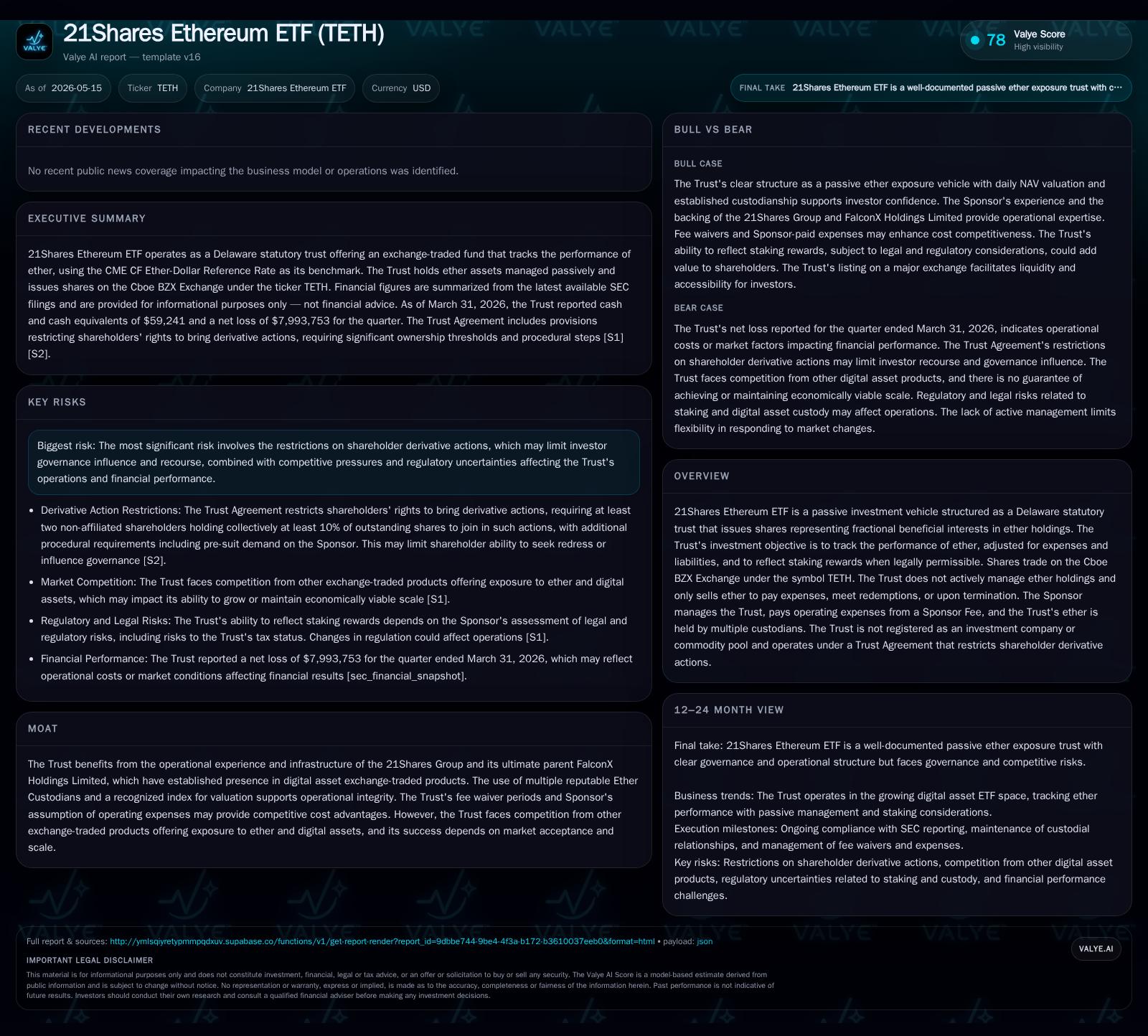
In its May 2026 10-Q filing, 21Shares Ethereum ETF confirmed no material changes in risk profile but reinforced significant shareholder derivative action restrictions. The Trust continues to pursue a passive, fully backed ether exposure with built-in optionality for staking rewards under conservative legal evaluation. While benefiting from a reputable custodian network and backing by FalconX Holdings, the ETF faces governance challenges uncommon in listed products that may limit investor recourse. Future growth depends heavily on Ethereum network developments, regulatory clarity around staking, and efficient cost management through Sponsor fee waivers.
Latest Quarterly Operational Update: Key Takeaways from the May 2026 Filing
The Trust’s most recent filing on May 15, 2026 [S2] reconfirms the stability of previously disclosed risk factors but prominently underscores governance frameworks that limit shareholder litigation capabilities. The Trust Agreement imposes a high bar for derivative suits—shareholders must collectively own at least 10% of outstanding shares and be non-affiliated to initiate or maintain such actions. This procedural threshold far exceeds typical public company arrangements and introduces practical impediments given DTC book-entry ownership obscuring beneficial holders' identities.
Operationally, the Trust maintains its model of passively holding ether without active trading or portfolio rebalancing outside of creation/redemption activity or expense payment. No material regulatory changes or legal proceedings were reported this quarter [S2]. The filing reiterates that the Trust continues monitoring market conditions, including liquidity regime shifts and network events affecting ether valuation metrics and NAV accuracy.
Business Model Deep Dive: Passive Ether Exposure with Staking Optionality
21Shares Ethereum ETF is structured as a Delaware statutory trust offering fractional interests in a pool of actual ether tokens [S1]. Its core investment goal is tracking the CME CF Ether-Dollar Reference Rate while adjusting for fees and liabilities. Uniquely, the Trust has scope to incorporate staking rewards into shareholder returns if assessed by the Sponsor as legally prudent—balancing yield enhancement against compliance risks that could jeopardize the Trust’s tax treatment [S1].
The Trust does not engage in derivatives trading nor commodity futures activities; all exposure stems from direct ether holdings safeguarded by multiple custodians: Coinbase Custody, BitGo entities (including the New York trust), and Anchorage Digital Bank [S1]. This multi-custodian approach reduces single-point failure risk while catering to institutional-grade custody standards.
Sponsor responsibilities encompass operating expense management funded by a structured Sponsor Fee, which has included periods of fee waivers designed to preserve competitive expense ratios vis-à-vis alternative Ether ETFs [S1; Valye report excerpt]. No active portfolio management or speculation occurs; ether turnover arises solely from share creations/redemptions or administrative outflows.
Competitive Positioning Within the Digital Asset ETF Ecosystem
Within the crowded field of ether-based exchange-traded products, 21Shares Ethereum ETF leverages its affiliation with FalconX Holdings Limited—a prominent digital asset platform—to provide operational expertise and trust infrastructure robustness. The diverse custodian lineup offers distinctive security advantages compared to single-custodian competitors, addressing core industry concerns over crypto custodial risk.
In terms of cost structure, periodic fee waivers constitute a strategic tool deployed by 21Shares’ Sponsor to achieve a pricing edge. However, the shareholder agreement’s tight restrictions on derivative litigation diverge from peer norms in publicly traded digital asset funds, potentially raising governance concerns among institutional investors sensitive to legal recourse protections.
Given these trade-offs, TETH appeals primarily to investors valuing direct ether backing combined with operational integrity but accepting limited governance influence due to contractual constraints embedded within Delaware Statutory Trust legal frameworks.
Growth Drivers: Staking Rewards, Market Acceptance, and Cost Advantages
Staking rewards integration stands as a pivotal growth lever. The Ethereum protocol's transition towards proof-of-stake consensus (Ethereum 2.0 updates referenced as Serenity) opens avenues for yield enhancement through locked-in token rewards distributed by validators. TETH’s discretionary ability to capture these rewards and pass them partially onto shareholders introduces margin expansion potential while adhering cautiously to legal guardrails that protect the Trust's tax status [S1; Valye excerpt].
The broader market acceptance of digital asset ETFs continues progressing amid growing institutional adoption of regulated crypto exposure vehicles. Demand expansion benefits from increased penetration into diversified portfolios seeking liquid alternatives to direct wallets or unregulated exchanges.
Fee waiver arrangements executed by the Sponsor further enhance relative attractiveness versus competitors, particularly important in an environment where pricing pressures have compressed margins industry-wide. These temporary expense subsidies lower total expense ratios borne by shareholders and can stimulate incremental net inflows if sustained.
Risks and Governance Constraints: Derivative Action Restrictions and Regulatory Ambiguity
A defining risk dimension unique to this Trust entails restrictive derivative action provisions governed under Section 7.4 of the Trust Agreement enforced pursuant to Delaware Statutory Trust Act Section 3816(e). Herein, shareholders face a procedural gauntlet requiring:
- At least two non-affiliated shareholders,
- Collective ownership of minimum 10% outstanding shares,
- Pre-suit demand processes granting broad discretionary control to the Sponsor over litigation initiation or compromise decisions,
- Maintenance of ownership threshold throughout any lawsuit duration.
These stipulations contrast with conventional corporate derivative rights frameworks where single shareholders can often proceed. Given shares are held in book-entry form via DTC without public beneficial owner information disclosure, coordinating requisite shareholder groups is arduous—effectively limiting investor enforceability of fiduciary claims regardless of merit [S5,S7].
On the operational front, inherent technological risks persist tied to Ethereum network innovations including software upgrades like Serenity that implement shard chains and staking protocols. Missteps or contentious forks could materially impair ether value underpinning TETH shares [S1]. Additionally, price volatility remains volatile historically as detailed by past intrayear swings exceeding multiple fold differences.
Regulatory uncertainties linger around classification and treatment of staking rewards within exchange-traded products—a landscape still evolving globally—potentially constraining aggressive staking integration despite latent return benefits.
What Investors Should Monitor Next: Shareholder Rights, Regulatory Environment, and Market Demand
Key milestones demanding close observation include:
- Any amendments or expirations related to Sponsor fee waivers outlined in future periodic disclosures that could impact net expense ratios.
- Regulatory guidance or enforcement actions clarifying legality of integrating staking rewards directly within registered securities products such as ETFs.
- Ethereum network developments including forthcoming software upgrades or governance decisions altering staking economics or token issuance policies.
- Evidence from NAV premium/discount trends indicating liquidity stresses or shifts in market appetite for physically-backed ether ETPs versus derivatives-based offerings.
- Potential shareholder activism attempts challenging restrictive governance clauses or prompting reforms amidst increasing institutional investor scrutiny.
These indicators collectively will shape TETH’s scalability prospects alongside competitive positioning in a rapidly maturing digital assets ecosystem.
Brief Financial Overview: Expense Management and Capital Position
Financial disclosures from the latest quarter highlight that while specific cash balances are not newly reported beyond $59K as per prior snapshots [F1], liquidity needs remain modest given passive investment vehicle characteristics [F1,S2]. Operating expenses continue being offset substantially by Sponsor fee payments under waiver arrangements noted historically which preserve manageable total expense layer effects for shareholders.
Given minimal operational complexity absent active trading desks or leverage structures typical of other fund types, capital adequacy concerns appear minimal. The primary financial levers relate instead to maintenance of custody cost efficiencies and prudent expense control aligned with competitive pressures across Ether ETP providers.
This analysis relies exclusively on publicly filed SEC documents dated up through May 2026 combined with contextual insights grounded in Delaware statutory trust law interpretation and current digital asset market structures. It does not constitute investment advice but aims to elucidate nuanced operational features critical for understanding 21Shares Ethereum ETF’s strategic posture within its niche market segment.
Disclaimer: This is research-only, informational analysis and not investment advice. It may include AI-generated interpretation and general industry context. Always verify important details using primary sources.

Comments