
Murano Global's Strategic Debt Restructuring Amid Market Pressure
Murano faces Nasdaq listing compliance challenges and is actively pursuing a consensual restructuring of its senior secured notes while exploring corporate reorganization options.
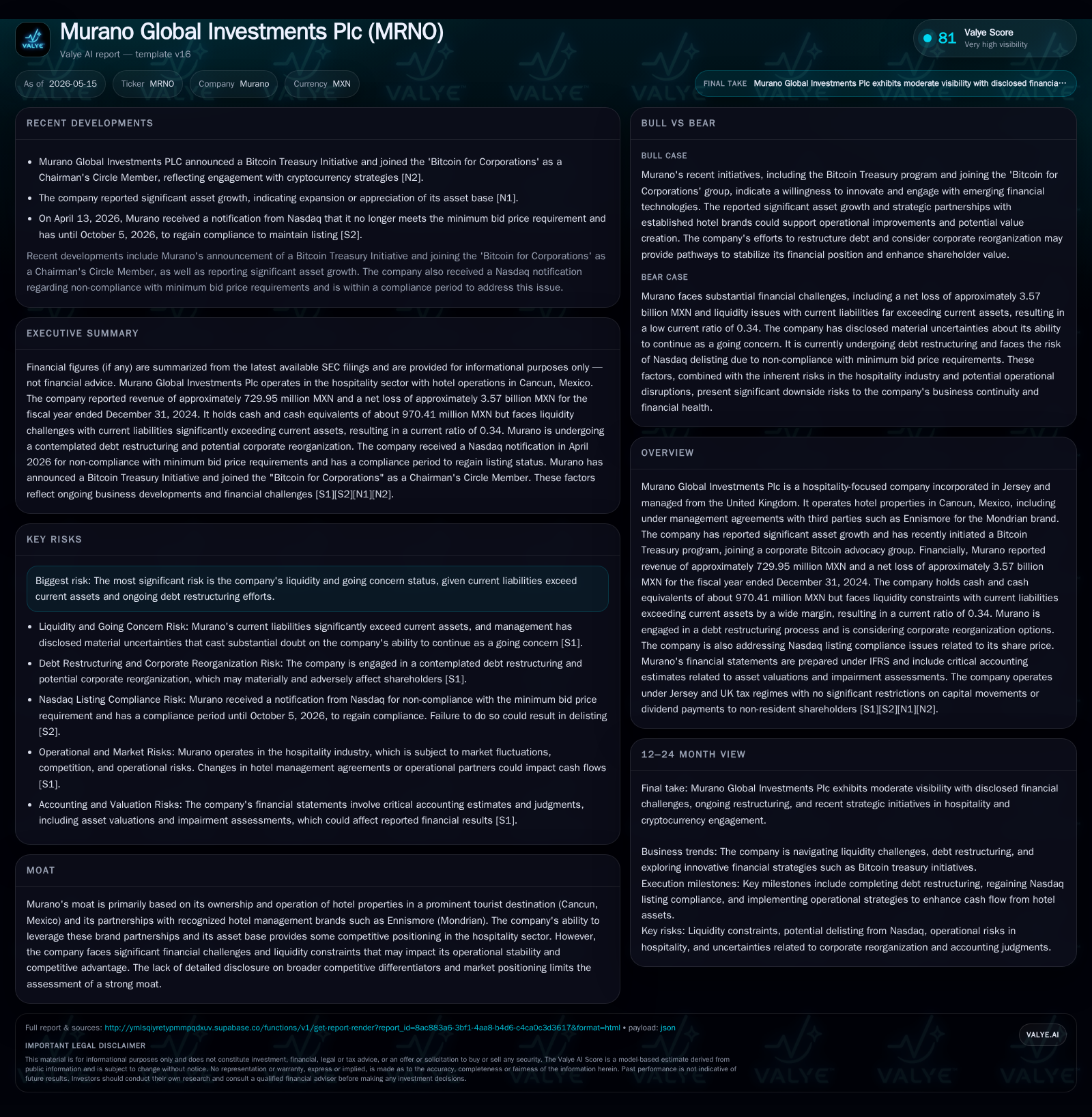
Murano Global Investments PLC received a Nasdaq notification in April 2026 for failing to maintain the minimum $1 per share bid price, initiating a compliance period through October 5, 2026 to regain compliance [S2]. Concurrently, the company announced an agreement in principle on restructuring terms for its $300 million senior secured notes due 2031 with an ad hoc group of noteholders [S3], addressing ongoing payment defaults and liquidity pressures. Murano’s business centers on hotel assets in Cancun operated under established brand management agreements, providing strategic positioning despite financial strain [S1][N1]. Liquidity constraints and going concern doubts pose critical near-term risks. The evolving debt restructuring process and Nasdaq compliance outcome are key milestones to monitor.
Nasdaq Compliance Warning: Immediate Market Implications
In April 2026, Murano Global Investments PLC received a notification letter from Nasdaq indicating it no longer meets the minimum bid price requirement of $1 per share after closing below this threshold for at least 30 consecutive business days [S2]. The company has until October 5, 2026, to regain compliance by maintaining a closing bid price at or above $1 for ten consecutive trading days. Failure to do so may lead to delisting unless an extension is granted based on other listing criteria.
This notice underscores risks for shareholders as diminished share price can reduce liquidity and investor confidence. Delisting would further impair Murano’s ability to raise capital through equity or equity-linked financings, complicating efforts to address existing financial distress.
Debt Restructuring Developments and Strategic Pathways
On March 10, 2026, Murano announced an agreement in principle with an ad hoc group of holders regarding the consensual restructuring of its $300 million aggregate principal amount of Senior Secured Notes due in 2031 bearing an 11% coupon [S3]. This move aims to resolve prolonged payment defaults since late 2025 and alleviate immediate debt servicing burdens.
This restructuring represents a pivotal step toward stabilizing operations while avoiding adversarial default proceedings. Concurrently, management is evaluating potential corporate reorganization strategies post-restructuring. These may involve changes in ownership structures, hotel management agreements, or operational partnerships designed to enhance cash flow generation from the Cancun hotel portfolio [S1].
Business Model and Asset Base: Hospitality Focus in Cancun
Murano’s core operations revolve around hospitality real estate assets in Cancun—a prominent international tourism destination known for steady leisure demand [N1][S1]. Its portfolio includes hotel properties managed under agreements with third-party operators such as Ennismore’s Mondrian brand. This approach leverages premium branding and operational expertise without direct involvement in day-to-day hotel management.
Revenue primarily comes from room rentals supplemented by ancillary services typical of upscale hospitality offerings. While Cancun benefits from structural demand factors like rising global travel trends, revenues remain subject to cyclical fluctuations influenced by macroeconomic conditions and extraordinary events.
Competitive Positioning: Brand Partnerships and Asset Strengths
Murano’s competitive advantages derive from ownership of prime beachfront properties combined with established brand partnerships that enhance guest experience credibility and marketing reach [S1][N1]. The Mondrian affiliation contributes operational sophistication and elevates customer loyalty.
However, the company’s financial vulnerabilities constrain investment capacity necessary for property maintenance or enhancements critical in luxury hospitality markets. Changes in partner management or contract terms could also disrupt operations.
Growth Catalysts: Corporate Reorganization and Asset Strategies
Unlike traditional hospitality growth drivers such as rate increases or inventory expansion, Murano’s prospective growth depends largely on strategic initiatives linked to corporate restructuring [S1]. Revisiting hotel management contracts or partnership frameworks may unlock operational efficiencies or additional cash flow potential.
Previous considerations of adjunct financial strategies like Bitcoin treasury holdings have been paused as focus narrows exclusively on core Mexican real estate assets and debt resolution [S18]. Near-term growth indicators will likely center on successful restructuring execution and announcements related to operational partnerships.
Risks and Constraints: Liquidity Challenges and Going Concern Doubts
Murano faces substantial challenges typical of leveraged hospitality operators with high fixed-cost assets. For fiscal year ending December 31, 2024, reported revenue was approximately 729.95 million MXN contrasted with a net loss of about -3.57 billion MXN—reflecting operating inefficiencies amplified by interest expenses [F1].
Liquidity metrics highlight critical stress: cash & equivalents stood near 970 million MXN versus current liabilities around 4.36 billion MXN yielding a low current ratio of approximately 0.34 [F1], underscoring difficulties meeting short-term obligations without external funding.
Auditor reports have expressed substantial doubt about Murano’s ability to continue as a going concern absent refinancing or operational improvements [S1]. Interest payment defaults since September 2025 further restrict negotiation leverage but have catalyzed the consensual restructuring process [S15][S20]. Nasdaq delisting risk adds another layer of funding uncertainty.
Near-Term Milestones: Market Price Recovery, Restructuring Progress, Operational Metrics
Market participants should monitor key developments through late 2026:
- Nasdaq bid price: Sustained recovery above $1 per share by early October is mandatory to avoid delisting actions [S2].
- Definitive restructuring documentation: Completion will clarify debt obligations and covenant terms impacting liquidity forecasts [S3][S21].
- Corporate reorganization announcements: Changes in hotel management contracts or partnerships may indicate shifts in asset monetization prospects [S1].
- Operational cash flow trends: Quarterly data revealing stabilization or improvement would contextualize progress amid macroeconomic headwinds.
Current Financial Profile: Liquidity Snapshot and Debt Overview
Heavy leverage concentrated in high-coupon senior secured notes has led to defaults highlighting urgent refinancing needs and reliance on creditor cooperation evidenced by ongoing negotiations [S6][S21]. The disparity between liquid assets and short-term obligations underscores vulnerability absent successful resolution.
Disclaimer: This analysis is based solely on publicly available filings as cited and does not constitute investment advice. Readers should conduct independent evaluation before making decisions concerning Murano Global Investments PLC securities or operations.
Disclaimer: This is research-only, informational analysis and not investment advice. It may include AI-generated interpretation and general industry context. Always verify important details using primary sources.

Comments