
Cardiff Lexington Corp Confronts Extended Receivables and Financing Needs Amid Healthcare Niche Expansion
The company’s latest quarter highlights liquidity challenges tied to its plaintiff-related orthopedic care model and ongoing acquisition ambitions.
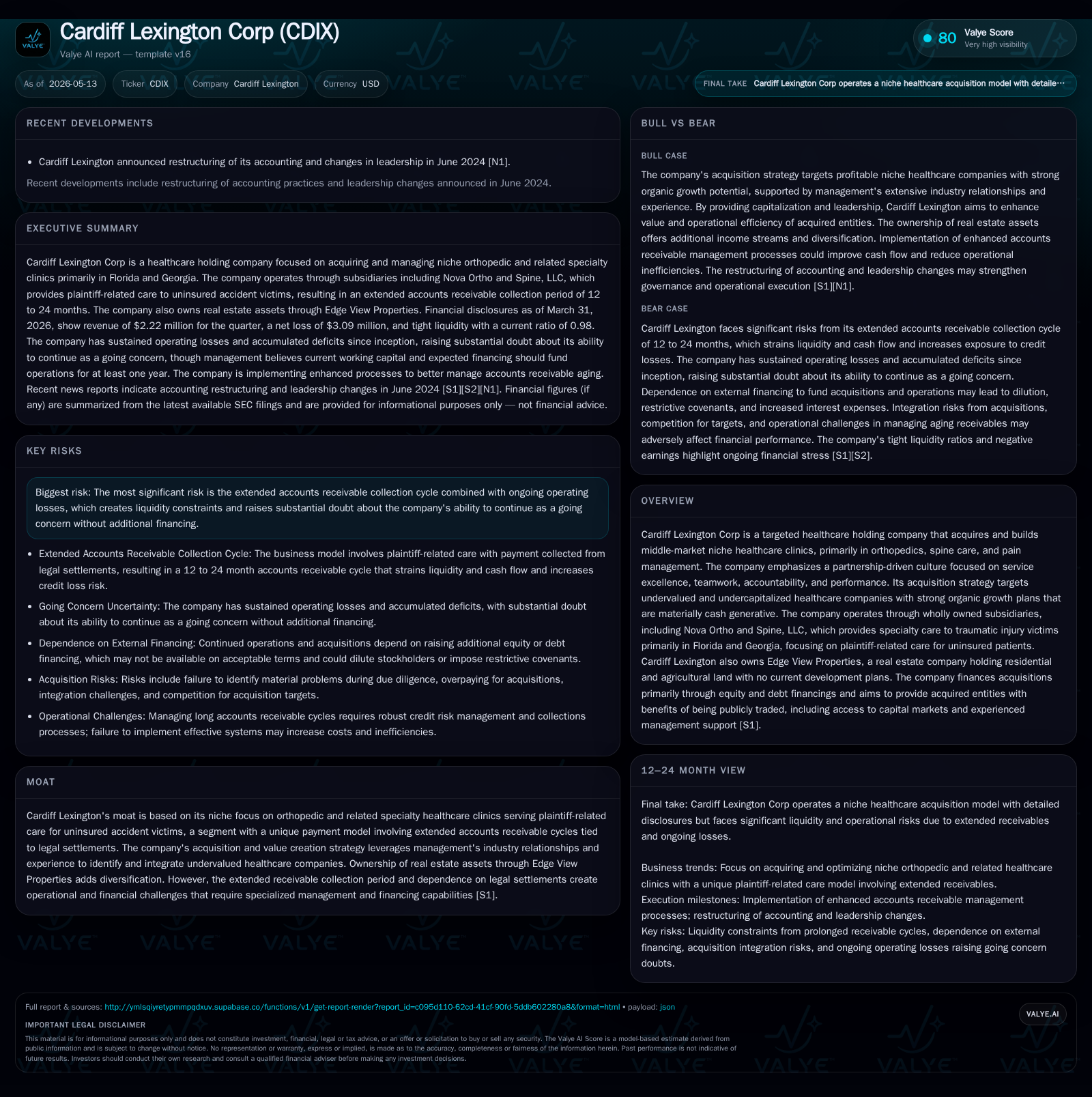
Cardiff Lexington Corp’s 10-Q filed May 13, 2026, reveals continuing operational strain from its extended accounts receivable cycles typical of plaintiff-related healthcare. The company’s business model revolves around acquiring orthopedic and spine care clinics focused on uninsured accident victims whose payments are contingent on long legal settlement processes, leading to inherent liquidity pressures. Cardiff Lexington’s growth strategy depends heavily on additional financing to fund acquisitions, with a grace period of at least one year expected before liquidity constraints may surface. While the niche focus provides some competitive advantage, risks stemming from slow cash conversion and reliance on external capital remain significant near-term concerns.
Recent Operating Update
Cardiff Lexington Corp's latest quarterly filing dated May 13, 2026 ([S2]) reaffirms the company’s ongoing challenge in managing liquidity under its unique plaintiff-related orthopedic care business model. The firm continues to rely heavily on an accounts receivable collection cycle that stretches between 12 and 24 months, a consequence of payment being contingent on successful legal settlements in personal injury cases. This prolonged cash conversion cycle remains central to the company's operational and financial dynamics.
The filing discloses no material changes in risk factors since the prior annual report but reiterates substantial doubt about going concern due to sustained operating losses and accumulated deficits since inception ([S2], [S1]). Management projects sufficient working capital for at least the next year based on existing operating plans but acknowledges dependence on new financing rounds — equity or debt — ranging between $5 million and $10 million to support acquisitions and sustain operations ([S1], [S20]). These developments underline an imperative near-term focus on capital markets access.
Business Model
Cardiff Lexington functions as a targeted healthcare holding company focusing on acquiring middle-market niche clinics primarily within orthopedics, spine care, and pain management specialties ([S1], [S26]). Revenues arise almost entirely from its wholly owned subsidiary Nova Ortho and Spine, LLC, which operates outpatient clinics predominantly servicing plaintiffs who are uninsured accident victims across Florida and Georgia.
The value proposition hinges upon possessing medical expertise combined with specialized knowledge of plaintiff-related billing cycles. Patients typically initiate lawsuits against defendants for trauma injuries; as a result, payment for medical services is guaranteed by letters of protection from patients' attorneys ensuring reimbursement upon settlement ([S1], [S13]).
A key pillar of Cardiff Lexington’s financial approach is retaining these personal injury accounts receivable rather than selling them at discount rates, aiming for long-term income streams. This strategy enhances profitability but requires pacing investments carefully against cash inflows given the extensive lag until settlements mature ([S1]).
Additionally, Cardiff Lexington holds real estate assets through Edge View Properties. These comprise residential and agricultural land parcels without active development plans but serve as diversification outside core healthcare operations ([S1], [S18]).
Industry Structure and Competitive Position
Cardiff Lexington occupies a highly specialized niche within healthcare delivery centered on plaintiff-related orthopedic services. This segment differs markedly from traditional healthcare providers who generally have shorter billing cycles facilitated through insurance or government programs.
Plaintiff-related business necessitates nuanced understanding of legal frameworks impacting payment timing and credit risk management. While this niche creates barriers for standard healthcare competitors lacking such expertise, it also imposes considerable financial constraints.
The company leverages a centralized acquisition model seeking undercapitalized mid-sized practices with geographic focus in the Southeastern U.S., targeting clinics possessing strong organic growth potential yet requiring capital infusion for expansion or stabilization ([S1], [S6]). By folding these entities into a publicly traded platform with financing capabilities and operational support, Cardiff Lexington aims to build scale while mitigating typical mid-market clinic limitations.
However, the extended receivable days naturally restrict free cash flow generation compared to peers reliant on insurance payors with brisk payment terms, thus exposing Cardiff Lexington to heightened liquidity risk absent sufficient external funding sources.
Growth Drivers
Growth is tentatively anchored on two primary vectors:
Acquisitions: The company’s strategy underscores continual aggregation of specialty clinics within targeted markets that offer recurring revenue profiles supported by physician practice optimization. The plan includes both outright ownership or majority controlling interests paired with either retained existing management teams or placement of new executive leadership vetted for alignment ([S1], [S9]).
Organic Expansion: Leveraging existing clinics’ footprint, Cardiff Lexington anticipates elevating patient volumes by enhancing utilization rates and broadening service offerings such as interventional pain management and emergency medical condition assessments ([S6]). An expansive network effect derived from centralized back-office resources is expected to improve operational efficiency over legacy stand-alone practices.
Importantly, management's industry experience and dense relationship networks act as deal-sourcing catalysts enabling access to mid-stage companies with strong growth trajectories currently impaired by capitalization gaps or governance limitations ([S1], [S6]).
The real estate holdings via Edge View can potentially evolve into incremental value through future sales or development but represent a longer-term optionality rather than immediate cash-flow contributors ([S18]).
Risks and Constraints
The most pronounced risk remains the protracted accounts receivable cycle extending well beyond traditional healthcare norms. This dynamic stresses cash flow causing:
Credit Exposure: Not all claims culminate in recoveries; losses materialize when cases are dismissed or clients lose trials resulting in unrecovered billings despite letters of protection ([S17], [S13]).
Operational Challenges: Managing such complex receivable aging demands robust credit monitoring infrastructure which has historically been insufficiently systematic based on disclosures; corrective expenditures are anticipated ([S17], [S19]).
Acquisition Integration: Expanding clinic portfolio raises integration complexities including aligning diverse operations across states while preserving quality standards amid resource dilution risks ([S14], [S19]).
Regulatory Compliance: Operating in healthcare entails constant oversight risks including adherence to HIPAA privacy requirements, anti-kickback statutes specifically implicated due to referral relationships within plaintiff-related care, plus state-level construction permits affecting possible expansion opportunities ([S10], [S16], [S23]). Failure here could result in penalties or accreditation loss impacting revenue streams.
Market Concentration: Two major stockholders command roughly 74% voting control limiting minority influence over strategic decisions possibly affecting governance dynamics and investor perceptions ([S21]).
Operationally, quarterly updates on accounts receivable aging metrics, collections efficiency improvements enabled by emerging credit management programs, as well as any reduction in operating loss trends would be closely monitored.
Additionally, signs of expanding clinic utilization rates or opening new locations within current or adjacent markets may signal progress toward scaling objectives outlined by management ([S6]).
Watch also regulatory filings or announcements related to compliance status or any litigation developments given the sector’s scrutiny level.
Finally, scrutinizing capital structure moves such as new financing arrangements or equity raises will provide insight into sustainability pathways.
Financial Profile - Snapshot as of Q1 2026 End (Mar 31)
Latest financial snapshot
*Cash figures date earlier but no newer data available.[F1]
The balance sheet reveals tense working capital conditions underscored by a current ratio of 0.98 reflecting near parity between short-term assets and liabilities. Total debt stands at approximately $815 million with net debt at about $304 million as of March 31, 2026 ([F1]). Operating losses have accumulated historically leading to sizable retained deficit (~$79 million by end FY25) highlighting ongoing profitability challenges despite positive operating income reported for FY25 last reported annual period (line-item details not covered here) [F1]. Such financial factors reinforce dependency on external capital to maintain growth aspirations.
Disclaimer: This analysis is produced solely for informational purposes based on publicly available SEC filings as cited. It does not constitute investment advice or a recommendation to buy or sell securities. Investors should conduct their own due diligence before making any investment decisions.
Disclaimer: This is research-only, informational analysis and not investment advice. It may include AI-generated interpretation and general industry context. Always verify important details using primary sources.

Comments