
Juniata Valley Financial Elevates Earnings Momentum in Q1 While Fortifying Community Banking Roots
Juniata Valley Financial reports robust first-quarter earnings growth supported by operational strength in its established regional banking franchise.
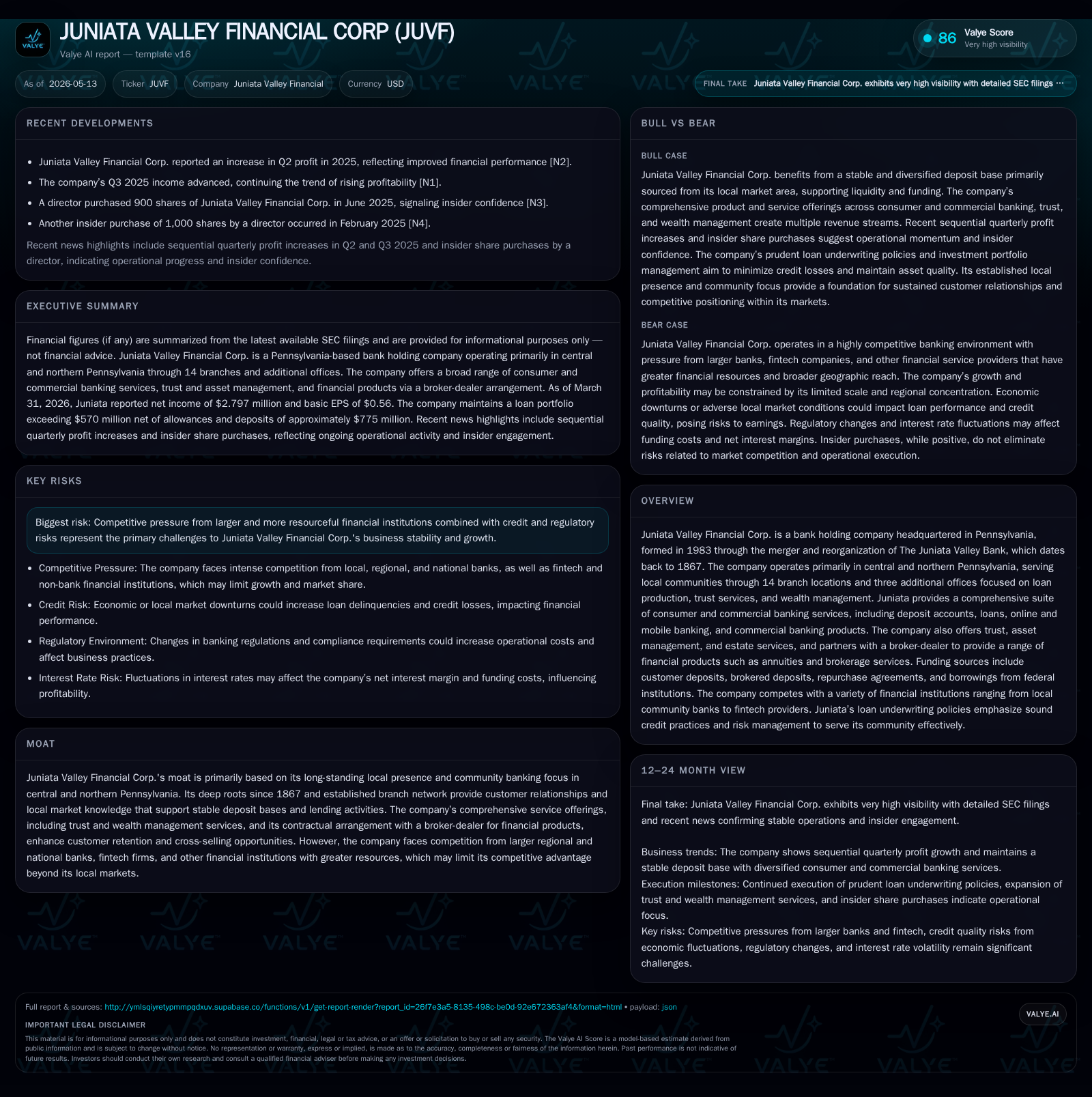
In its latest quarterly filing dated May 13, 2026, Juniata Valley Financial Corp. posted a notable rise in net income to $2.797 million for Q1 2026 from $2.008 million a year earlier, backed by strong core banking performance and disciplined asset management [S2]. Operating with no debt on the balance sheet as of December 31, 2025, the company leverages its long-standing community banking model focused on central and northern Pennsylvania through a network of 14 branches plus specialized offices for loan production and wealth services [S1]. Competitive pressures from larger banks and fintech firms exist, but Juniata’s deep local presence and multi-line financial offerings provide differentiation. Key growth drivers include expanding lending activities, trust and wealth management services, and increasing adoption of digital platforms. Risks center on credit quality vigilance, margin compression risks amid competition, and regulatory compliance costs. Monitoring upcoming management commentary and deposit or loan volume trends will be crucial to gauge continued momentum [S3].
Latest Quarterly Results Spotlight Earnings Growth and Operational Stability
Juniata Valley Financial Corp.’s May 13, 2026 quarterly report reveals a substantial uplift in profitability for the first quarter ended March 31, 2026. Net income soared to $2.797 million compared with $2.008 million for the same period last year, representing approximately a 39% increase driven by strong core banking operations reflecting both solid loan activity and disciplined expense controls [S2]. Basic earnings per share rose accordingly to $0.56 from $0.40 a year prior.
This quarter’s filing underscores a balanced risk posture with no debt outstanding as of December 31, 2025, emphasizing a conservative capital structure conducive to stability and operational flexibility [S2][F1]. The amortized cost versus fair value schedules of held-to-maturity debt securities showed expected maturity distributions aligning with prudent asset-liability management strategies.
Collectively, these results paint a picture of ongoing earnings momentum steered by disciplined credit oversight combined with steady deposit funding anchored in local community relationships.
Business Model Anchored in Community Banking and Diverse Financial Services
Founded through the reorganization of The Juniata Valley Bank dating back to 1867, Juniata Valley Financial operates predominantly as a one-bank holding company deeply rooted in central and northern Pennsylvania markets. Its business model centers around community banking principles fostering close customer connections through an established network that includes 14 full-service branch locations coupled with three strategic offices dedicated to loan production, trust services, and wealth management [S1].
Revenue generation flows mainly from three pillars:
- Loan Products: Commercial loans alongside consumer lending constitute principal interest yielding assets.
- Deposit Accounts: Providing a stable funding base via consumer deposits including now interest-bearing accounts tailored for businesses.
- Wealth & Trust Services: An integrated offering featuring asset management, estate planning services plus partnerships with broker-dealers broadening product reach into annuities and brokerage instruments.
This multi-faceted revenue mix strengthens cross-selling prospects while cementing customer retention through embedded financial service ecosystems. The reliance on local market knowledge permits tailored underwriting approaches enhancing portfolio quality.
Competitive Dynamics: Local Presence Against Regional and National Rivals
While Juniata Valley Financial benefits from enduring community ties cultivated over more than a century of regional service—providing it a defensible moat based on trusted relationships and localized market intelligence—it does face significant headwinds from larger regional banks that command broader geographic reach and resource scale [S1].
Furthermore, burgeoning fintech competitors are increasingly penetrating retail segments with technology-driven convenience and pricing that challenge traditional deposit-gathering models.
The firm’s modest footprint limits expansion potential beyond its home markets but simultaneously reduces exposure to some macro-financial volatilities experienced by mega-banks.
Regulatory frameworks impose stringent compliance burdens that proportionally weigh more heavily on smaller institutions like Juniata versus their national peers but also create barriers against new entrant threats within these territory-constrained geographies.
Growth Catalysts Identify Opportunities in Lending, Wealth Management, and Digital Channels
Key growth initiatives focus on:
- Loan Production Expansion: Dedicated offices specialize in commercial lending origination targeting sectors such as small businesses and agricultural clients within the region aiming to capture incremental market share [S2].
- Trust & Estate Services: With an aging population demographic inside central Pennsylvania counties served, demand for sophisticated fiduciary products is anticipated to rise offering stickiness through recurring fee income streams.
- Digital Banking Adoption: Enhancing online/mobile platforms caters to evolving customer preferences improving engagement metrics critical for long-term retention especially among younger consumers [S1][S2].
Operational disclosures highlight an increase in new loan commitments aligned with strategic goals while preliminary signs of deposit growth via core client accounts support funding stability essential for sustained credit extension capacity.
Stress testing requirements set forth by federal regulators apply differently given Juniata’s asset size below thresholds mandating formal annual examinations but vigilance is necessary nonetheless.
Competition compresses net interest margins as larger players leverage scale advantages allowing aggressive pricing tactics threatening smaller bank profitability cushions.
Additionally, increasing complexity in compliance obligations under evolving local/state regulatory statutes inflates cost structures potentially constraining operational leverage gains.
Monitoring nonperforming loans proportions and provisioning adequacy will be critical performance indicators alongside efficiency ratios reflecting cost management efficacy facing these challenges.
Market Signals and Upcoming Milestones to Monitor Post-Q1 Release
Following the April 22 event filing tied to Q1 earnings dissemination [S3], watchpoints include any May-June updates where management might issue more granular guidance or strategic directional commentary revealing expectations for balance-sheet growth or margin trends.
Other milestones encompass announcements around branch network optimization (openings or closures) or expansions into adjacent wealth management capabilities potentially enhancing fee income bases.
Loan pipeline velocity reports or quarterly deposit gathering metrics could serve as early demand barometers validating or challenging perceived momentum evidenced in the initial quarter results.
Understanding how digital platform enhancements translate into active user growth may also provide granular insight into future competitiveness measures distinct from pure traditional bank physical footprint indicators.
Summary Assessment: Financial Health Supports Strategic Execution
Juniata Valley Financial enters mid-2026 fortified by strong liquidity positions evidenced by zero reported debt at year-end December 31, 2025 providing ample balance-sheet flexibility to pursue organic growth investments without material leverage risk exposure [F1][S2].
The marked improvement in Q1 profitability confirms operational resilience benefiting from scalable community banking foundations augmented by diversified fiduciary service streams.
Nonetheless, cyclical uncertainties linked to credit risk environment shifts along with intensifying competitive dynamics require ongoing monitoring supporting prudent capital allocation decisions.
Investor stakeholders should attend carefully to forthcoming disclosure refreshes capturing execution effectiveness on growth initiatives alongside any evolving regulatory considerations shaping cost trajectories going forward.
This analysis is provided solely for informational purposes based on public filings without offering investment advice or recommendations.
Disclaimer: This is research-only, informational analysis and not investment advice. It may include AI-generated interpretation and general industry context. Always verify important details using primary sources.

Comments