
Mastech Digital Strengthens Digital Transformation Services with Strategic Execution
Mastech Digital’s Q1 2026 results reflect steady operational progress amid seasonal headwinds and strategic growth initiatives.
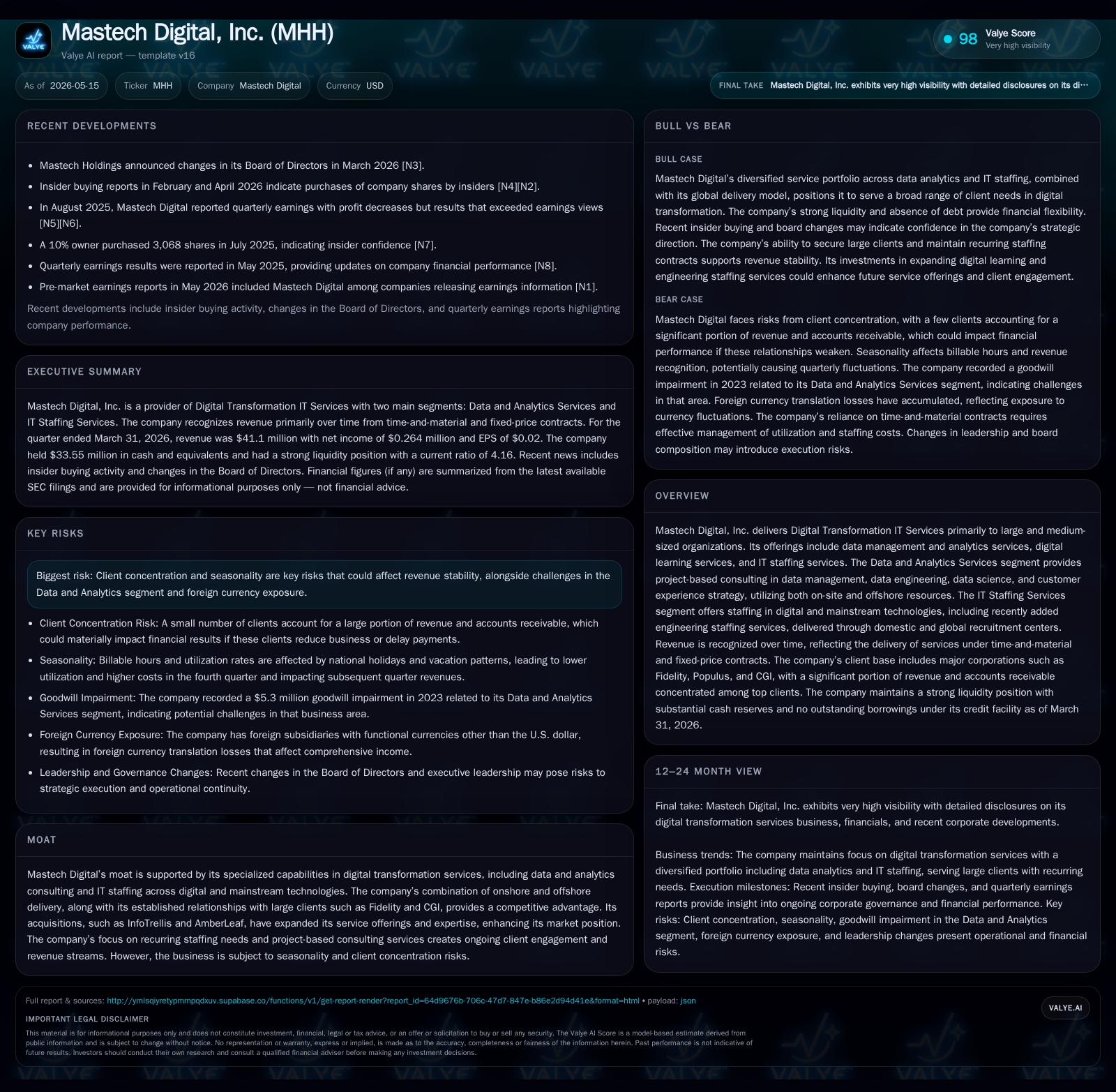
In its latest quarterly filing, Mastech Digital highlights consistent delivery in its dual segments of Data and Analytics Services and IT Staffing Services despite typical Q1 seasonality impacting consultant utilization. The company leverages a hybrid onshore-offshore delivery model alongside recent acquisitions to bolster its digital transformation offerings. Client concentration and foreign currency exposure remain notable risks, but strategic share repurchase programs and insider buying underscore management confidence. A strong liquidity position supports ongoing investments to deepen market penetration and service breadth.
Recent Quarterly Operating Update: What Changed in Q1 2026
The May 15, 2026 10-Q filing details Mastech Digital’s operational cadence through the first quarter ending March 31, 2026 [S2]. As anticipated from year-over-year patterns commonly observed in the staffing industry, billable utilization rates experienced softness owing to national holidays and the typical vacation schedules that lower consultant hours. This seasonality reduces revenue recognized under the time-and-material contracts during Q1 since revenue is accrued in direct proportion to work performed.
Contract completions often peak late in the calendar year, affecting recognition in subsequent quarters — a dynamic clearly acknowledged by management. The mix of time-and-material versus fixed-price contracts influences the timing of revenue accrual; notably, fixed-price engagements depend on cost-based progress measures which require managerial judgment.
An accompanying 8-K filing further contextualizes these operational factors by confirming ongoing financial discipline and no significant changes to liquidity or capital structure during the quarter [S3]. This update also announced management's renewed share repurchase authorization signaling confidence despite macroeconomic uncertainties.
Mastech Digital’s Business Model: Services, Clients, and Revenue Recognition
Mastech Digital operates primarily within two synergistic business segments: Data and Analytics Services (DAS) and IT Staffing Services (ITS). The DAS segment offers project-based consulting around data management, data science, customer experience strategy, and analytics implementation through a hybrid blend of onsite presence in key markets like Atlanta, Toronto, London, and offshore delivery centers in Chennai [S1]. These services are contracted on both time-and-materials terms—billed hourly—or fixed-price bases where revenue recognition follows a cost input schedule.
The ITS segment complements DAS by providing recurring staffing solutions across digital technologies including software engineering—a newer addition—as well as downstream digital learning services aimed at enhancing organizational capabilities [S1]. ITS relies on an integrated domestic-global recruitment platform which enables flexible placement strategies meeting client demand in diverse technology stacks.
Significantly, Mastech counts substantial enterprises such as Fidelity Investments, Populus, CGI among its major clientele — emphasizing a business-to-business model catering largely to large to medium corporations [S1]. Such client relationships foster stickiness through recurring staffing needs alongside medium-term consulting projects.
Revenue recognition is appropriately matched to service delivery phases with careful attention to contingent fees especially related to direct hire placements where fees become payable only upon extended employment by clients [S1]. This mix supports stable cash flows while allowing scalability as deployments increase.
Recent acquisitions such as InfoTrellis (acquired 2017) have deepened data engineering and analytics expertise while AmberLeaf (2020) expanded capabilities for cloud-centric customer experience managed services—both increasingly vital components of clients’ digital transformation roadmaps [S18].
Competitive Environment and Industry Structure in Digital Transformation Services
Mastech occupies a competitive niche blending traditional IT staffing with specialized digital consulting expertise. The industry features several large systems integrators who offer comprehensive transformation services but often lack the targeted agility smaller firms can provide. Mastech’s hybrid onshore/offshore operating model delivers cost-effective scalability while maintaining proximity to client operations.
Pricing dynamics show pressure typical of time-and-material contracts but are partially mitigated by the fixed-price projects within DAS that allow margin expansion through operational efficiencies [S1]. Reputational advantages derive from long-standing relationships with blue-chip clients whose internal procurement processes impose high barriers to entry for competitors.
Staffing supply chain considerations include recruiting center footprint scale domestically alongside offshore talent pools in India—a balance that optimizes sourcing costs without undermining quality or responsiveness [S18]. Regulatory concerns are modest given the service nature of offerings but currency fluctuations introduce translation adjustments which historically have been immaterial though always monitored [S2].
Growth Drivers: Scaling Analytics, Staffing Innovations, and Client Penetration
The principal engines driving growth rest on expanding DAS capabilities through incremental consulting mandates focused on analytics platform modernization post-InfoTrellis acquisition alongside new project wins leveraging AmberLeaf’s cloud managed services portfolio [S3]. Engineering staffing services launched recently broaden market addressability within high-demand digital domains.
Cross-selling opportunities arise from unified sales approaches allowing ITS personnel to access existing DAS accounts for staffing solutions while consultants gain visibility into broader client IT workforce expansions [S1]. The hybrid delivery model enhances gross margin potential as offshore resources contribute to cost containment.
Notably, insider buying activity reported earlier this year signals management’s conviction towards organic growth prospects supported by disciplined capital allocation including active share repurchases to enhance per-share value metrics [N2].
Risks and Constraints: Seasonality, Client Concentration, and Foreign Currency Exposure
Seasonality remains a persistent risk influencing quarterly earnings volatility due to consultant utilization patterns impacted by holidays and vacation schedules as detailed in multiple filings [S1][S2]. This also heightens benefit costs primarily during Q4.
Client concentration risk emerges from significant revenue contributions derived from a handful of major firms like Fidelity and CGI. Although these relationships afford stability when intact, over-dependence increases vulnerability to contract loss or renegotiation impacts [S1][S18].
Foreign currency fluctuations present modest translation risks given international subsidiaries’ functional currencies differ from reporting USD; however historical impact has been immaterial but not negligible [S2][S14]. Monitoring currency trends remains prudent amidst global macro volatility.
Additionally, accounting judgment involved in revenue recognition for certain direct hire contingent fee scenarios could affect timing of earnings realization reflecting inherent estimation uncertainty [S1].
Monitoring Points: Guidance, Contract Wins, and Execution Milestones
Key milestones to follow include forthcoming quarterly guidance updates potentially clarifying anticipated seasonal recovery effects post-calendar year end. Contract renewal rates among marquee clients will be a critical barometer for sustained demand visibility [S3].
Successful integration trajectories for InfoTrellis-anchored analytics projects and AmberLeaf’s cloud managed services will be important indicators of scalable platform expansion capability.
Execution on share repurchase authorizations—having recently expired one program while initiating another with a $5 million authorization—provides insight into capital deployment strategy aligning shareholder interests with operational momentum [S8][N2].
Other measurable KPIs such as improvement in billable utilization rates or pipeline conversion ratios announced during earnings calls or disclosures will offer transparency into underlying business health dynamics.
Latest Financial Snapshot: Liquidity, Capital Structure, and Profitability Overview
Latest financial snapshot
| Metric | Value | Period |
|---|---|---|
| Cash & equivalents | $34mm | |
| 2026-03-31 | ||
| Current assets | $67mm | |
| 2026-03-31 | ||
| Current liabilities | $16mm | |
| 2026-03-31 | ||
| Current ratio | 4.16x | |
| 2026-03-31 |
Source: SEC companyfacts cache [F1].
| Metric | Value | Period End |
|---|---|---|
| Cash & Equivalents | $33.55M | |
| 2026-03-31 | ||
| Current Assets | $66.57M | |
| 2026-03-31 | ||
| Current Liabilities | $16.01M | |
| 2026-03-31 | ||
| Current Ratio | 4.16 | |
| 2026-03-31 |
As of the latest quarter end, Mastech Digital maintains a strong liquidity position evidenced by cash plus equivalents totaling approximately $33.55 million supporting working capital needs comfortably given current liabilities near $16 million yielding a current ratio exceeding four times available assets over short-term obligations [F1][S2].
This financial posture enables measured capital returns through buybacks without compromising solvency or operational agility within an evolving digital transformation market landscape.
Disclaimer: This is research-only, informational analysis and not investment advice. It may include AI-generated interpretation and general industry context. Always verify important details using primary sources.

Comments