
Advanced Biomed Evolves Amid Regulatory Milestones and Strategic Acquisitions
The company advances its regulatory progress and pivots strategy via an acquisition and leadership transition, marking a potential inflection point.
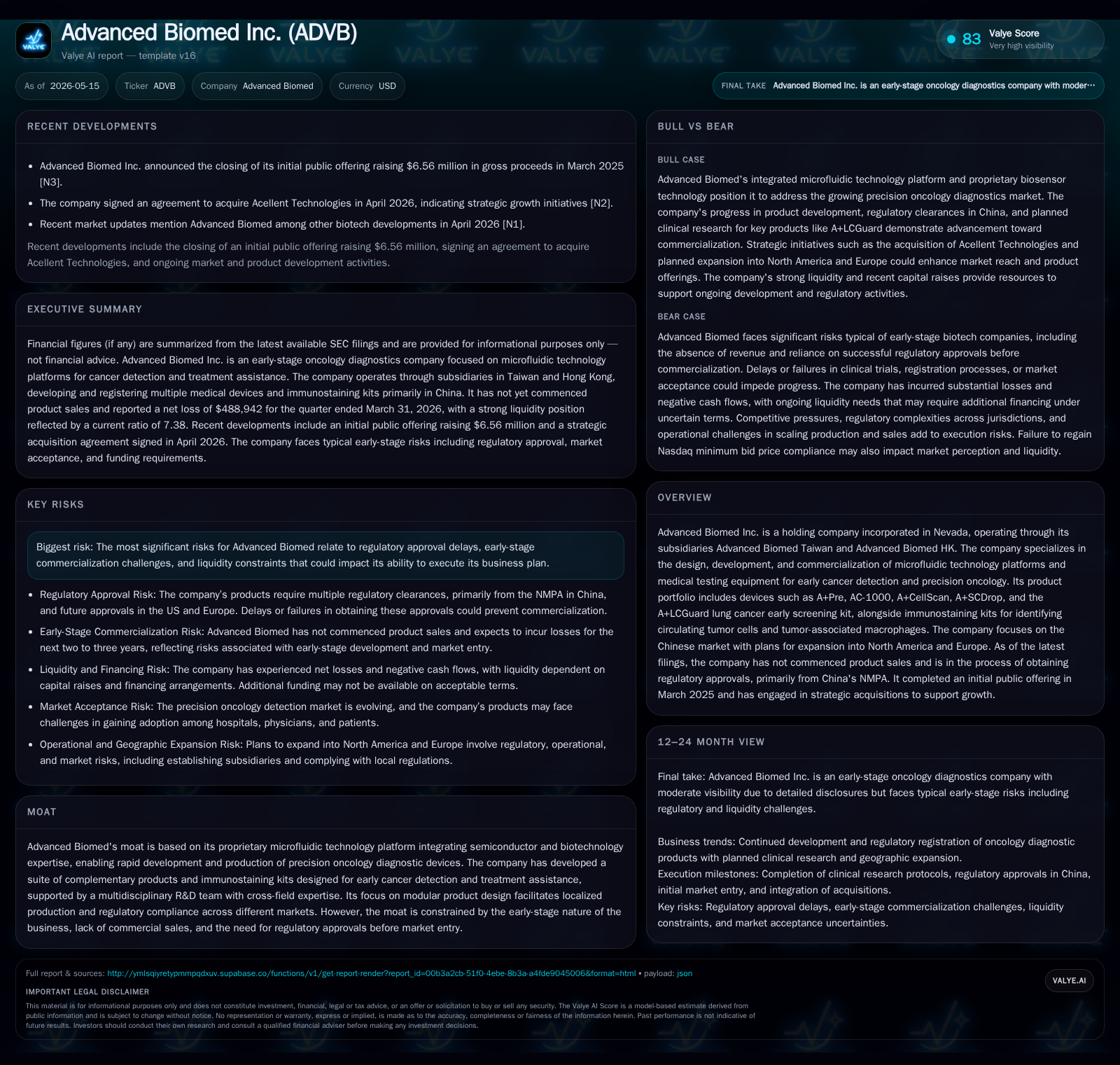
Advanced Biomed reported in its Q1 2026 10-Q and related event filings the completion of a key acquisition in AI-driven financial tech and a major CEO transition. These moves signal a strategic pivot to broaden beyond its microfluidic precision oncology platform, which is progressing through regulatory approval phases in China but has yet to achieve commercial sales. Its core products address early cancer detection by isolating circulating tumor cells through proprietary microfluidics technology. The acquisition diversifies the business model and leadership expertise, potentially impacting operational focus and growth trajectory. Key risks remain regulatory delays and early-stage commercialization hurdles alongside operational challenges from the strategic shift.
Recent Operating Highlights from the Latest Quarter
Advanced Biomed’s Q1 2026 10-Q filing dated May 15 underscores pivotal developments reshaping its trajectory. Most notably, the company closed its acquisition of Acellent Technologies (Hong Kong) Co. Limited at the end of April 2026 [S2][S5]. Acellent specializes in AI-powered financial verification and audit solutions—a business line starkly different from Advanced Biomed’s legacy microfluidic precision oncology focus. The consideration was settled via issuance of 270,000 common shares valued around $1.08 million. This marks an explicit strategic pivot broadening the company’s technology base beyond life sciences into artificial intelligence applications.
Concomitant with this corporate development was a top-level management turnover: Yi Lu stepped down from Chief Executive Officer, director, and chairman positions by mutual agreement in connection with this pivot [S3][S28]. Xiaomin Chen assumed these roles effective April 28, bringing over two decades of experience in artificial intelligence development within finance and regulated industries. Mr. Chen’s background includes leading efforts in AI large language models tailored for compliance-heavy environments such as financial markets—a clear signal that ADVB aims to leverage AI capabilities alongside or beyond its biomedical origins.
Despite this strategic broadened focus, the company's foundational oncology product lines continue their prescribed regulatory pathways primarily targeted at China’s NMPA clearance process [S1][S2]. As of the latest disclosures, core devices such as A+Pre (blood sample viscosity reducer), AC-1000 (circulating tumor cell enrichment), A+CellScan (fluorescent labeling & scanning), A+SCDrop (single cell sorting) plus the A+LCGuard lung cancer screening kit have varying statuses: some have secured initial clearance (A+Pre and AC-1000), while others remain under registration application or review stages [S1]. Importantly, no revenue-generating product certifications have been obtained so far and no product sales have commenced [S1].
The company's balance sheet indicates sound short-term liquidity with a current ratio of 7.38 as of March 31, 2026 (current assets roughly $10.5 million vs. current liabilities about $1.4 million) [F1]. Though reassuring for sustaining near-term operations during development expenses and acquisition integration costs, Advanced Biomed remains dependent on future capital raises given ongoing R&D investment requirements detailed in prior disclosures.
Business Model and Product Innovation
Advanced Biomed generates value through its proprietary microfluidic technology platform which melds semiconductor manufacturing techniques with biotechnology insights to address early cancer diagnostics—a sector emphasizing precision oncology.
This platform architecture supports multiple complementary devices designed for sequential processing steps in blood-based circulating tumor cell (CTC) detection workflows:
- A+Pre reduces blood sample viscosity enabling efficient microfluidic manipulation.
- AC-1000 performs separation and enrichment of CTCs utilizing patented biochip substrates integrating functional microfluidics modules.
- A+CellScan combines fluorescent immunostaining with automated scanning to identify relevant cancer markers.
- A+SCDrop maintains single-cell viability facilitating downstream analyses like genetic profiling or drug response assays.
- A+LCGuard targets lung cancer early screening using integrated assay kits.
Integral to the offering are immunostaining kits identifying tumor-associated macrophages alongside tumor cells enhancing diagnostic context.
Revenue mechanics depend on device sales paired with consumable biochips and reagent kits. Hospitals and diagnostic centers pay for device acquisition followed by recurring usage fees for consumables—typical SaaS-like recurring revenue potential contingent on clinical adoption rates post regulatory approvals.
The modular nature allows localized manufacturing adaptation compliant with regions’ regulatory frameworks—important given divergent requirements between China’s NMPA (primary current target market) versus planned expansion markets in North America and Europe [S1]. This modularity also helps buffer supply chain risks common in biotech equipment sectors.
Competitive Landscape and Industry Positioning
Advanced Biomed operates within an emergent but rapidly evolving precision oncology diagnostics market characterized by high technical complexity and stringent regulatory barriers.
Its moat arises from a differentiated technological base combining semiconductor precision manufacture with biotechnological biochips—enabling sophisticated CTC capture and analysis typically requiring multi-disciplinary expertise seldom assembled under one roof [S1]. This cross-field integration confers potential advantages over competitors relying solely on either molecular diagnostics or standard imaging platforms.
Nonetheless, competitive pressure stems from established global diagnostic firms actively developing liquid biopsy platforms alongside numerous specialized startups focusing on genetic sequencing or biomarker discovery tools without necessarily offering complete device-to-consumable ecosystems.
Regulatory progression remains critical since product commercialization depends on successive NMPA clearances—with some products already cleared exhibiting validation progress but others still pending registration applications or review supervision stages [S1]. This staggered pipeline maturity implicitly delays revenue onset relative to some publicly traded peers who may be further along in clinical validation or broader market authorizations such as FDA clearance attempts elsewhere.
Pricing power is so far untested without commercial deployments; competitive price sensitivity among Chinese hospital customers is likely significant given nascent reimbursement schemes for novel diagnostics currently under evolution nationally.
Manufacturing capacities tied closely to microfluidic chip production precision need scaling aligned carefully with approval timetables to avoid bottlenecks once sales ramp commences.
Growth Catalysts and Market Expansion Prospects
Several tangible drivers anchor potential growth trajectories:
- Regulatory approvals: Frontline catalyst resides in achieving full NMPA clearance for A+CellScan variants plus immunostaining kits expected imminently post-registration review stages documented [S1]. Successful certifications will enable initial commercial offerings domestically.
- Geographic expansion: Plans exist for establishing operational hubs beyond China into North America/Europe which represent sizable oncology testing markets; modular product architectures are designed to facilitate local production compliance easing entry barriers [S1].
- Strategic Acquisition Leverage: The April acquisition of Acellent Technologies introduces AI-powered financial verification capabilities potentially applicable internally for enhanced R&D cost control or externally as diversified revenue streams complementing slow-burn biotech commercialization cycles [N1][S3][S5].
- Leadership Transition: New CEO Chen's AI expertise aligns well with evolving healthcare diagnostics trends increasingly infused with machine learning-driven image analysis or biomarker pattern recognition—potentially accelerating development roadmaps or refining product differentiation efforts beyond traditional microfluidics alone.
- R&D Pipeline: Continued innovation including addition of perfusion-based 3D cell culture incubators improving tumor organoid modeling (e.g., A+PerfusC™) could extend offerings into drug response prediction aiding pharma partnerships or clinical decision support enhancements enhancing stickiness among users [S1].
Growth milestones will materialize based on timely achievement of approvals enabling sales launches followed by uptake patterns evidenced via orders/bookings metrics unreported yet but critical to assess momentum later this year.
Risks and Operational Challenges
Primary risk vectors remain substantial:
- Regulatory delays: Any lag in clearing late-stage devices or immunostaining kits risks deferral of commercial rollouts materially shrinking runways for cash burn mitigation efforts already sealed by absence of existing revenue streams [S24][S1].
- Early-stage commercial risks: Without historical sales data, presumptions about customer adoption rates remain inherently speculative; market entry execution especially in highly regulated medical sectors tests distribution channel penetration capabilities absent yet at scale [S24].
- Strategic Focus Shift Impact: Broadening into AI-fintech post-acquisition while managing legacy oncology pipeline involves integration challenges affecting capital allocation priorities plus potential dilution of executive attention during vital commercialization windows [S3][S28].
- Leadership Transition Uncertainty: While incoming CEO represents strong AI proficiency, continuity risks arise given his limited life sciences background potentially necessitating augmented biomedical domain hires amid restructuring phases affecting organizational stability [S28][S21].
- Liquidity Dependence: Although the current ratio >7 signals healthy near-term liquidity reserves per latest quarter-end data ($10.5M current assets vs $1.4M liabilities), sustained R&D burn alongside acquisition-related expenditures implies further financing needs within coming quarters remain likely absent meaningful revenue realization imminently [F1][S25][S26].
- Regulatory Environment Volatility: Differing standards across jurisdictions complicate global commercialization timelines increasing legal compliance burdens afflicting emerging medtech firms entering multi-region markets simultaneously [S24].
Key Monitoring Points and Upcoming Milestones
To track Advanced Biomed’s progression toward unlocking commercial value investors should monitor:
- NMPA certification updates for products presently under registration application/review stages signaling approaching marketing launch eligibility.
- Progress reports on integration success regarding Acellent Technologies including clarity on how synergies translate into new offerings or cost efficiencies.
- Announcements relating to further executive appointments strengthening biomedical leadership breadth post CEO transition enabling balanced focus between biotech heritage versus AI expansion pursuits.
- Evidence of initial sales contracts or pilot program adoptions reflecting early customer traction validating acceptance dynamics within target hospital networks in China.
- Updates on potential capital raises indicative of liquidity runway extensions required ahead of self-sustaining cash flow generation given ongoing manufacturing scale-up efforts.
Advanced Biomed's near-term path is therefore defined by milestone-driven catalysts centering on regulatory breakthroughs aligned tightly with successful integration management amid substantial strategic repositioning effects shaping longer-term growth profile prospects.
Disclaimer: This analysis provides an overview based solely on publicly available SEC filings and news disclosures for Advanced Biomed Inc., without offering investment advice or recommendations. It focuses on operational developments supported by official company documents up to May 15, 2026.
Disclaimer: This is research-only, informational analysis and not investment advice. It may include AI-generated interpretation and general industry context. Always verify important details using primary sources.

Comments