
Plastec Technologies: Transitioning from Manufacturing Roots to Investment Exploration
Plastec has shifted from precision plastics manufacturing to an investment-focused holding company, maintaining strong liquidity but facing execution challenges.
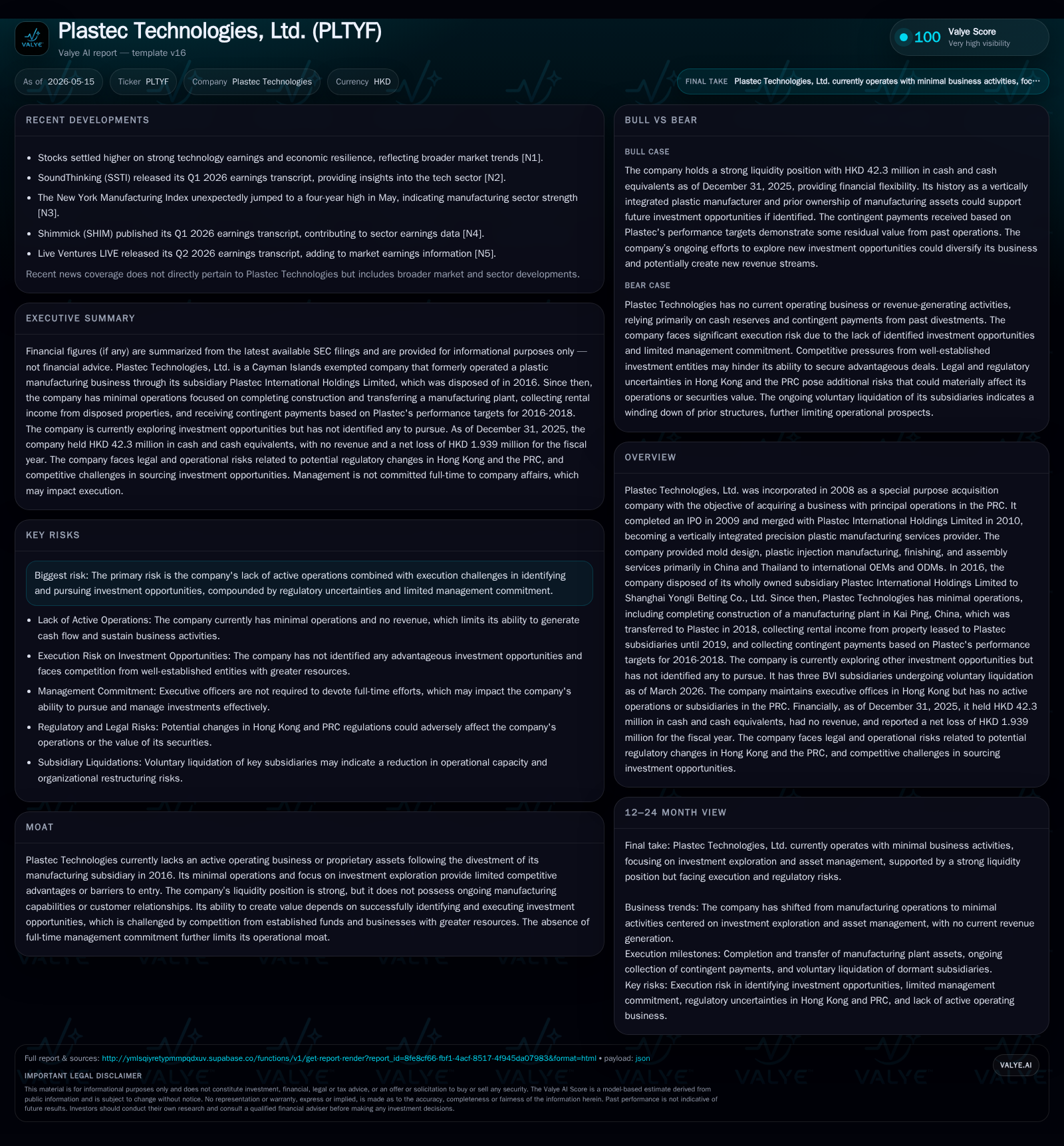
Plastec Technologies, Ltd. reported no operating revenue for fiscal 2025, maintaining minimal operations with losses driven primarily by administrative expenses. Having divested its manufacturing business in 2016, Plastec now focuses on exploring investment opportunities but has yet to identify suitable targets. Despite a solid cash position exceeding HK$42 million and no debt, the company lacks proprietary assets, ongoing operations, or full-time management commitment, posing challenges to growth and operational execution. The competitive landscape of investment acquirers and regulatory uncertainties in PRC transactions further complicate Plastec’s pathway to revival.
Latest Quarterly Operating Update and Its Immediate Implications
Plastec Technologies’ April 2026 6-K report confirmed that the company recorded zero revenue for the fiscal year ended December 31, 2025, maintaining minimal operational activity [S2][F1]. The company recognized an operating loss close to HK$3.7 million driven primarily by selling, general, and administrative expenses rather than production costs or sales-driven factors [F1][S1]. This steady cash burn underscores the lack of ongoing manufacturing or service operations, positioning Plastec as effectively a non-operating entity focused on strategic repositioning.
Liquidity remains robust with cash and equivalents standing at approximately HK$42.3 million against liabilities under HK$0.63 million, yielding an exceptionally high current ratio of over 67 [F1]. This financial strength provides a cushion that enables continued exploration of market opportunities without immediate solvency concerns but also highlights the absence of active revenue streams.
Business Model Evolution: From Precision Plastics Manufacturing to Holding and Investment Focus
Historically, Plastec operated as a vertically integrated precision plastic manufacturer specializing in mold design, injection molding, finishing processes, and assembly primarily for OEMs/ODMs supplying consumer electronics, home appliances, telecom devices, computer peripherals, and precision toys [S1]. Operations spanned China and Thailand until the pivotal divestment in October 2016 when Plastec International Holdings Limited was sold to Shanghai Yongli Belting Co., Ltd., marking the end of its core manufacturing activities [S1][S11].
Post-divestment, Plastec’s activities reduced significantly: completion then transfer of a newly built manufacturing plant in Kai Ping occurred in 2018; rental income derived from previously owned properties ceased after asset disposals concluded in late 2019; residual earnouts tied to prior Plastec performance were received through 2018; and since then, operational scope has shrunk to investment opportunity exploration without material subsidiary operations [S1][S13][S21].
Currently without manufacturing assets or customer contracts, Plastec operates primarily as a shell holding company with a mandate to pursue new business combinations or acquisitions if viable opportunities emerge. The absence of full-time executive commitment further restricts active operational capabilities [S1]. This model places the company closer structurally to special purpose acquisition companies (SPACs) or blank-check entities than a traditional industrial operator.
Competitive and Industry Context Post-Divestment
Within its prior industry—precision plastic components manufacturing aligned with ODM/OEM supply chains—Plastec had established vertical integration across design through assembly offering competitive differentiation via control over quality and delivery timelines [S1]. The exit from this space removed inherent barriers such as capital intensity, technical know-how, and customer relationships.
In the current posture focusing on investment exploration amid a surge in blank check vehicles and private equity initiatives targeting China-based businesses or cross-border deals [S1], Plastec faces fierce competition. Well-capitalized peers deploy broader deal sourcing networks and full-time management teams dedicated exclusively to acquisitions.
Moreover, regulatory scrutiny intensifies around foreign investments into the People’s Republic of China (PRC), especially concerning Variable Interest Entity (VIE) structures which some investors use to circumvent direct ownership restrictions [S1][S24][S26]. While Plastec currently does not employ VIE arrangements nor plans immediate use thereof, it acknowledges the associated risks should such strategies be pursued. Regulatory ambiguity imposes execution risk both on deal feasibility and post-transaction corporate governance.
Growth Drivers: Potential Investment Opportunities and Strategic Challenges
Growth prospects rely almost entirely on Plastec’s ability to identify suitable acquisition candidates that fit legal parameters and investor return thresholds [S1]. Given its cash runway and lack of legacy subsidiary burdens post-asset disposals [S4], the company maintains strategic flexibility to act when opportunities arise.
However, multiple structural constraints impede near-term growth: the scarcity of attractive targets due to saturated capital markets; increased competition driving up valuations and search costs; geopolitical tensions affecting cross-border deal flows; and limited internal resources constrain intensive due diligence efforts. There is no disclosure of any pipeline deals or imminent transaction announcements at present [S1][S12].
This environment suggests Plastec's expansion will be episodic rather than linear—dependent upon infrequent deal closures rather than recurring revenue growth. Administrative costs will likely remain persistent unless offset by acquisition-related income streams.
Risks and Constraints: Execution, Management Commitment, and Market Competition
Key risks crystallize around:
- Execution Difficulty: The absence of dedicated full-time executives decreases responsiveness to market opportunities amid competitive urgency from agile fund managers [S1].
- Operational Inactivity Burden: Minimal revenue coupled with consistent administrative expenditures creates a constant drag requiring liquidity replenishment if new income sources are not found [F1][S6].
- Regulatory Ambiguities: Potential tightening or reinterpretation of PRC rules especially relating to overseas listings or use of VIE entities could reduce available target universe or impair corporate structuring options post-deal [S24][S26].
- Competitive Pressures: An expanding pool of better-resourced VC/PE firms targeting similar sectors elevates bidding costs risks diluting returns or causing prolonged capital deployment cycles [S1].
- Management Turnover Impact: Unexpected loss of key officers could exacerbate delays in deal sourcing or negotiations given already thin staffing commitments.
Failure in addressing these risks would impair shareholder value creation prospects materially over medium term given dependence on investment-related earnings initiation.
What Investors Should Monitor Next: Milestones and Corporate Activity Outlook
Critical indicators going forward include:
- Announcements regarding identification or signing of definitive agreements for acquisition targets indicating tangible progress beyond exploratory stage [S2][S1].
- Updates on voluntary liquidation proceedings underway for several dormant subsidiaries seeking corporate simplification potentially affecting cost base [S21].
- Any shifts towards greater executive engagement or expansion in management team signaling readiness for intensified deal activity.
- Strategic changes such as asset monetization alternatives if deal pipelines remain constrained would hint at adjustments in capital allocation philosophy.
- Regulatory developments influencing feasibility of PRC-related investments particularly regarding VIE usage or capital controls could recalibrate opportunity sets materially. Monitoring public disclosures including SEC filings alongside press releases will be imperative for discerning shifts impacting risk-reward profile.
Financial Snapshot: Liquidity Profile Supporting Strategic Flexibility
Latest financial snapshot
| Metric | Value | Period |
|---|---|---|
| Cash & equivalents | 42,324,000 HKD | |
| 2025-12-31 | ||
| Current assets | 42,324,000 HKD | |
| 2025-12-31 | ||
| Current liabilities | 630,000 HKD | |
| 2025-12-31 | ||
| Current ratio | 67.18x | |
| 2025-12-31 |
Source: SEC companyfacts cache [F1].
| Metric | Value (HKD) | Date |
|---|---|---|
| Cash & Equivalents | 42,324,000 | |
| 2025-12-31 | ||
| Total Debt | 0 | |
| 2025-12-31 | ||
| Current Assets | 42,324,000 | |
| 2025-12-31 | ||
| Current Liabilities | 630,000 | |
| 2025-12-31 | ||
| Current Ratio | 67.18 | Derived |
The robust cash reserves reflect proceeds from prior divestments supplemented by careful expense management allowing full coverage of fixed outlays for foreseeable periods without external financing needs [F1][S4]. Zero reported debt eliminates leverage risk providing unencumbered capital deployment capability. However, ongoing net losses highlight reliance on executing investments successfully within this liquidity envelope for value accretion rather than underlying operational profitability at this stage.
This analysis summarizes publicly available SEC filings through mid-2026 alongside selected financial metrics without recommendations or forecasts. It is based strictly on documented facts without speculative extrapolation beyond disclosed business conditions or management commentary.
Disclaimer: This is research-only, informational analysis and not investment advice. It may include AI-generated interpretation and general industry context. Always verify important details using primary sources.

Comments