
Magyar Bancorp’s Earnings and Loan Growth Highlight Resilience in Regional Banking
The latest quarterly results underscore Magyar Bancorp’s strategic expansion in commercial lending and liquidity capacity amid interest rate pressures.
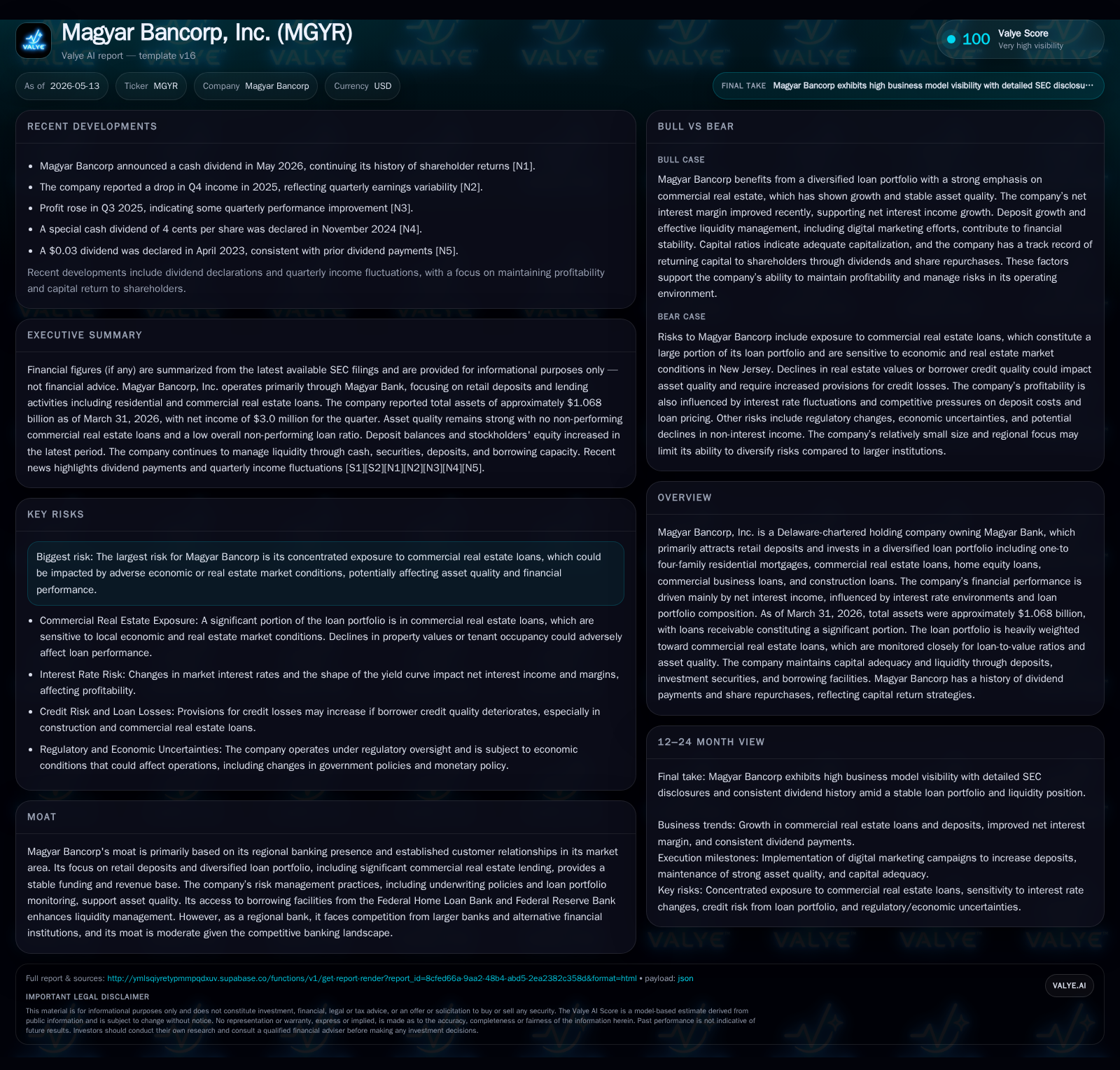
Magyar Bancorp, Inc. reported a 7.1% increase in total assets for Q1 2026, driven by robust growth in commercial real estate and construction loans, alongside an expanded liquidity position supported by borrowing capacity from the FHLBNY and FRBNY. Net interest income rose 17.2%, benefiting from higher loan yields and an increased loan book despite margin pressures from rising borrowing costs. The company’s business model centers on retail deposit gathering and diversified lending with a moderate moat tied to its regional banking presence, though concentrated commercial real estate exposure remains a key risk. Moving forward, dividend sustainability, deposit growth, and regulatory developments will be important milestones to monitor.
Latest Quarterly Operating Highlights
In the first quarter of 2026, Magyar Bancorp reported meaningful operational momentum anchored by asset growth and improved earnings metrics [S2]. Total assets expanded by $70.7 million or 7.1% quarter-over-quarter to $1.068 billion as of March 31, 2026, fueled principally by a surge in cash and equivalents that climbed over fivefold—an increase of $40.6 million to $47.6 million—and a $21 million rise in loans receivable [S2]. Notably, commercial real estate (CRE) loans grew significantly by $24.6 million within this period, complemented by an additional $6.4 million increase in construction and land loans [S2]. This growth was partially offset by declines in residential segments including one- to four-family mortgages.
Net interest income—a key profitability driver—increased by 17.2% to $9.2 million for the quarter compared to Q1 2025 [S8]. This was supported by a healthy lift in the net interest margin (NIM) from 3.31% to 3.66%, driven by repricing in commercial term loans adjusting upward on their five-year anniversaries [S8]. The bank's average loan balances also expanded materially during the period, reinforcing the interest income base.
Supporting this loan growth is enhanced liquidity capacity critical for setting efficient funding conditions amid competitive deposit markets and fluctuating rate environments. Magyar’s short-term liquidity is underpinned by diverse sources including asset maturities, new deposits, asset sales, and importantly borrowing facilities with the Federal Home Loan Bank of New York (FHLBNY) granting approximately $168.1 million of net borrowing capacity at quarter-end, alongside the Federal Reserve Bank of New York (FRBNY) with access totaling $110.5 million—slightly up from prior periods [S2].
Interest expense on borrowings rose sharply by $174 thousand or 78%, reflecting both a higher level of borrowings (up 52.7%) and an increased cost (up 47 basis points to 3.28%) consistent with prevailing rising interest rates [S2]. While deposit costs showed some moderation, borrowings have become a more expensive funding component impacting the margin outlook.
Business Model and Product Mix Overview
Magyar Bancorp is structured as a Delaware-chartered holding company owned fully by shareholders and centered operationally through Magyar Bank [S1]. Its primary strategy relies on building retail deposit relationships within its regional footprint while deploying this capital into a diversified loan portfolio spanning residential mortgages (primarily one-to-four family homes), home equity lines, multi-family housing loans, commercial real estate financing, commercial business loans, and construction projects [S1].
Earnings are largely dependent on net interest income—the spread between what it earns on loans/investments versus what it pays on deposits/borrowings—as reflected historically and reiterated in recent filings [S1]. This interest-sensitive model displays sensitivity to market rate shifts as well as changes in loan mix; commercial real estate lending comprises a material portion of total loans which elevates both yield potential and credit risk concentration.
The bank's competitive moat stems mainly from entrenched regional relationships facilitating steady retail deposit inflows at favorable rates relative to larger competitors. However, this moat is moderate given significant competition not only from large national banks but also non-traditional fintech lenders challenging customer acquisition and pricing dynamics.
Sector Dynamics and Competitive Environment
Magyar Bancorp operates within the highly competitive regional banking sector dominated increasingly by larger institutions with expansive branch networks and diverse product offerings [S1]. Regulatory scrutiny has intensified particularly related to underwriting standards for commercial real estate lending due to historical sector volatility; maintaining capital adequacy is vital here with Magyar reporting a Tier 1 capital ratio of approximately 11.15% as of March 31, 2026—meeting regulatory expectations yet providing limited cushion under stress scenarios [S4].
Macroeconomic factors influencing demand include local commercial real estate market conditions in New Jersey where property values can be cyclical amid economic changes affecting tenants’ ability to service debt, plus broader interest rate trends impacting loan pricing power.
Supply-side challenges stem partly from competitive deposit pricing that escalates funding costs while simultaneously imposing constraints on rapid loan volume growth without proportional balance sheet expansion or capital infusion.
Key Growth Drivers and Loan Portfolio Composition
Commercial real estate remains the cornerstone growth driver for Magyar Bancorp's lending book as demonstrated during Q1 2026 where CRE secured loans increased by $24.6 million—representing accelerated origination momentum [S2]. Construction loans similarly added $6.4 million during this period underscoring developer confidence or client pipeline expansion.
This growth is enabled in part by Magyar's effective liquidity management allowing funds deployment toward higher-yielding assets without excessive reliance on costly wholesale funding channels beyond available bank advances [S22]. Deposit base improvements via digital marketing initiatives targeting certificates of deposit contributed positively, increasing overall deposit balances nearly 8% over six months through March which supports balance sheet stability [S17].
Meanwhile, residential mortgage lending contracted moderately reflecting perhaps strategic de-emphasis or weaker market demand as refinancing activity slows amid higher rates, shifting focus toward commercial credits which tend to offer higher margins but necessitate tighter risk controls especially surrounding loan-to-value ratios monitored closely across portfolios [S2],.
Consistent investment securities purchasing further diversifies yield sources while preserving asset quality—no credit impairments were recorded for securitized portfolios during recent quarters bolstering financial strength [S2].
Risk Factors and Margin Pressures
Concentration risk in commercial real estate represents Magyar Bancorp’s principal vulnerability given substantial exposure comprising over half the loan book with non-owner occupied CRE estimated at nearly 275% of risk-based capital as per regulatory figures—a relatively elevated leverage level demanding vigilant portfolio management under shifting economic cycles [S10],.
Although asset quality currently appears stable with no reported non-performing CRE loans at quarter end [S10], potential declines in regional property valuations or tenant occupancy could amplify credit loss expectations necessitating provisions as reflected modestly higher credit loss provisions recently compared with prior years [S14], [S25].
Margin pressure arises due to increasing borrowing costs; interest expenses on borrowings spiked significantly (+78%) driven both by volume growth (+53%) and an uptick in cost (+47 bps) reaching an average cost over three percent - narrowing net spread if not offset fully elsewhere [S2], [S14].
Non-interest income faced headwinds declining over 30% due primarily to reduced gains from SBA loan sales and lower fee income linked to unpredictable prepayment penalties on commercial loans that depend heavily on borrower behavior timing uncertainty making revenue streams less dependable quarter-to-quarter [S12], [S14].
These factors combined require disciplined expense control balancing marketing investments sustaining deposits against compensation rises noted alongside technology expenditures impacting operating leverage moderately upwards [S12], [S18].
Upcoming Catalysts and Execution Milestones
Market participants should track several near-term inflection points shaping Magyar Bancorp’s trajectory:
- Regulatory developments pertaining to CRE underwriting standards or capital buffer requirements could impact lending capacity or risk appetite.
- Deposit growth sustainability remains crucial especially renewal rates within certificates of deposit campaigns following demonstrated digital marketing success.
- Quarterly earnings releases forthcoming will indicate consistency of net interest income improvement amid margin headwinds.
- Credit loss provision trends reflecting underlying economic conditions regionally will offer insight into portfolio resilience or emerging distress patterns.
- Dividend declarations such as the approved quarterly dividend payment announced April 23, 2026 ($0.10/share) signal management confidence but warrant scrutiny regarding payout sustainability aligned with earnings coverage ratios [S3], [N1].
Current Financial Snapshot and Capital Position
Latest financial snapshot
| Metric | Value | Period |
|---|---|---|
| Cash & equivalents | $48mm | |
| 2026-03-31 | ||
| Total debt | $49mm | |
| 2026-03-31 | ||
| Net debt | $1411000 | |
| 2026-03-31 |
Source: SEC companyfacts cache [F1].
| Metric | Value |
|---|---|
| Total Assets | $1.068 billion |
| Cash & Equivalents | $47.6 million |
| Total Debt | $49.05 million |
As of March 31, 2026, Magyar Bancorp held approximately $47.6 million in cash & equivalents supporting operational flexibility alongside total debt outstanding close to $49 million yielding net debt near neutral levels given cash buffers per best-effort estimates from filings [F1], [S2].
Disclaimer: This is research-only, informational analysis and not investment advice. It may include AI-generated interpretation and general industry context. Always verify important details using primary sources.

Comments