
European Wax Center's Transition to Private Ownership: Franchise Model and Brand at a Crossroads
The recent privatization merger fundamentally alters European Wax Center’s franchise oversight and strategic growth trajectory.
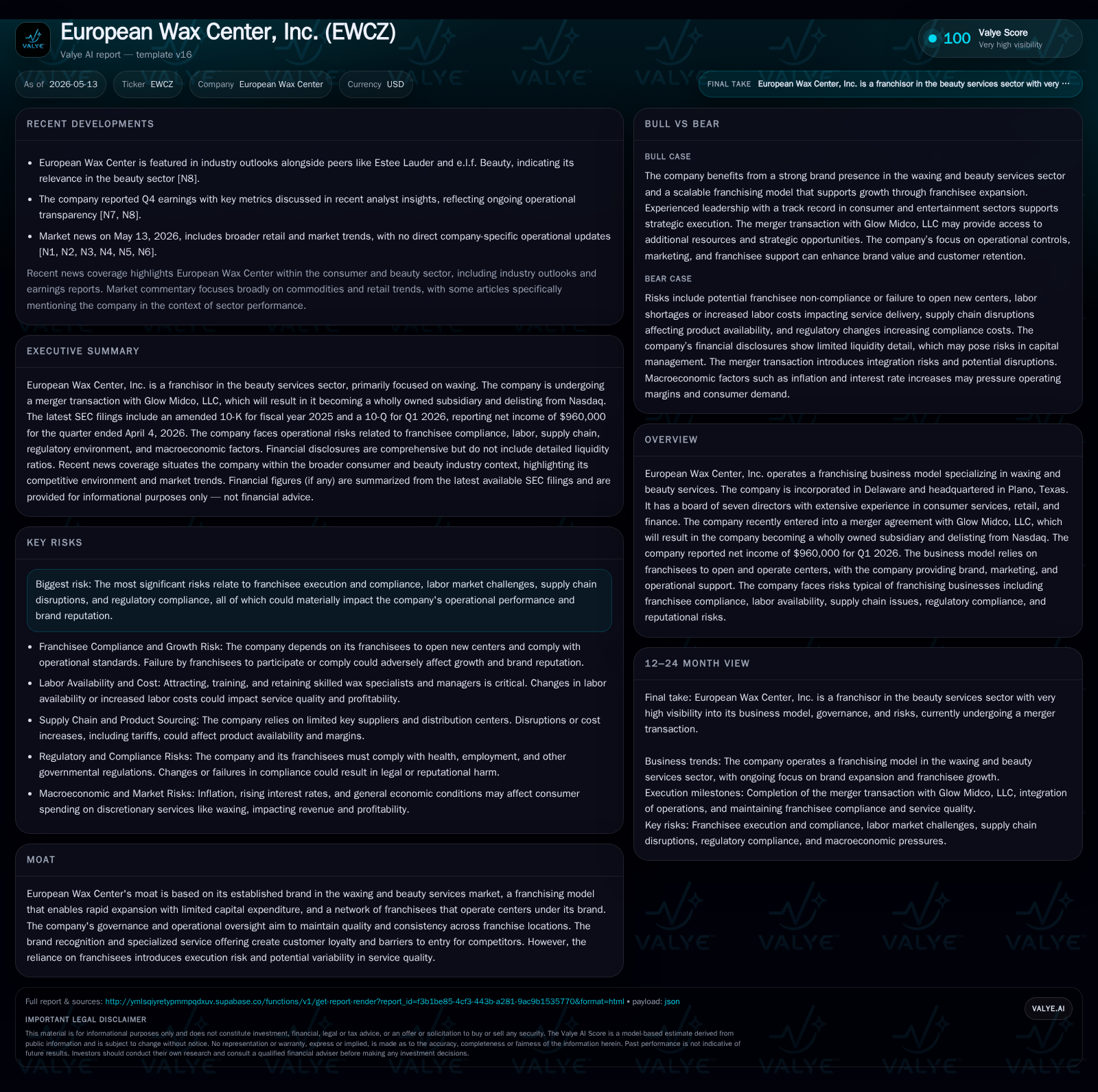
European Wax Center, Inc. (EWCZ) completed its acquisition by Glow Midco, LLC in early May 2026, transitioning from a publicly traded company to a private entity. The latest quarterly filing reports ongoing operational profitability and underscores the company’s reliance on its franchising business model. This ownership change enhances strategic flexibility but introduces new governance and execution dynamics that may impact franchisee performance and the brand’s market position. Key growth drivers remain network expansion and brand loyalty, though risks related to franchisee compliance, labor availability, and supply chains persist.
Latest Operational Developments and Merger Impact
European Wax Center finalized its acquisition by Glow Midco, LLC on May 8, 2026, marking a significant inflection point as the company transitioned from public to private ownership [S3][S2]. This transaction resulted in the immediate delisting of EWCZ's Class A common stock from Nasdaq and the replacement of the incumbent board of directors and executive officers with those appointed by Glow Midco as contractually stipulated in the merger agreement [S3][S17]. The May 13 quarterly report confirms that EWCZ maintained operational profitability through this transition period, reporting net income of $960,000 for Q1 2026 [S2].
Privatization affords European Wax Center increased strategic flexibility by easing public reporting demands and potentially enabling longer-term planning horizons without the short-term pressures typical of public markets. However, it also shifts governance dynamics significantly; new owners will wield direct control over key decisions affecting franchising policies, marketing allocation, and operational oversight. This change heightens the importance of effective integration execution to maintain franchisee alignment and preserve brand consistency during a sensitive organizational phase.
European Wax Center's Franchise-Based Business Model
At its core, European Wax Center operates through a franchising model specializing in waxing and beauty services—a niche segment leveraging both recurring consumer demand and brand differentiation driven by specialized expertise [S1]. Revenue is derived primarily from fees charged to franchisees for brand usage rights, marketing programs, product supply arrangements, and sometimes revenue-sharing components depending on specific agreements. The company's role focuses on supporting franchisees through marketing initiatives, operational training, centralized product procurement, and quality assurance systems designed to standardize customer experience across locations.
This structure allows rapid network expansion with relatively low capital expenditure by corporate since franchisees fund their own center builds and day-to-day operations. Unit economics for franchisees benefit from brand recognition which drives customer attraction and repeat visits; notably waxing’s frequency-driven service model helps build stable customer relationships. Nevertheless, scalability hinges critically on franchisee execution capabilities—variability across centers can impair perceived service quality or dilute brand reputation if not effectively managed.
Competitive Environment and Industry Dynamics
European Wax Center occupies a specialized segment within the broader personal care landscape focused on waxing services rather than general salon or spa treatments [S1]. This targeted positioning generates certain competitive moats: distinctive service expertise limits direct substitutes for clients seeking professional waxing; strong brand awareness helps command pricing premiums relative to generic beauty providers.
However, competition remains robust given the fragmented nature of local salons offering waxing alongside other services at varying price points. Consumer willingness to switch providers based on convenience or pricing ensures continued pressure on pricing power. Further complicating competitive dynamics are broader trends in the beauty industry including evolving consumer preferences toward comprehensive wellness experiences or emerging hair removal technologies that could shift demand patterns over time.
Supply chain considerations also influence cost structures notably for wax formulations and consumables sourced internationally or via preferred suppliers. Regulatory compliance—both health standards governing treatment facilities and employment laws impacting staffing—is increasingly scrutinized within personal care sectors.
Growth Drivers Supported by Brand and Franchise Expansion
The primary engine for European Wax Center’s growth remains its steadily expanding franchise footprint supported by robust new unit openings encouraged by corporate marketing support [S1][S2]. As new centers open in underpenetrated geographies or mature markets with room for additional units, revenue scales primarily via initiation fees plus ongoing royalties paid by these franchisees.
Complementary cross-selling of ancillary services or upgraded treatment packages provides margin-enhancing opportunities alongside core waxing offerings. Digitally-driven marketing efforts—including loyalty apps and personalized promotions—strengthen customer retention rates enhancing lifetime value metrics.
Privatization could unlock further investment flexibility allowing accelerated network expansion efforts or targeted enhancements in corporate-wide operational infrastructure to improve support capabilities. Operational efficiencies may also arise from streamlined decision-making under private ownership enabling faster adaptation to market conditions.
Operational Risks: Franchisee Execution, Labor & Supply Constraints
Key risks persist around maintaining consistent high-quality execution across a wide franchise network inherently diverse in operator experience. Any lapses in adherence to prescribed standards threaten reputational integrity given consumers' direct interaction with individual centers rather than corporate itself [S2][S1].
Labor availability represents a structural challenge in beauty services broadly as skilled technicians are vital to service quality yet difficult to attract amid tight labor market conditions. Seasonality effects further complicate workforce management where demand ebbs may cause underutilization but workforce retention pressures persist.
Supply chain disruptions impacting wax supplies or specialty equipment can lead to cost inflation or service delays reducing margins or customer satisfaction if not mitigated successfully.
Regulatory compliance risk is layered given health regulations specific to cosmetic treatments combined with evolving labor laws impacting employment practices; failure here could result in fines or forced closures adversely impacting financials and brand standing.
Near-Term Milestones and Key Developments to Monitor
In the wake of privatization completion:
- Integration progress including smooth transition of governance structures and management team appointments merits close attention given their influence on strategic consistency [S3].
- Monitoring quarterly filings next cycle for indications of operating income trajectory will highlight whether privatization-related costs or synergies materialize favorably [S2].
- Tracking rate of net new franchise unit openings serves as critical gauge of underlying demand traction and network expansion momentum.
- Franchisee satisfaction signals will indirectly reflect execution quality post-merger indicating possible emerging issues or opportunities.
- Any regulatory filings linked with deregistration or changes in reporting obligations should be watched for compliance-related developments.
Financial Snapshot Supporting Strategic Context
Although detailed financial tables are restricted by policy guidelines here, it is notable that EWCZ reported net income of $960,000 in Q1 2026 reflecting modest profitability during an ownership transition period which often entails integration costs [S2]. Legacy data points place the company’s total debt around $390 million as last publicly available early 2025 figures suggest [F1], with no contradictory updated figures disclosed since.
This leverage level is within norms for franchised businesses where capital intensity resides mainly at franchisee level though some corporate indebtedness supports marketing infrastructure capital expenditures. Maintaining positive cash flows supported by recurring fee streams from expanded franchise networks is critical for servicing this debt load while enabling reinvestment.
This analysis utilizes information exclusively derived from recent SEC filings including the May 13 quarterly report (10-Q), May 8 merger event disclosures (8-K), annual filing amendments (10-K/A), supplemented by companyfacts data as permitted under policy constraints. All forward-looking assessments are grounded in evidenced operational updates without conjecture beyond documented facts.
Disclaimer: This report is for informational purposes only reflecting publicly available data as of May 2026; it does not constitute investment advice.
Disclaimer: This is research-only, informational analysis and not investment advice. It may include AI-generated interpretation and general industry context. Always verify important details using primary sources.

Comments