
Fidelity Solana Fund Updates Operational Profile After First Quarter
The latest 10-Q filing highlights continued staking activities and operational refinements that reinforce FSOL’s positioning as a regulated gateway for SOL exposure.
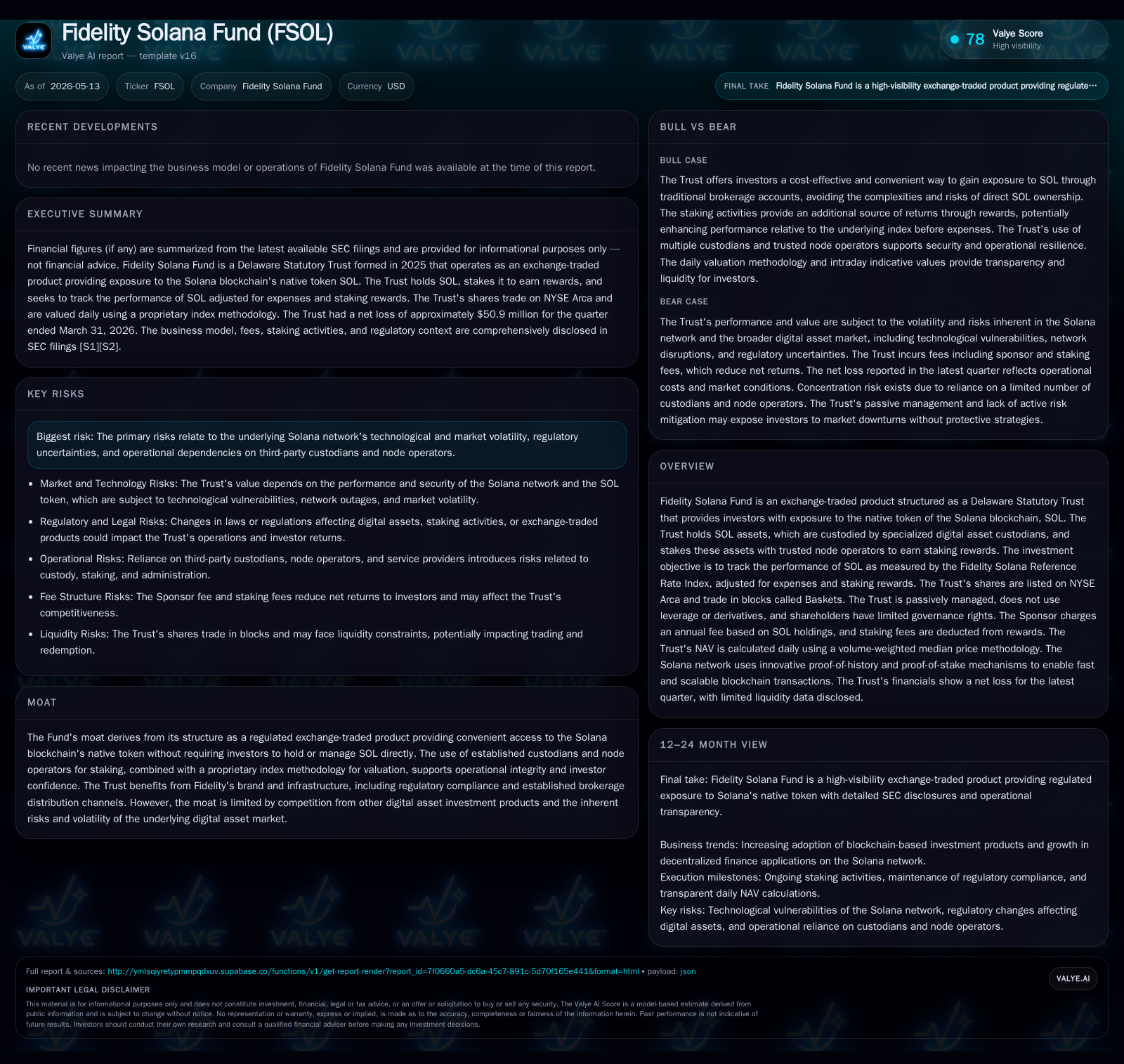
Fidelity Solana Fund (FSOL) provided its newest quarterly update in May 2026, reaffirming its operational execution in staking Solana tokens while maintaining regulatory compliance as a Delaware Statutory Trust exchange-traded product. The Fund passively tracks SOL price performance adjusted for staking rewards, leveraging established custodians and node operators. Its business model centers on providing investors with accessible SOL exposure through tradable shares on NYSE Arca, supported by Fidelity’s infrastructure. Growth drivers include increasing institutional demand for regulated digital asset products and enhanced staking returns, while risks focus on Solana’s network volatility and evolving regulatory landscapes. Financially, the Fund remains in an early-stage operational phase with net losses consistent with nascent fee income and startup costs.
Latest Operating Update: Q1 2026 Filing Highlights
The May 13, 2026 Form 10-Q [S2] provides the most recent disclosure on Fidelity Solana Fund's operating status. The filing reiterates ongoing receipt of staking rewards from delegated SOL holdings while confirming the continuation of the Index-based daily NAV computation using volume-weighted median price (VWMP) methodologies. No material changes have been introduced concerning custodial arrangements or staking practices since inception; however, the filing underscores adherence to regulatory guidelines that govern staking participation to avoid jeopardizing tax qualification statuses.
Risk factor disclosures reference the Prospectus dated November 17, 2025 [S14], emphasizing the importance of investor awareness regarding digital asset market volatility and custodial operational risks. This latest quarterly update consolidates confidence in FSOL’s steady operational trajectory post-launch in November 2025.
Fund Business Model and Product Quality
FSOL is structured as a Delaware Statutory Trust [S1] designed specifically to offer regulated exposure to SOL, the native token of the Solana blockchain. The Fund issues beneficial interest Shares representing proportional ownership in assets held by the Trust. These Shares trade publicly on NYSE Arca, enabling traditional brokerage access without requiring investors to maintain direct wallets or engage with private key management.
The Fund's core investment strategy is passive: maintaining direct custody of SOL tokens via contractually engaged custodians—namely Anchorage Digital Bank, BitGo Bank & Trust (formerly BitGo Trust Company), and Coinbase Custody Trust Company [S6]. The physical holding of SOL supports staked token delegation through vetted node operators selected by the Sponsor to generate staking rewards, which are added net of fees to investors' total returns.
Creation and redemption processes center on Baskets composed of blocks (25,000 Shares each) whose composition is periodically updated based on accrued expenses and prevailing token valuations. Authorized Participants—typically registered broker-dealers or qualified financial institutions—execute creations/redemptions by delivering or receiving exact proportions of SOL corresponding to the NAV per Share at the time of transaction [S12,S23].
Share valuation depends on a proprietary Fidelity Solana Reference Rate Index calculated every 15 seconds during regular trading hours by aggregating eligible spot market data via VWMP mechanisms [S8,S13]. This approach delivers fair-value pricing reliability transparent to investors. The Trust does not engage in leverage or derivatives; it restricts holdings solely to SOL absent other crypto assets except cash incidental for operations.
Governance rights of shareholders remain limited due to FSOL's trust structure; voting mechanisms or involvement in network governance fall outside shareholder purview [S1]. Fees charged encompass a unified annual Sponsor Fee set at 0.25% based on SOL holdings value and usual network-level staking commissions deducted from gross rewards before distribution to shareholders [S21].
Industry Context and Competitive Positioning
Within the digital asset ETP landscape, FSOL differentiates itself by providing direct economic participation in native blockchain assets combined with staking-derived yield opportunities incorporated into total returns—unlike futures-based products or synthetic ETPs that lack physical token backing.
Federal regulatory clarity shifted positively in March 2026 when the SEC jointly with CFTC classified SOL explicitly as a "digital commodity" rather than a security [S10]. This token taxonomy reaffirms that protocol staking income under defined conditions does not constitute a securities sale. Such legal framing provides stronger footing for FSOL's compliance posture relative to earlier periods marked by regulatory ambiguity.
Competition includes other spot-market-focused digital asset trusts (like those tracking Bitcoin or Ethereum) plus futures contracts launched by CME regulated under CFTC rules incorporating heightened surveillance efforts [S7]. The presence of well-known custodians and node operators gives FSOL structural reliability; leveraging Fidelity’s firm-wide distribution channels enhances accessibility for institutional investors reluctant to self-custody volatile cryptos.
Network supply and validator decentralization underlying Solana partly determine available staking yields; changes here affect competitive advantages among various staked crypto ETP providers but FSOL’s clear custody model moderates counterparty risk premium demanded by investors.
Growth Drivers Shaping Demand and Staking Benefits
Demand for FSOL hinges structurally on increasing acceptance of blockchain-native assets by mainstream institutional portfolios seeking regulated vehicles that combine simplicity with yield enhancement via staking rewards. As regulatory frameworks stabilize post-2026 clarifications (SEC/CFTC integration), trust in these products deepens.
Staking rewards elevate FSOL’s attractiveness because they can provide incremental returns over pure price appreciation benchmarks inherent in many ETP alternatives. Although staking yields fluctuate with network parameters—such as inflation rates baked into token economics or validator participation levels—the embedded yield increases potential investor utility beyond mere capital gains.
Incremental issuance volume expressed by total Shares outstanding tracked alongside NAV progression would be key metrics for assessing adoption momentum (although not explicitly stated in filings). Further uptake may be accelerated if Fidelity expands its suite of blockchain-related offerings or integrates complementary digital asset services enhancing ecosystem stickiness.
Growing secondary market liquidity facilitated by Authorized Participants ensures tighter spreads and better trading efficiency reducing risks from discounts/premiums typical in less liquid crypto-products. Combined with Fidelity’s robust compliance framework supporting plan fiduciary prudence evaluations may further institutionalize FSOL holdings over time.
Risks and Constraints Affecting Performance and Market Access
Principal risks cluster into technological vulnerabilities affecting Solana network uptime or consensus security that could degrade token value sharply; inherent price volatility characteristic of cryptocurrencies; third-party dependencies including potential failure or compromise at custodians or node operators affecting asset safekeeping or reward distribution timing [S14,S24].
Regulatory uncertainty persists despite recent progress: future SEC interpretations could alter permissible fund activities around staking mechanics or limit eligibility criteria impacting creation/redemption flow dynamics. Foreign jurisdiction divergences add cross-border compliance complexity for global investors.
Tax implications pose challenges: distributions from net staking rewards are treated as taxable income regardless of reinvestment status; complex scenarios around forks or airdrops generate additional shareholder tax liabilities even absent receipt of new assets [S15,S17]. This creates intricacies in shareholder after-tax returns requiring careful reporting considerations.
Operationally, temporary suspensions of creations/redemptions may occur under liquidity stress linked directly to staking program mechanics or extreme market dislocations compromising ETF arbitrage effectiveness causing wider trade-to-NAV divergences [S22,S28]. These factors can affect perceived trading efficiency for end investors.
Key Developments to Monitor Going Forward
Critical milestones going forward include successive quarterly filings updating quantitative data around NAV growth trajectories, updated documentation on staking reward realizations net of costs confirming sustainable yield profiles, plus any amendments capturing evolving regulatory interpretations impacting operating latitude.
Investor attention should also track shifts in secondary trading volumes reflecting broader market participant engagement; emergence of new authorized participants expanding creation/redemption capacity; adjustments by Fidelity related to fee structures or index calculation methodology possibly aimed at optimizing investor alignment;
Further developments from SEC/CFTC guidance enforcement actions influencing compliant crypto asset fund operations could either open avenues for expansion or impose constraints altering risk/reward dynamics materially.
Monitoring usage metrics such as basket creation/redemption frequency would provide insight into liquidity health underpinning market price efficiency relative to underlying NAV valuation benchmarks.
Financial Snapshot Supporting Operational Insights
As reported for fiscal year-end December 31, 2025 per annual Form 10-K [F1,S2], the Fund recorded a net loss totaling approximately $6.1 million—a figure consistent with anticipated early-stage operating costs incurred during initial launch phases amidst scaling fee revenues tied directly to underlying assets under management growth.
No material debt obligations or liquidity strains have been highlighted in recent filings suggesting ample structural support primarily derived from sponsor capitalization without reliance on borrowings. These financial realities reinforce FSOL’s status as an inception-phase vehicle focused on building operational footing while preserving compliance integrity amid volatile underlying asset valuations.
In summary, financial outcomes reflect expected nascent economics rather than performance deficits given fundraising timing aligned closely with launch dates approximating late-2025 commencement coincident with first full-year reporting period conclusions.
This analysis synthesizes Fidelity Solana Fund’s current operating landscape based strictly on SEC filing disclosures up to May 13, 2026. It refrains from forward-looking projections absent explicit company guidance while contextualizing business model nuances within evolving industry standards governing digital asset exchange-traded products.
Disclaimer: This is research-only, informational analysis and not investment advice. It may include AI-generated interpretation and general industry context. Always verify important details using primary sources.

Comments