
Strategic Student & Senior Housing Trust Faces Refinancing Risks with Pivot to Senior Housing Focus
After divesting its student housing assets, STSR's operations center solely on senior housing amid suspended share redemptions and notable debt maturities.
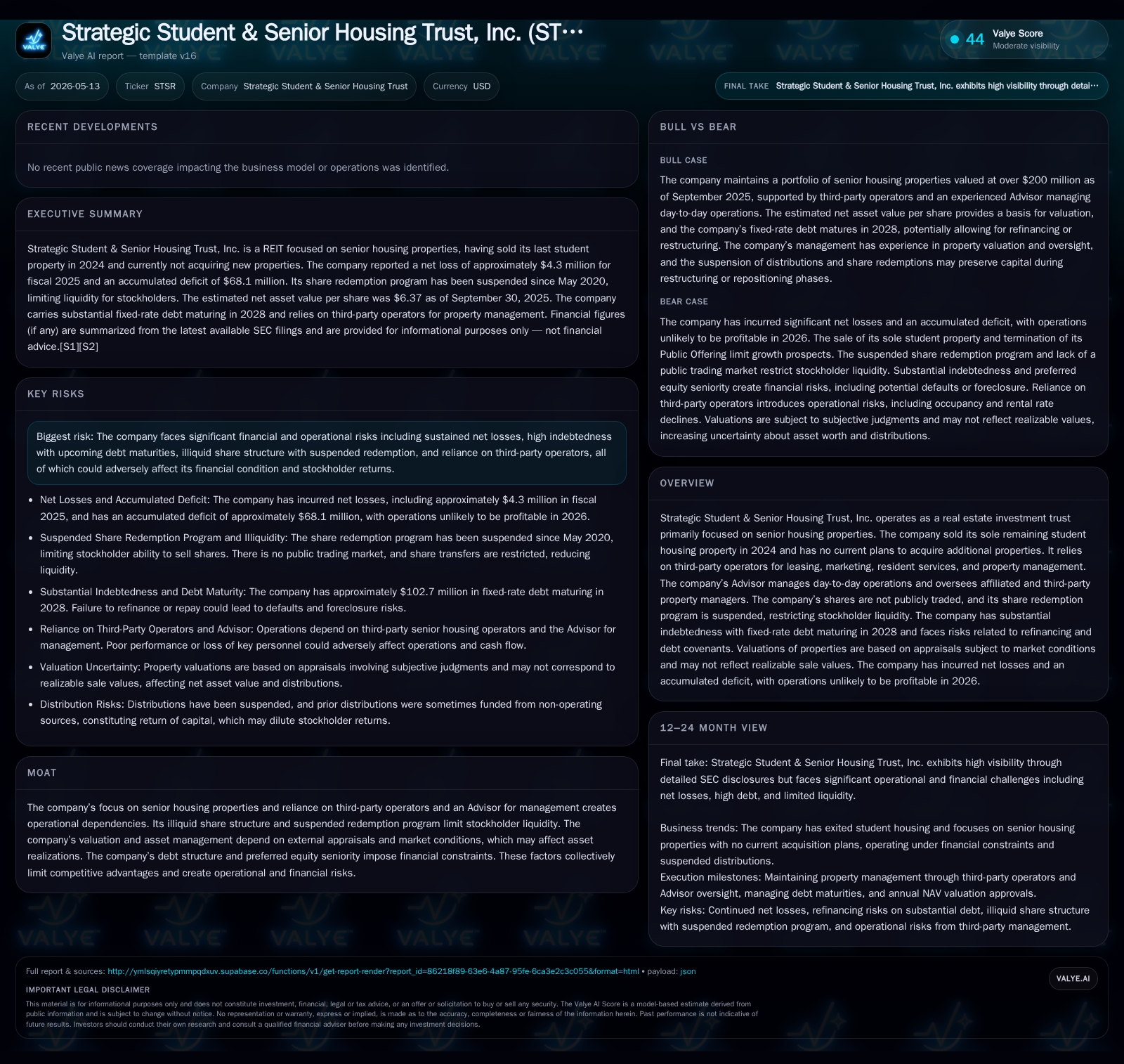
Strategic Student & Senior Housing Trust, Inc. (STSR) has transitioned to a pure-play senior housing REIT following the 2024 sale of its last student housing property. Its May 2026 quarterly filing confirms the continued suspension of its share redemption program, restricting investor liquidity and underscoring operational challenges. The company leans heavily on third-party operators and an external Advisor for all property management functions, which introduces execution dependencies. Significant fixed-rate debt matures in 2028, raising refinancing risks in a rising interest rate environment. STSR’s estimated net asset value per share was recently set at $6.37, reflecting appraised portfolio valuations subject to market fluctuations. Growth prospects are constrained by halted property acquisitions and financial leverage, while operational cash flow remains under pressure amid sustained losses.
Recent Operating Update
The most consequential update for Strategic Student & Senior Housing Trust, Inc. (STSR) came from its Form 10-Q filed on May 13, 2026 [S2]. The filing reconfirms the company’s suspension of its share redemption program since May 2020—a pivotal development that effectively locks-in shareholders given the illiquid nature of the shares. This restriction limits investor flexibility amid ongoing operational challenges.
Moreover, STSR reported no acquisitions or strategic moves toward expanding its portfolio since it fully exited the student housing sector in 2024 [S1]. The company now solely holds senior housing assets. This shift closes off growth avenues via new property investment at present.
Financially, STSR carries approximately $102 million in fixed-rate mortgage debt maturing in 2028 [F1].
Business Model Overview
STSR operates as a non-traded real estate investment trust specializing exclusively in senior housing assets following the divestiture of its sole student housing property in 2024 [S1]. It generates revenue primarily through lease income on these mature assets.
A notable feature of its business model is heavy reliance on third-party operators for leasing, marketing, resident services, and day-to-day property management. Additionally, an external Advisor is responsible for overseeing these property managers and handling administrative functions. This outsourcing model reduces direct operational control but also limits fixed overhead expenses.
Revenue mechanics revolve around occupancy rates within senior living communities managed by third parties who provide resident services under separate agreements. Since STSR does not directly manage residents or marketing efforts, its top-line performance heavily depends on operator execution quality and market demand.
Margins and cash flows can fluctuate with occupancy levels and rental rate adjustments, but given the contractual arrangements with operators—likely fee-based or percentage-of-revenue structures—STSR's gross margins may be compressed compared to self-managed REITs. Cash conversion timing also hinges on operator remittance schedules.
Industry Structure and Competitive Positioning
The senior housing market is highly fragmented with large national players operating integrated care facilities providing independent living, assisted living, memory care, and skilled nursing services. Some competitors operate their own management vertically or through affiliated entities.
In contrast, STSR’s model as a capital-light landlord focusing exclusively on property ownership positions it lower in the value chain than full-service operators but isolates it somewhat from operational risks inherent in resident care services.
However, this structure introduces dependence risk on outsourced operators’ performance and market reputation.
Nonetheless, no explicit backlog or acquisition pipeline has been disclosed recently [S2]. Capital raises via public offerings are currently inactive.
Risks and Watchpoints
Several material risks stand prominently:
- Refinancing Risk: Large fixed-rate mortgage debt matures in 2028 totaling over $100 million [F1]. Rising interest rates or credit market tightening could increase interest costs substantially if refinancing occurs at worse terms or is delayed.
- Illiquid Share Structure: Stockholders face limited exit opportunities due to suspended redemptions since May 2020 [S1,S2], reducing investor appeal and potentially depressing share values.
- Operational Dependence: Reliance on third-party operators creates execution risk; any operational shortcomings could depress occupancy and revenue without direct recourse by STSR.
- Net Losses / Cash Flow Pressure: Continued net losses with accumulated deficits exceeding $68 million hamper financial flexibility [S1]. Negative cash flow challenges distribution resumption possibilities.
- Asset Valuation Volatility: NAV per share ($6.37 as estimated September 30, 2025) depends heavily on appraisals sensitive to cap rates and discount rate inputs [S18,S26]. Market downturns could depress realizable asset values.
- Debt Covenant Compliance: Existing loan covenants restrict financial maneuvering; breach could trigger defaults leading to foreclosure risks.
- Regulatory Exposure: Costs related to ADA compliance and liability insurance claims remain ongoing concerns affecting operating costs [S16,S28].
What to Watch Next
Key milestones include:
- Debt Refinancing Developments: Any announcements regarding refinancing strategies or negotiations ahead of the scheduled 2028 maturities will be critical to gauge financial stability.
- Redemption Program Status: Updates on potential reinstatement or amendments could impact shareholder liquidity perceptions significantly.
- Operating Performance Metrics: Occupancy trends reported by third-party operators will signal demand sustainability within the senior living portfolio.
- NAV Revaluations: Annual updates to estimated net asset value per share will reflect changing market sentiment toward underlying real estate assets.
- Capital Deployment Moves: Any shift toward acquisitions or asset sales would indicate strategic repositioning beyond holding pattern status.
Financial Profile Summary
Latest financial snapshot
| Metric | Value | Period |
|---|---|---|
| Cash & equivalents | $4.44mm | |
| 2026-03-31 | ||
| Total debt | $102.3mm | |
| 2026-03-31 | ||
| Net debt | $97.8mm | |
| 2026-03-31 |
Source: SEC companyfacts cache [F1].
At March 31, 2026, STSR held $4.44 million in cash alongside approximately $102 million in total debt resulting in roughly $97.8 million net leverage [F1]. The debt is fixed-rate with maturity set for 2028 but stands as a significant leverage burden relative to a NAV around $83.5 million [S20],[F1].
While demographic trends underpin long-term demand for senior living accommodations structurally supporting the business model substrate, immediate growth drivers appear muted amid financial constraints and suspended liquidity pathways for shareholders. Monitoring debt management initiatives alongside operational execution by third-party operators will be paramount indicators shaping the company’s near-term outlook.
Disclaimer: This report is for informational purposes only and does not constitute investment advice or an offer to buy/sell securities.
Disclaimer: This is research-only, informational analysis and not investment advice. It may include AI-generated interpretation and general industry context. Always verify important details using primary sources.

Comments