
Rapid Line Inc. Advances Cognitive Platform Amid Capital Challenges
Rapid Line’s latest quarterly filing highlights a technology startup advancing a brain-computer interface cognitive learning platform while confronting critical capital constraints and zero revenue.
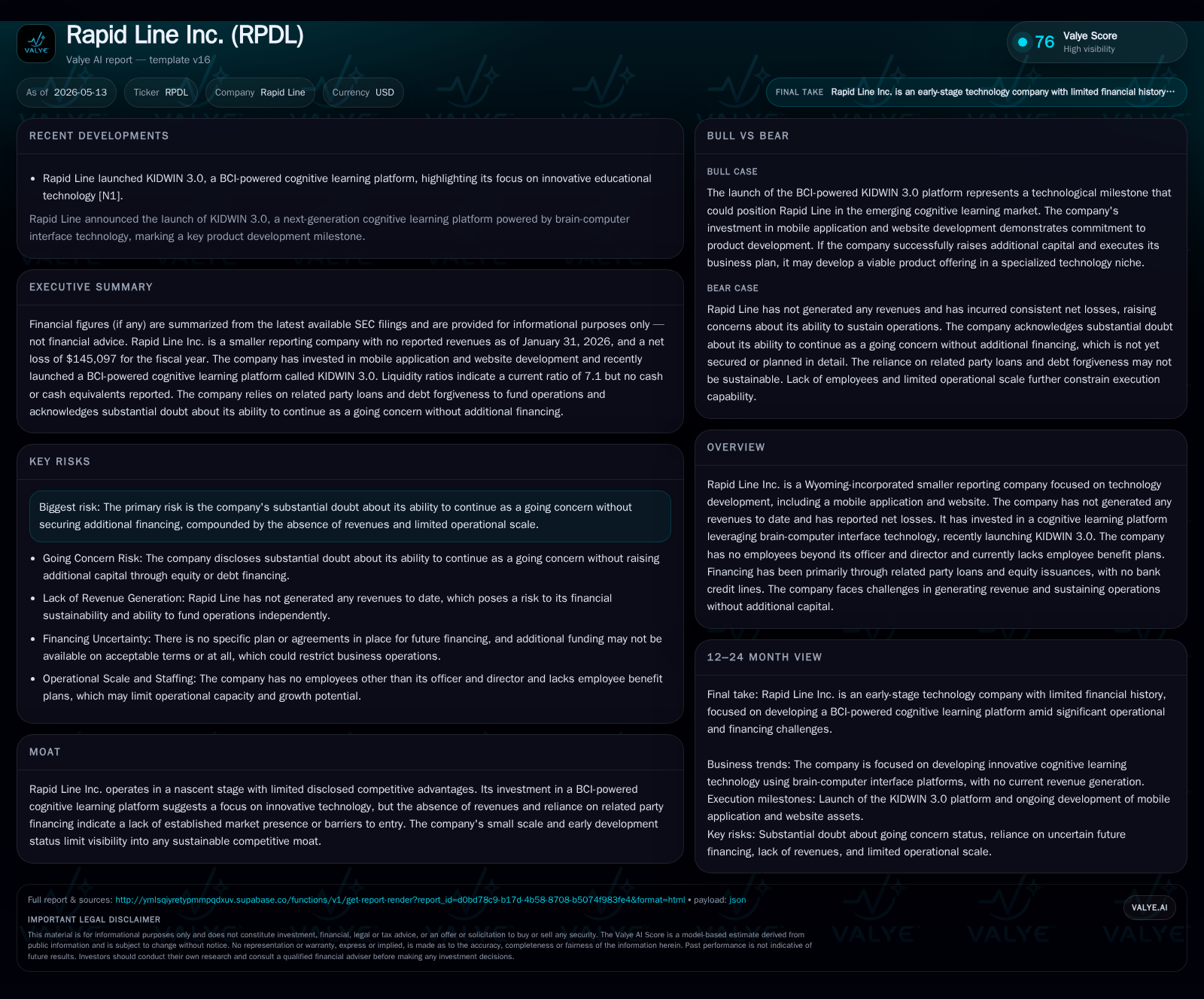
Rapid Line Inc. remains focused on developing its cognitive learning platform, KIDWIN 3.0, leveraging brain-computer interface technology, yet has not generated revenue to date. The company’s December 2025 quarterly report reveals a limited cash runway of roughly three months without new funding, with no bank credit lines and reliance on equity or debt issuances for operations. Despite significant operating losses and recurring need for capital injections, Rapid Line continues to invest in product development and marketing in an emerging BCI market with modest competitive advantages. Going concern risks abound absent fresh financing or revenue growth.
Latest Quarterly Operating Update: Funding and Operational Status
Rapid Line's Q3 2025 report filed December 8, 2025 ([S2]) underscores the firm’s precarious financial footing during ongoing product development. The disclosures specify that the existing working capital combined with anticipated cash flows can sustain operations only over the next three months. Critically, the company lacks any bank credit lines or external financing arrangements aside from private placements of equity and debt securities.
Management anticipates further scaling of operating expenses linked to planned inventory acquisition, developmental efforts for its start-up initiatives, and marketing pushes aimed at gradual market entry. Given these expanding cost drivers and the absence of revenues—confirmed again as zero for the three- and nine-month periods ending October 31—the company forecasts a need for additional capital raises via equity or debt issuances to meet longer-term obligations ([S2], [F1]).
The absence of established financing relationships beyond related-party loans restricts Rapid Line’s financial flexibility. This narrow runway highlights acute execution risk hinging fundamentally on prompt successful fundraises.
Business Model and Product Overview: Cognitive Learning Platform and KIDWIN 3.0
As detailed primarily in the latest annual filing dated May 13, 2026 ([S1]), Rapid Line positions itself as a specialized technology developer with core offerings centered around its cognitive learning system powered by brain-computer interface (BCI) technology. The flagship product iteration is KIDWIN 3.0, accessed through mobile application and website platforms.
The business model hinges on technological innovation enabling enhanced cognitive function training via direct neural interaction. However, the company has yet to commercialize these offerings or generate any customer-based revenues ([F1], [S1]).
Organizationally, Rapid Line maintains an extremely lean setup with no employees other than named officers/directors and lacks formal employee benefits programs—indicative of early-stage startup conditions where operational focus remains fixed on R&D rather than sales or support infrastructure ([S1]).
Financing history includes related-party loans and equity issuances but no broader institutional capital commitments or credit facilities ([S1], [F1]). This structure imposes limitations on scaling capacity until product-market fit is demonstrated.
Industry Context: Brain-Computer Interface Innovation and Competitive Dynamics
Rapid Line operates within a nascent ecosystem at the intersection of BCI technology and cognitive enhancement software—a space marked by rapid technological flux yet shallow commercialization history ([S1]). The application of BCI to education or cognitive skill-building represents a frontier segment with significant R&D intensity but few entrenched players.
Competitive moat is limited due to the following factors:
- Minimal established customer switching costs given lack of operational traction currently.
- Early-stage intellectual property positioning but yet unproven proprietary advantage beyond conceptual BCI integration.
- Regulatory frameworks for BCI applications remain evolving but do not currently impose material barriers restricting entry or innovation speed.
Thus, Rapid Line inhabits an environment where innovation pace must overcome significant adoption inertia—addressing user validation, ergonomic design challenges in neurotech interfaces, and market education hurdles simultaneously.
Growth Drivers: Technology Advancement, Market Potential, and Capital Deployment
Growth prospects hinge critically on substantive advances in their KIDWIN platform’s functional capabilities along with successful transition toward go-to-market readiness. Potential drivers include:
- Product iterations that improve user experience or effectiveness in cognitive skill acquisition supported by emerging neuroscience research.
- Scaling customer uptake in segments open to cognitive enhancement tools such as education technology spheres, therapeutic domains, or workforce training ecosystems.
- Adequate funding deployment fueling inventory procurement necessary for device-based BCI hardware if applicable, as well as digital marketing campaigns designed to attract early adopters—activities cited as pending capital-dependent ([S2]).
Notably, absent new funding rounds raising sufficient cash reserves to finance these operational expansions will severely constrain growth trajectories irrespective of underlying technological promise.
Risk Factors and Constraints: Going Concern Doubts and Financing Dependence
Persistent material risk shadows Rapid Line due to its inability to self-fund beyond short horizons without additional external financing ([S2], [S1]). Key concerns include:
- Zero revenues achieved since inception highlighting fundamental market-entry failure so far.
- Operating losses escalating sharply—with FY2026 net loss reported at -$145K accompanied by deteriorated operating cash outflows exceeding -$146K—unmitigated by any positive cash flow from operations ([F1]).
- Heavy reliance on related-party loans historically followed by debt forgiveness episodes underscores fragile financial underpinnings lacking broad investor commitment ([S2], [F1]).
- Absence of bank lending lines indicates restricted access to conventional credit markets; planned equity/debt issuance efforts face dilution risk impacting shareholder value; no clear arranged funding pipeline is publicly identified ([S2]).
- Management explicitly states substantial doubt about continuing as a going concern without securing new capital infusions ([S1], [S2]).
These constraints collectively pose existential risk until definitive progress is made in either commercial validation or fund raising success.
Key Milestones and What to Watch Next
Investors analyzing Rapid Line should monitor several critical forthcoming indicators including:
- Announcements detailing concrete plans or commitments for capital raise executions—either private placements or public offerings—as these will directly underpin survival prospects ([S2]).
- Technical progress updates on KIDWIN versions potentially signaling readiness for beta releases or pilot deployments enhancing credibility around usability claims ([S1]).
- The emergence of strategic partnerships with educational institutions, healthcare providers, or hardware manufacturers which could validate product-market fit assumptions.
- Any modifications in leadership structure or scaling headcount beyond current lean model suggesting operational ramp-up initiatives.
Transparent disclosures around these dimensions will serve as directional signals for assessing Rapid Line’s pathway out of developmental infancy.
Financial Performance and Capital Structure Overview
The company’s financial trajectory has been marked by sustained net losses reflecting zero revenue generation alongside relatively modest operating expense bases reflective of small scale:
Historical performance (annual)
Capital returns and efficiency (annual)
Recent quarterly reports reveal that total assets hover near $27K against liabilities approximately $2.7K yielding an encouraging current ratio north of 7; however this strength is offset by substantial accumulated deficit equity nearing -$68K reflecting extensive retained losses ([F1], [S2]).
Substantial debt forgiveness totaling approx. $144K in prior periods has temporarily relieved immediate creditor pressure but does not substitute for sustainable funding mechanisms nor indicate viable revenue inflows imminently forthcoming ([S2], [F1]).
Capitalization remains concentrated among insiders/related parties with no widely diversified institutional investment presence documented thus far ([S1]).
Overall financial profile paints a picture typical of very early-stage tech startups deeply dependent on successive funding cycles before generating meaningful commercial returns.
This analysis synthesizes information disclosed within public filings up to May 13, 2026 ([S1], [S2]) combined with historical financial data from SEC XBRL datasets ([F1]). It does not constitute investment advice but offers an informed industry perspective grounded strictly in documented evidence.
Disclaimer: This is research-only, informational analysis and not investment advice. It may include AI-generated interpretation and general industry context. Always verify important details using primary sources.

Comments