
ASTRONICS Corp Strengthens Aerospace Edge with Strategic Credit Move
Astronics’ latest quarter reveals a new $300 million revolving credit facility enhancing liquidity and supporting growth amid aerospace market cyclicality.
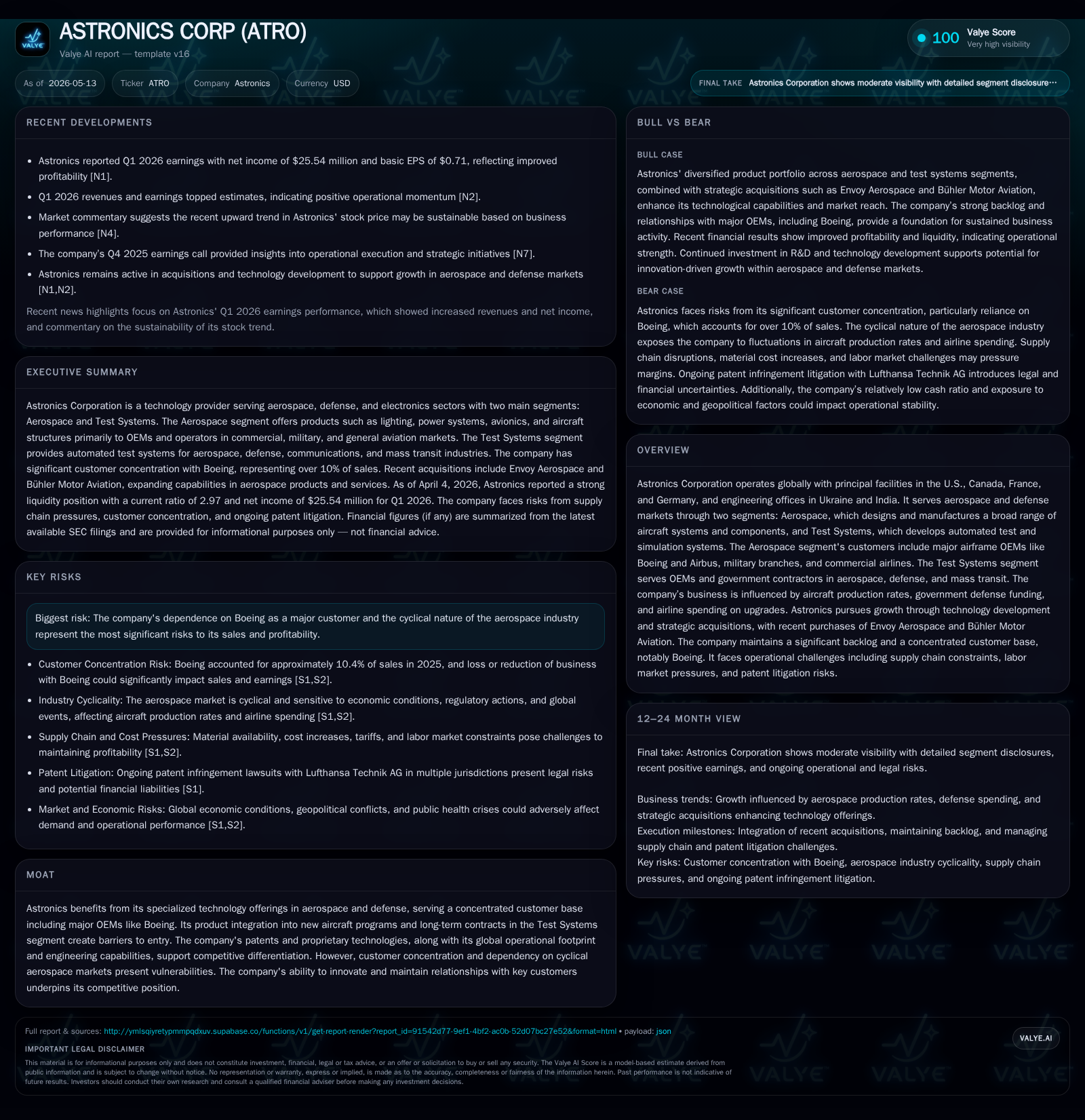
In its Q1 2026 filing, Astronics Corporation replaced its prior asset-based lending facility with a $300 million senior secured revolving credit facility, providing substantial borrowing capacity and covenant flexibility. This capital structure move aligns with the company’s strategic focus on operational efficiency and execution of growth initiatives in both its Aerospace and Test Systems segments. Serving major aerospace OEMs and defense contractors, Astronics benefits from specialized technology offerings but remains exposed to the cyclical nature of aircraft production and customer concentration risks. The company’s recent acquisitions and increased capital expenditures signal a proactive approach to bolster product breadth and capacity. Key upcoming milestones include monitoring commercial aerospace demand recovery and integration progress of acquired businesses.
Recent Quarterly Highlights and Capital Structure Update
Astronics Corp’s first quarter filing dated May 13, 2026 ([S2]) unveiled a critical evolution in its capital structure: the replacement of its previous asset-based lending (ABL) revolving credit facility with a $300 million senior secured revolving credit facility entered into October 22, 2025. This new facility extends the maturity to October 16, 2030 — substantially longer than the old ABL's maturity — signifying stronger financial flexibility.
As of April 4, 2026, the company had drawn $85 million against this line but retains approximately $212.8 million available for future drawdowns after accounting for letters of credit ([S4]).
This refinancing reduces borrowing costs via Term SOFR-based interest margins ranging from 1.25% to 2.125%, down from higher pricing under the terminated ABL facility ([S5][S6]). The improved borrowing base directly supports Astronics’ operational agility amid persistent aerospace industry cyclicality by enabling higher capex outlays and acquisition activity without liquidity constraint concerns ([N1]).
Business Model, Core Segments, and Product Quality
Astronics’ business model is anchored upon two reportable segments: Aerospace and Test Systems ([S1],[S16]).
The Aerospace segment primarily supplies advanced aircraft systems such as inflight entertainment & connectivity products, lighting & safety hardware, electrical power generation/distribution components, flight-critical systems, seat motion technologies as well as certification services via Envoy Aerospace ([S11],[N1]). Customers include major airframe manufacturers like Boeing and Airbus as well as commercial airlines globally ([S13]). Revenues here are sensitive to commercial transport aircraft production cycles but also benefit from aftermarket upgrades.
The Test Systems segment develops automated test equipment used by aerospace/defense OEMs and government contractors ([S1]), including simulation solutions utilized in military electronics testing and mass transit systems ([S16]). This segment operates largely under long-term fixed-price or volume contracts providing a relatively steadier revenue stream that partially offsets Aerospace segment cyclicality ([S13]).
Astronics maintains manufacturing facilities across the U.S., Canada, Europe (France & Germany) with engineering hubs in Ukraine and India ([S1]), positioning it well to serve global OEMs while managing cost structures effectively.
Product quality is supported by proprietary engineering expertise combined with FAA certification capabilities now bolstered by the Envoy Aerospace acquisition completed mid-2025 ([S11]). The company focuses on sustaining technological differentiation through innovation in flight entertainment systems and power management solutions where switching costs favor incumbents due to rigorous qualification processes.
Competitive Landscape and Industry Dynamics
Astronics operates within a competitive aerospace supplier ecosystem dominated by large diversified suppliers as well as specialized component manufacturers ([S13]). Within Aerospace systems supply to Boeing/Airbus programs, Astronics faces competition from vertically integrated suppliers advantaged by scale but counters with niche product specialization in cabin electronics and electrical power distribution.
The Test Systems segment competes for defense contracts alongside government-focused equipment makers where barriers stem from complex regulatory compliance requirements and certified performance standards ([N9],[N12]). These factors create entry hurdles that support pricing leverage.
Industry cyclicality is a prominent theme; commercial aircraft OEM production rates fluctuate based on airline demand which impacts upstream suppliers’ order flows ([S1]). Post-pandemic travel recovery has progressively driven up build rates but supply chain constraints have occasionally bottlenecked delivery schedules requiring capacity investment ([N9],[N12]).
Capacity expansions by Astronics — evident in notable Q1 capital expenditure jumps especially within the Aerospace segment — demonstrate commitment to meeting increasing backlog demand while maintaining quality control ([S2],[N1]). Regulatory changes have presented minimal direct impact so far but remain monitored given government contracting exposure particularly in test systems ([S1],[N6]).
Key Growth Drivers and Execution Paths
Growth levers for Astronics hinge on several dimensions:
- Increasing commercial transport aircraft production at Boeing/Airbus as global air travel volume strengthens drives component orders ([N1],[S2]).
- Airlines upgrading cabins with inflight entertainment connectivity enhancements provide aftermarket recurring revenue potential within Aerospace segment product lines ([N2],[N1]).
- Defense budget allocations fuel the Test Systems business via sustained contract wins for automated electronic test solutions essential for modern avionics validation ([S16],[N2]).
- Acquisition strategy centered on bolstering technology capabilities illustrated by Envoy Aerospace’s FAA certification authority services and Bühler Motor Aviation’s motor technology broaden cross-selling opportunities ([S11],[N1],[N2]).
- Increased capital expenditures ($10.7 million invested in Aerospace during Q1 FY2026) aimed at manufacturing capacity expansion reflect proactive management of anticipated demand ramp-up ([S2]).
Operational execution emphasizes leveraging these growth engines through targeted project wins combined with initiatives aiming at simplification activities started last year to boost operating efficiencies amid cost pressures ([S8],[N1]). KPIs like order backlog growth, aircraft build rate data points from major OEMs, acquisition integration timeline adherence stand out as effective barometers for monitoring progress.
Risks, Customer Concentration, and Market Cyclicality
Customer concentration risk remains significant; Boeing alone constitutes a disproportionately large share of Aerospacesegment revenues which exposes Astronics materially to changes in Boeing’s production forecasts or program delays ([S13],[N6]).
The cyclicality embedded within commercial aviation sectors infuses revenue volatility: reductions in discretionary air travel or airline investment slowdowns can trigger order deferrals or cancellations that ripple upstream through suppliers like Astronics ([S1],[N6]). Historical sensitivity during economic downturns underscores this vulnerability.
Government funding trends influence the Test Systems segment though contractual relationships offer some predictability; however geopolitical instability or regulatory shifts impacting defense budgets could alter future spending patterns negatively ([S26],[N6]).
Integration risks related to acquisitions remain pertinent: failure to synthesize acquired units swiftly could dilute returns or inflate costs undermining growth prospects ([S23]). Additionally, supply chain disturbances affecting raw material availability or component sourcing add operational uncertainty.
Upcoming Catalysts and Operational Milestones
Near-term monitoring items include:
- Updates on commercial transport aircraft order books from Boeing/Airbus expected in upcoming earnings releases acting as leading indicators for Aerospace revenue trajectory ([N2],[S24]).
- Progress reports on acquisition integration milestones especially Envoy Aerospace’s contribution to certification pipeline expansion will illustrate value creation pace ([S16],[N1]).
- Execution outcomes tied to recently elevated capital expenditure programs; tracking resultant output improvements or backlog fulfillment rates will reveal capacity alignment efficacy ([S2]).
- Broader macroeconomic factors including airline passenger demand recovery velocity influencing retrofit spending patterns for cabin upgrades remain pivotal external growth signals ([N1],[N2]).
- Compliance with financial covenants under the new revolving credit facility serves as an ongoing governance gauge ensuring liquidity sufficiency amidst fluctuating cash flow cycles ([F1]).
Continued operational discipline managing costs while scaling manufacturing throughput will be essential as Astronics seeks to convert backlogs into revenue sustainably.
Latest Financial Snapshot: Balance Sheet Health and Liquidity
Latest financial snapshot
| Metric | Value | Period |
|---|---|---|
| Cash & equivalents | $12mm | |
| 2026-04-04 | ||
| Current assets | $469mm | |
| 2026-04-04 | ||
| Current liabilities | $158mm | |
| 2026-04-04 | ||
| Current ratio | 2.97x | |
| 2026-04-04 |
Source: SEC companyfacts cache [F1].
| Metric | Latest (Q1 FY2026) |
|---|---|
| Cash & Equivalents | $11.9 million |
| Total Revolving Debt | $85.0 million |
| Current Assets | $468.6 million |
| Current Liabilities | $157.7 million |
| Current Ratio | 2.97 |
As per the April 4 quarter-end filings ([F1]), Astronics maintains strong liquidity highlighted by a nearly threefold current ratio reflecting adequate short-term asset coverage over liabilities.
Such financial positioning reduces refinancing uncertainties prevalent among mid-tier aerospace suppliers enabling management focus on executing strategic growth initiatives without immediate balance-sheet constraints.
This analysis synthesizes information disclosed by Astronics Corporation through SEC filings dated February-May 2026 coupled with recent market commentary known as of mid-May 2026. It aims to provide an informed perspective on operational developments without any investment recommendation or forecast implication.
Disclaimer: This is research-only, informational analysis and not investment advice. It may include AI-generated interpretation and general industry context. Always verify important details using primary sources.

Comments