
Giftify's Post-CardCash Acquisition Trajectory: Scaling Gift Card Exchange and Restaurant Deals
Giftify advances integration of CardCash and Takeout7, leveraging technology and partnerships to reshape its market footprint.
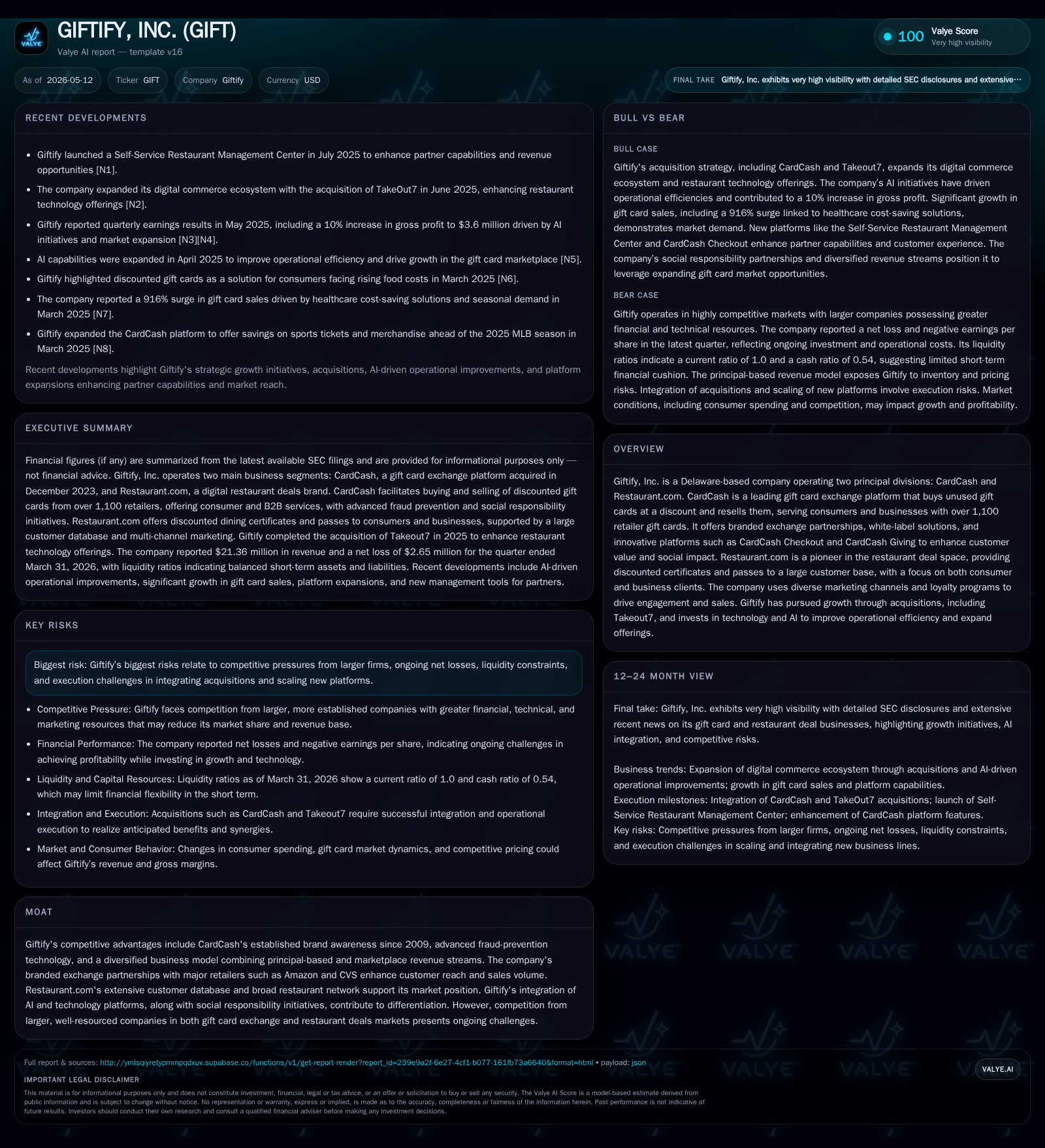
In its latest 10-Q filing dated May 12, 2026, Giftify highlighted continued efforts to integrate its recently acquired CardCash gift card exchange platform alongside the newly merged Takeout7 into its Restaurant.com division. These moves aim to scale transaction volume through enhanced AI-driven processing efficiency and broaden market reach via branded partnerships. While maintaining a roughly balanced liquidity position with $4.2 million cash against similar current liabilities, Giftify faces risks including Nasdaq listing pressure and ongoing net losses. The company's growth hinges on successful platform convergence, operational leverage from machine learning applications, and expanding merchant and consumer network effects in both gift card resale and restaurant discount spaces.
Latest Quarterly Update: Integration and Operational Highlights
Giftify's May 12, 2026 10-Q [S2] underscores ongoing integration efforts following key acquisitions that materially reshape its operational profile. The core highlight is the continuing incorporation of CardCash Exchange into Giftify’s ecosystem post the December 2023 acquisition for $26.7 million [S1]. CardCash’s platform specializing in buying unused merchant gift cards at a discount and reselling them has been a proven generator of consumer and business transactions across more than 1,100 retailers.
Additionally, the May 2025 acquisition of Takeout7—a restaurant technology firm providing online ordering solutions powered by AI marketing tools—has been merged into the Restaurant.com division early this year [S1]. This move extends Giftify’s restaurant deal offerings by injecting comprehensive digital marketing capabilities aimed at independent restaurants.
Management commentary from the recent filings signals a strategic priority to scale CardCash's gift card processing volumes by four to five times with only a modest rise in costs through increased utilization of machine-learning transaction processing facilitated by richer data inputs [S1]. These technology investments are designed to boost operating leverage within CardCash's marketplace model while strengthening fraud prevention.
The company is concurrently managing market challenges reflected by a Nasdaq listing warning issued in March/April 2026 due to the stock price falling below the minimum $1 bid requirement for over 30 trading days [S3]. This regulatory signal introduces a reputational risk dimension influencing investor sentiment though does not immediately impair operations.
Overall operational momentum relies heavily on executing these integrations effectively while ramping AI-backed processing efficiencies.
Business Model Overview: Synergies of CardCash and Restaurant.com
Giftify operates fundamentally through two principal divisions centered around distinct but complementary value propositions [S1]:
CardCash acts as a leading gift card exchange platform buying unused merchant gift cards at discounted rates from consumers/distributors and reselling them with markups. Its revenue arises from difference spreads plus fees across a portfolio exceeding 1,100 retailer brands such as Target and Starbucks. CardCash supports multiple revenue streams including branded exchange partnerships (notably Amazon and CVS), white-label solutions for partners, and innovative platforms like CardCash Checkout for seamless e-commerce integration. It targets both B2C consumers looking for discounts on merchant cards and B2B clients who trade in bulk.
Restaurant.com pioneers discount dining certificates benefiting consumers seeking value deals as well as restaurants requiring digital marketing exposure. It drives engagement through loyalty programs supported by multi-channel marketing approaches. The business has expanded its technological scope by acquiring Takeout7 whose AI-powered Platr platform offers end-to-end online ordering combined with digital marketing targeting smaller restaurants.
This dual-division model enables Giftify to cross-leverage consumer bases—card buyers may be cross-marketed restaurant deals while restaurant partners gain exposure via loyalty incentives tied to gift card consumption patterns. The mix of principal-based inventory models (CardCash purchasing gift cards upfront) alongside marketplace facilitation offers diversified revenue sources along with differentiated margin profiles.
Competitive Environment: Navigating Established Players and New Entrants
Giftify competes in a fragmented but competitive landscape marked by large legacy players possessing far greater capital resources, extensive customer bases, and marketing reach [S1]. Larger retailers themselves operate proprietary gift card exchange programs or marketplaces creating pricing pressure on third-party reseller platforms like CardCash.
On the restaurant deals side, competition ranges from generic coupon aggregators to specialized dining deal providers offering localized or high-volume discounts. Many competitors enjoy entrenched customer loyalty or superior technology budgets enabling rapid adoption of novel fintech or marketing tools.
Giftify differentiates via:
- Its long-standing CardCash brand since 2009 with strong consumer awareness enhanced through multi-channel marketing.
- Proprietary fraud-prevention mechanisms critical in mitigating risks typical of discounted gift card trading which can erode trust if mishandled.
- Strategic branded partnerships expanding access beyond standard open marketplace sales.
- Integration of advanced AI/ML transaction processing aiming at superior efficiency gains versus incumbents reliant on manual or legacy infrastructures.
- An emerging ecosystem synergy between CardCash’s B2C/B2B reach coupled with Restaurant.com’s loyalty-driven customer reactivation framework.
Nonetheless, capital constraints relative to deeper-pocketed rivals restrict aggressive pricing maneuvers or broadscale expansion investments without external financing support.
Growth Catalysts: Technology, Acquisitions, and Market Penetration
Recent filings indicate several growth levers poised to accelerate Giftify’s trajectory:
AI-Powered Transaction Processing: CardCash targets scaling its gift card volume throughput by four to five times leveraging machine learning for fraud detection, transaction routing optimization, and process automation with limited incremental operational cost increase [S1]. This technological edge promises margin improvement potential if realized at scale.
Acquisition Synergies: The assimilation of Takeout7 into Restaurant.com not only adds ordering capability but also deepens Giftify’s B2B service stack via AI-enhanced digital marketing tools tailored to independent restaurants—a segment traditionally underserved yet strategically sizable [S1].
Branded Exchange Partnerships Expansion: Existing high-profile retailer collaborations catalyze card inventory sourcing quality plus consumer trust. Expanding these alliances broadens addressable market opportunities while improving sales velocity through co-marketing initiatives.
Diversified Revenue Streams: Combining direct purchase/resale arbitrage at CardCash with fee/app-based income from Restaurant.com’s deals plus white-label solutions mitigates demand cyclicality risks inherent solely within either segment.
Customer Loyalty Programs: Persistent engagement efforts incentivize repeat usage across both divisions driving customer lifetime value enhancements beyond acquisition cost pressures.
Risks and Execution Challenges: Leveraging Advantages Amid Pressure
Giftify confronts tangible headwinds affecting scalability:
Competitive Intensity: Larger industry incumbents benefit from entrenched scale advantages operationally lowering cost-of-customer-acquisition versus Giftify which remains dependent on maintaining differential tech capabilities.[S1]
Ongoing Net Losses: Operating income remains negative exceeding $10 million annually as reported in the latest full fiscal year [F1], constraining reinvestment capacity without raising additional equity or debt capital sizable enough yet undemonstrated as sustainable.[F1]
Liquidity Ambiguity: Despite maintaining about $4.18 million cash closely matched against near-identical $7.73 million current liabilities (ratio
1) [F1], the firm’s modest debt burden ($34k) offers some cushion but access to new funding remains uncertain especially given market volatility.Nasdaq Listing Warning: A recent notice concerning failure to meet minimum bid price rules could undermine shareholder confidence triggering share price volatility or liquidity challenges [S3].
Integration Complexity: Fully realizing promised synergies from acquisitions such as Takeout7 demands seamless cultural/technical alignment along with timely product rollout execution which historically costs time/money.[S2]
Cybersecurity Risks: Given substantial reliance on digital transaction infrastructure coupled with payment data flow obligations, potential security breaches pose operational disruption risks managed via ongoing governance oversight but potentially material if incidents occur [S1].
Forward Outlook: Milestones and Market Signals to Monitor
Key indicators for Giftify's near-term performance will likely include:
- Measurable gains in transaction volume multipliers at CardCash initiated through advanced machine learning deployments aiming at processing efficiency scale targets [S2].
- Customer retention metrics within Restaurant.com following Takeout7 integration revealing adoption rate of new ordering/digital marketing tools among independent restaurants [S2].
- Announcements of new branded exchange partnership expansions or enhanced white-label client wins reflecting distribution strength enhancements [S1].
- Regulatory filings or issuer updates addressing Nasdaq listing compliance status potentially impacting stock trading liquidity conditions [S3].
- Improvement trajectories in gross margins reflecting cost structure shifts tied to technology leveraging efforts as disclosed in management commentary [S1].
- Cash flow burn rate moderation aligning with strategic capital controls signaling path toward longer-term sustainability [F1].
Financial Snapshot: Balance Sheet Health and Profitability Trends
Latest financial snapshot
| Metric | Value | Period |
|---|---|---|
| Cash & equivalents | $4mm | |
| 2026-03-31 | ||
| Current assets | $8mm | |
| 2026-03-31 | ||
| Current liabilities | $8mm | |
| 2026-03-31 | ||
| Current ratio | 1x | |
| 2026-03-31 |
Source: SEC companyfacts cache [F1].
| Metric | Value (USD) | Period Ended |
|---|---|---|
| Cash & Equivalents | 4,181,974 | |
| 2026-03-31 | ||
| Total Debt | 34,066 | |
| 2023-09-30 | ||
| Current Assets | 7,738,350 | |
| 2026-03-31 | ||
| Current Liabilities | 7,730,719 | |
| 2026-03-31 | ||
| Revenue | 83,181,716 | |
| 2025-12-31 | ||
| Operating Income | -10,354,746 | |
| 2025-12-31 | ||
| Net Income | -10,491,658 | |
| 2025-12-31 |
Giftify's balance sheet reflects balanced short-term liquidity with a current ratio near one based on March quarter-end numbers while carrying very low debt relative to cash holdings [F1]. However, sustained annual operating losses above $10 million underscore ongoing profitability challenges despite growing top-line revenues near $83 million last fiscal year [F1]. Investment in technology platforms coupled with acquisition-associated goodwill totaling over $20 million indicates considerable capital deployed toward long-term growth positioning [S12]. Continuous focus on improving gross margins through platform efficiencies will be essential for moving towards profitability thresholds.
This analysis synthesizes publicly available SEC filings up to May 12, 2026 without offering investment advice or projections beyond disclosed facts. Readers should consider underlying business fundamentals alongside broader industry conditions when evaluating Giftify's future prospects.
Disclaimer: This is research-only, informational analysis and not investment advice. It may include AI-generated interpretation and general industry context. Always verify important details using primary sources.

Comments