
Canary Staked SUI ETF Reviews Operational Trends and Strategic Position
Latest quarterly disclosures reveal ongoing net losses and limited transparency, raising questions on Canary’s strategic positioning in the crypto-asset ETF space.
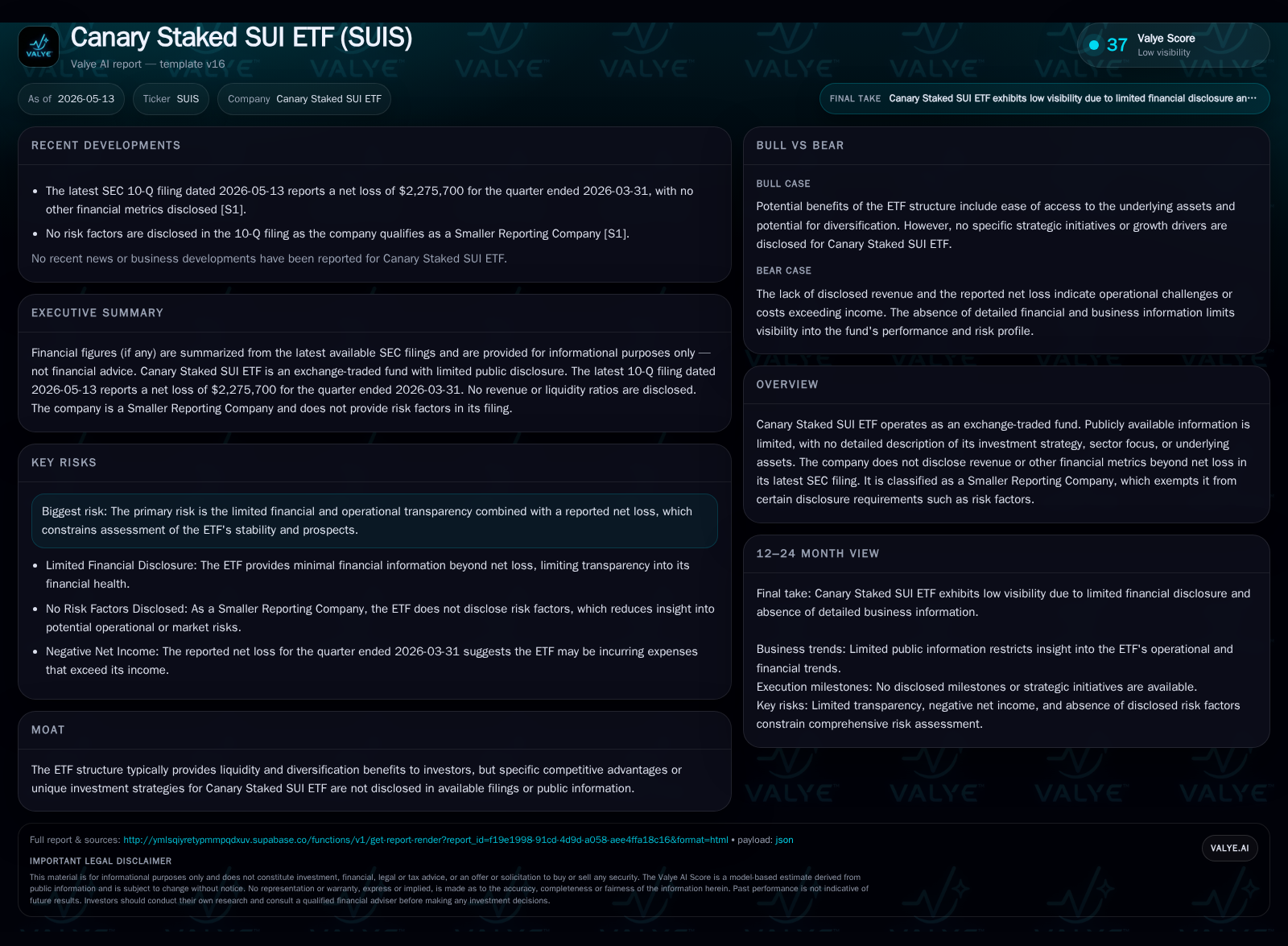
The Canary Staked SUI ETF’s most recent 10-Q filing for Q1 2026 confirms continued net losses without providing granular financial or risk disclosures due to its Smaller Reporting Company status. As an ETF focused on staked crypto assets, it offers typical intraday liquidity and diversification benefits common to exchange-traded products, although specific investment strategy details remain undisclosed. Industry context around crypto ETFs shows regulatory uncertainty and competitive pressures, while key growth drivers are tied to broader adoption of staking products and blockchain assets. However, limited public information constrains assessment of Canary’s competitive moat or operational resilience. Going forward, transparency enhancements and market developments in crypto ETF regulation will be critical to monitor.
Latest Operating Update: Insights from the Q1 2026 Filing
The Canary Staked SUI ETF’s latest quarterly report filed on May 13, 2026 ([S2]) encapsulates a continuation of net losses amounting to approximately $2.3 million by March 31, 2026 [F1]. Notably absent are revenue breakdowns or granular commentary on operating segments. This paucity of details aligns with its "Smaller Reporting Company" classification under SEC rules, which exempts it from submitting a formal risk factors section ([S3]). While this exemption simplifies regulatory filings, it simultaneously poses roadblocks for analysts attempting thorough risk assessment.
The absence of revenue or fee metrics obscures the economic drivers behind the losses—whether attributable to asset management costs, marketing, or market-based valuation pressures remains unclear. No indications exist within these documents of changes in assets under management (AUM), subscription dynamics, or expense restructuring efforts that might otherwise illuminate near-term operational trajectories.
Business Model Overview: Understanding What Canary Staked SUI ETF Offers
By nature as an exchange-traded fund (ETF), Canary Staked SUI is designed to aggregate investor capital to purchase a basket of underlying assets—in this case presumably staked tokens of the 'SUI' cryptocurrency network. While the specific composition is not disclosed in [S2], typical staked asset ETFs derive value both from price appreciation of held tokens plus ongoing staking yields paid by blockchain protocols for securing network consensus.
Revenue mechanisms for such ETFs usually encompass management fees calculated as a percentage of net asset value (NAV) plus ancillary income streams related to securities lending or derivatives overlays; however, this data is not made public here. Investors pay indirectly through these fees which fund operational expenses—costs that must be balanced against returns generated by staking rewards and token appreciation.
The product’s strategic strength lies in providing investors with exposure to complex crypto staking ecosystems while offering the simpler access and liquidity inherent in ETF structures—intraday tradability on conventional stock exchanges avoids custody complexities experienced by direct token holders. This can attract institutional clients seeking regulated vehicles for digital asset exposure.
ETF Industry Context: Positioning within Exchange-Traded Fund Markets
Within the broader ETF marketplace, Canary Staked SUI resides among thematic funds concentrated on blockchain technologies and digital currencies. These niche ETFs increasingly appeal to investors chasing innovative growth sectors yet contend with a still-evolving regulatory backdrop. The SEC has maintained stringent oversight over cryptocurrency offerings due largely to market manipulation concerns and investor protection mandates.
Competitive factors shaping success include transparent pricing models, fee competitiveness versus alternatives (wallets, DeFi staking platforms), liquidity provisions through designated market makers, and clear indexing rules that govern portfolio assembly. These elements ensure tight bid-ask spreads and replicable returns relative to underlying benchmarks—criteria essential for capturing sustained inflows from retail and professional investors alike.
Canary’s competitive positioning cannot be fully assessed given missing disclosures related to fees or benchmark alignment but likely confronts established leaders offering similar products focused on Bitcoin staking or Ethereum participation.
Operational Strengths and Product Benefits: Liquidity and Diversification
ETF architecture naturally conveys several integral operational advantages: foremost intraday liquidity enabling investors to transact shares during exchange hours at real-time prices; secondly diversified holdings reducing idiosyncratic asset risk relative to singular token ownership; thirdly the ability to roll trading costs across pooled assets leading to cost efficiencies for end-users.
For staked crypto assets like those presumably held by Canary Staked SUI, this mitigates direct exposure risks such as node downtime or personal custody errors while preserving yield accrual benefits. Investors gain simplified access without navigating complex validator requirements or platform reliability concerns prevalent in direct staking participation.
While no proprietary technological edge or differentiated stewardship was evidenced within filings ([S2]), reliance on proven ETF mechanics remains a fundamental strength supporting demand stability amid volatile crypto market cycles.
Growth Drivers: Potential Catalysts Amid Limited Disclosure
Even though explicit commentary remains absent regarding growth initiatives by Canary Staked SUI, logical industry drivers offer pathways for potential expansion:
- Escalating demand among institutional investors seeking regulated blockchain yield products over unregulated decentralized finance alternatives.
- Heightened retail awareness fueled by surging interest in stake-earning cryptocurrencies combined with growing acceptance of tokenized instruments on traditional exchanges.
- Innovation within crypto protocols that increase staking incentives thereby enhancing total return profiles attractive through dedicated ETFs.
- Strategic partnerships with liquidity providers and custodians boosting seamless share creation/redemption processes underpinning NAV scaling.
- Expanded distribution channels through brokerage integration facilitating higher accessibility and investor uptake.
Industry analysis suggests that combining the intangible benefits of staking rewards with transparent public market trading features positions ETFs like Canary Staked SUI well for steady demand accumulation if coupled with competitive fees and credible governance frameworks.
Risks and Constraints: Transparency Challenges and Market Uncertainty
The principal impediments faced stem chiefly from constrained disclosure practices inherent in Smaller Reporting Company status ([S3]) which denies stakeholders detailed visibility into risk exposures including counterparty concentration risks or litigation contingencies common in the cryptocurrency domain.
Continuing net losses underline pressing profitability challenges raising questions about cost structure efficiency relative to revenue generation mechanisms [F1]. Concurrently evolving regulatory scrutiny over digital asset funds—currently marked by SEC investigations into crypto compliance violations—injects heightened operational uncertainty threatening fund viability.
Market dynamics characterized by high cryptocurrency price volatility exacerbate valuation risks embedded within NAV calculations impacting investor sentiment abruptly. Additionally, shifts towards alternative DeFi liquidity pools or self-custody options could dilute product demand if ETFs cannot match yield competitivity or convenience advantages.
Lastly, competitive intensity from both established crypto index funds and emerging blockchain thematic ETFs necessitates demonstrated differentiation which Canary has yet to evidence publicly.
Forward Watchpoints: Key Milestones and Industry Signals Ahead
Monitoring future progress demands attention toward metrics often indicative of fund health despite opacity:
- Asset under management trajectories reported in forthcoming quarterly disclosures illustrating demand momentum.
- Movement toward voluntary enhancement of disclosure practices possibly aligned with transitioning out of Smaller Reporting Company scope signaling maturation.
- Regulatory clarity regarding permissible structures for staked crypto ETFs potentially unlocking wider investor eligibility especially institutional mandates.
- Market reception gauged via secondary market liquidity indicators identifying investor confidence levels reflected through trading volumes and bid-ask spreads.
- Innovation announcements such as launching new share classes with reduced fees or enhanced yield optimization strategies augmenting competitive positioning.
Such milestones would considerably improve analytical confidence regarding Canary’s ability to capitalize on growing staking trends while maintaining operational sustainability in a fragmented digital assets ecosystem.
This analysis is based solely on publicly filed regulatory documents and observed industry trends as of May 13, 2026. It does not constitute financial advice or recommendations but aims to contextualize available information concerning Canary Staked SUI ETF. Readers should seek additional data sources before forming investment considerations.
Disclaimer: This is research-only, informational analysis and not investment advice. It may include AI-generated interpretation and general industry context. Always verify important details using primary sources.

Comments