
Cordyceps Sunshine’s Post-Spinoff Product Shift Strains Margins and Liquidity
The company faces contraction after spinning off its cultivation subsidiaries, grappling with negative working capital and ongoing losses.
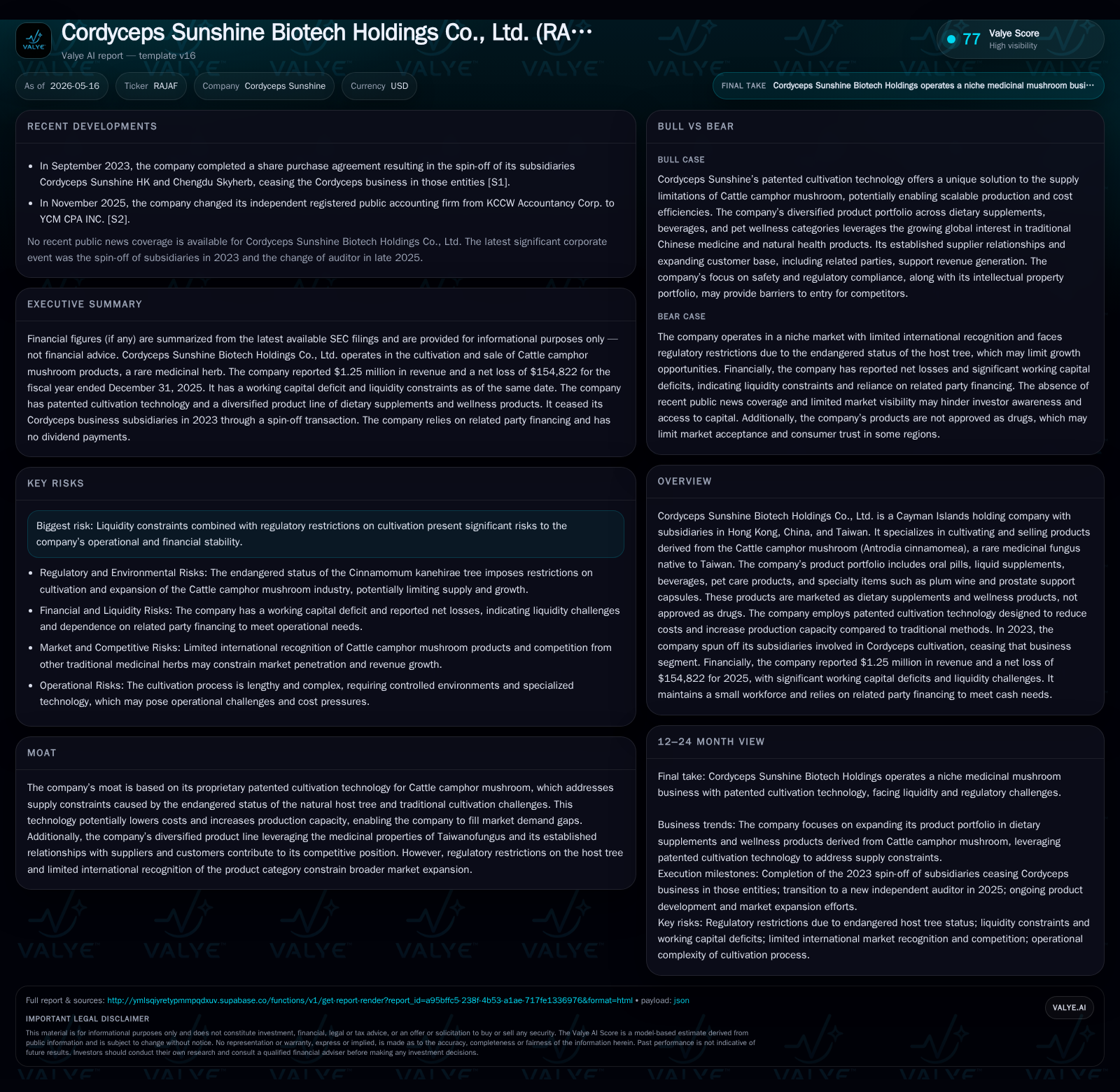
Cordyceps Sunshine Biotech Holdings Co., Ltd. spun off its cultivation subsidiaries in late 2023, ceasing direct involvement in Cordyceps farming and shifting to product sales leveraging patented cultivation technology. Despite revenue stabilizing around $1.25 million in 2025, operating margins remain under pressure due to increased costs tied to early expansion efforts and a strategic pivot to lower pricing to boost volume. The company’s balance sheet reveals stark liquidity constraints reflected by a severely negative working capital position driven by outstanding payables from cultivation facility transactions. Regulatory restrictions and limited product category recognition further constrain growth, while management expects near-term demand growth in Taiwan. Continued capital reliance on related parties poses a crucial watchpoint for operational continuity.
Recent Operating Update
Cordyceps Sunshine Biotech Holdings Co., Ltd. released its latest audited annual filings on May 15, 2026 [S1], anchored by an interim update in November 2025 [S2]. The November filing highlighted no auditor changes red flags during the fiscal year ending December 31, 2024, affirming stable financial reporting controls amid operational shifts. In late September 2023, a critical strategic event took place whereby Cordyceps spun off its wholly owned subsidiaries responsible for cultivating Cordyceps (Cattle camphor mushroom) products — Cordyceps Sunshine HK and Chengdu Skyherb [S21]. This divestiture extinguished approximately $1.15 million of debt owed to a related party through an equity transaction, marking an exit from direct cultivation activities.
Financially, total consolidated revenue for 2025 stayed marginally flat relative to 2024 at $1.25 million [F1], stemming from increased third-party sales offset by fluctuating related-party transactions [S1]. However, operating income improved slightly but remained negative at ($141K), narrowing from ($184K) in 2024 due mainly to decreased depreciation expenses following the spin-off of cultivation assets [S1]. Despite these improvements, general and administrative costs persisted near $902K [F1], reflecting ongoing investments likely tied to marketing expansion and administrative overheads.
The company ended FY 2025 with current assets of approximately $998K against liabilities of $5.19 million—resulting in a razor-thin current ratio near 0.19 and a substantial working capital deficit exceeding $4.19 million [F1]. These payables predominantly originate from purchase agreements for cultivation facilities signed before the spin-off transaction that remain unsettled [S24]. The cash position is critically low at just over $3K, underscoring tight day-to-day financing conditions.
Business Model
Cordyceps Sunshine operates primarily as a holding company post-spin-off with subsidiaries engaged in marketing and selling Cordyceps-derived products rather than direct mushroom farming [S21]. The core offering revolves around dietary supplements and wellness products derived from Taiwan’s rare medicinal fungus Antrodia cinnamomea—known colloquially as the Cattle camphor mushroom. Unlike pharmaceuticals, these products are not approved drugs but marketed for their traditional health benefits.
The company leverages patented proprietary technology designed to cultivate this rare mushroom more efficiently relative to traditional slow natural processes limited by the endangered host tree's availability [S1]. This technology potentially allows it to capture unmet demand through higher production volume at lower cost structures. The diversified product suite encompasses oral pills, liquid supplements, beverages (including specialty plum wine), pet care products, and prostate support capsules—a broad application approach targeting multiple consumer health niches.
Revenue generation hinges on selling these products either directly or via related parties—demonstrated by variable revenue splits over recent years [S7][F1]. Pricing dynamics reveal a push toward price reductions in 2025 aimed at stimulating volume growth; however, this strategy also inflates cost of revenue proportionally due to greater sales volume [S1]. Margins thus remain volatile subject to pricing mix and promotional intensity.
Industry Structure and Competitive Position
Cordyceps Sunshine operates within a highly specialized segment of the traditional medicine supplement industry focused on rare fungal species indigenous to Taiwan. The niche is characterized by significant natural resource limitations since the core mushroom grows on an endangered tree species restricting large-scale wild harvesting. Competitors either attempt traditional cultivation methods—which are slower and costlier—or invest in proprietary biotechnologies.
The company's patented cultivation technology constitutes its chief moat by potentially easing supply bottlenecks and positioning it as a reliable source amid constrained competitors. However, limited global regulatory acceptance of such supplements outside Asian markets combined with restrictions on harvesting or cultivating endangerment-listed host trees imposes structural growth ceilings.
Established relationships with suppliers—especially those involved in raw materials—and customers within Taiwan provide distribution advantages but also raise exposure concentration risks given the small scale of operations [S7]. The move away from direct cultivation curtails operational complexity but may limit long-term control over raw material quality unless rigorous supplier oversight is maintained.
Growth Drivers
Growth prospects center on several interlocking pillars:
Market Expansion in Taiwan: Management targets deeper retail penetration domestically where awareness for traditional medicinal fungi like Antrodia cinnamomea remains strongest [S10][S7]. Increasing consumer health consciousness could marginally expand addressable market size.
Product Line Diversification: Offering supplementary therapeutic options beyond pills—for example beverages or pet care—broadens potential customer touchpoints.
Leverage of Patented Cultivation Technology: While direct farming has been spun off, licensing or indirect arrangements could allow the company to benefit from proprietary methods without incurring capital-intensive growing operations.
Related Party Sales: Transactions with entities like Gasar Biotechnology show significant related-party revenue contribution (~14% in recent years) which could stabilize volumes though risks dependency concentration [S7].
Price Promotions Leading to Volume Gains: In 2025, lowering prices stimulated sales but exerted margin pressure; effective volume-price balance is critical going forward [S1].
These drivers suggest potential incremental structural growth if execution scales while maintaining product quality standards tied closely to complex fungal sourcing.
Risks / Watchpoints / Growth Constraints
Liquidity Pressure: Extreme working capital deficits exceeding $4 million against less than $1 million current assets indicate acute short-term solvency challenges evident as of end-2025 [F1]. Cash reserves barely exceed $3K further compounding funding risk.
Heavy Related Party Dependence: Reliance on financing and sales arrangements involving affiliated entities exposes operation continuity if these supports diminish unexpectedly [S5][S7].
Regulatory Restrictions: Endangered status of natural Camphor tree hinders expansion capacity; environmental regulations limit new farming areas impacting raw material scalability.
Market Recognition Limitations: As dietary supplements lacking drug approvals, international markets may be difficult to penetrate significantly without costly clinical evidence or regulatory compliance achievements.
Operational Disruption Post-Spinoff: Divestiture of cultivation units relinquished vertical integration control; future raw material procurement depends on external suppliers’ quality assurance and pricing policies.
Negative Equity Trajectory: Accumulated deficit stood at over half a million dollars end-2025 highlighting persistent net loss trends post-spin-off despite recent modest improvements in net losses versus prior years [F1][S1].
Price-Margin Tradeoffs: Lowering selling prices boosts sales volumes but compresses gross margins; maintaining profitability amidst competitive pressures demands careful pricing policy balance.
What To Watch Next
Key milestones and indicators include:
Quarterly Revenue Trends: Monitoring if the near-flat annual revenues mature into sustainable upward momentum versus cyclicality given promotional tactics.
Working Capital Evolution: Reduction of payables related to prior cultivation facility acquisitions would alleviate immediate liquidity crunch.
Related Party Support Continuity: Any disclosed changes or agreements clarifying ongoing financial assistance or supply arrangements will be critical for survival.
Regulatory Environment Updates: Changes impacting permitted cultivation practices or import/export rules could materially affect supply chain stability.
Product Launches or Market Expansions: Evidence of new product introductions or entry into untapped geographic markets would signal strategic execution progress.
Cost Control Measures: Trends in overhead expenses including G&A relative reductions would contribute directly toward improving operating leverage.
Management commentary alludes to strengthening domestic product demand anticipated through 2026 but stops short of formal guidance indicating cautious optimism grounded largely on market fundamentals [S10].
Financial Analysis Summary (Annual Historical Context)
Historical performance (annual)
Capital returns and efficiency (annual)
Revenue roughly doubled from FY23 to FY24 but plateaued into FY25 with minor decline (-0.65%) illustrating stabilized top-line despite marketing pushes. Operating income swung sharply negative post-FY23 as depreciation linked to expansion pushed expenses higher before partial normalization post-spin-off adjustments reducing depreciation allocation back into inventory valuation. Net loss remains recurring although reduced compared with previous year’s accelerated losses indicating some operational progression. Negative operating cash flows emerged only in FY25 after two years positive cash generation primarily due to increased working capital demands tied to substantial unpaid payables following large capex commitments earlier.
Shareholders' equity remains negative indicating cumulative historic losses exceed net asset base establishing precarious financial footing requiring close attention on recapitalization or earnings turnaround prospects.[F1][S1][S24]
Conclusion
Cordyceps Sunshine Biotech Holdings is navigating the aftermath of shedding its core cultivation business while aiming to capitalize on patented production technology through expanded product sales primarily targeting Taiwan’s dietary supplement market. Operating losses have narrowed somewhat aided by depreciation accounting shifts yet remain persistent fueled by elevated administrative costs associated with an early-stage scaling phase compounded by pricing concessions aimed at securing volume gains.
The reliance on related-party transactions underlines operational dependencies issuing cautionary flags amid uncertain external funding prospects under increasing negative equity burdens. Regulatory restrictions surrounding endangered host tree cultivation impose hard limits on future capacity expansions unless alternative biotechnologies emerge. Monitoring quarterly revenue recovery trends alongside any restructuring of payables will be essential indicators of the firm’s ability to regain financial stability and leverage its specialized botanical supplement niche within constrained industry dynamics.
Disclaimer: This analysis is based solely on publicly available SEC filings as of May 15, 2026 ([S1],[S2]) combined with Valye News proprietary synthesis frameworks without endorsement or investment advice regarding Cordyceps Sunshine Biotech Holdings Co., Ltd.
Disclaimer: This is research-only, informational analysis and not investment advice. It may include AI-generated interpretation and general industry context. Always verify important details using primary sources.

Comments