
Forafric Global PLC’s Strategic Reshaping Focuses on Morocco and Soft Wheat Amid Liquidity Pressures
Recent filings reveal Forafric's pivot to concentrate on core Moroccan operations, soft wheat production, and a proposed controlling stake transfer.
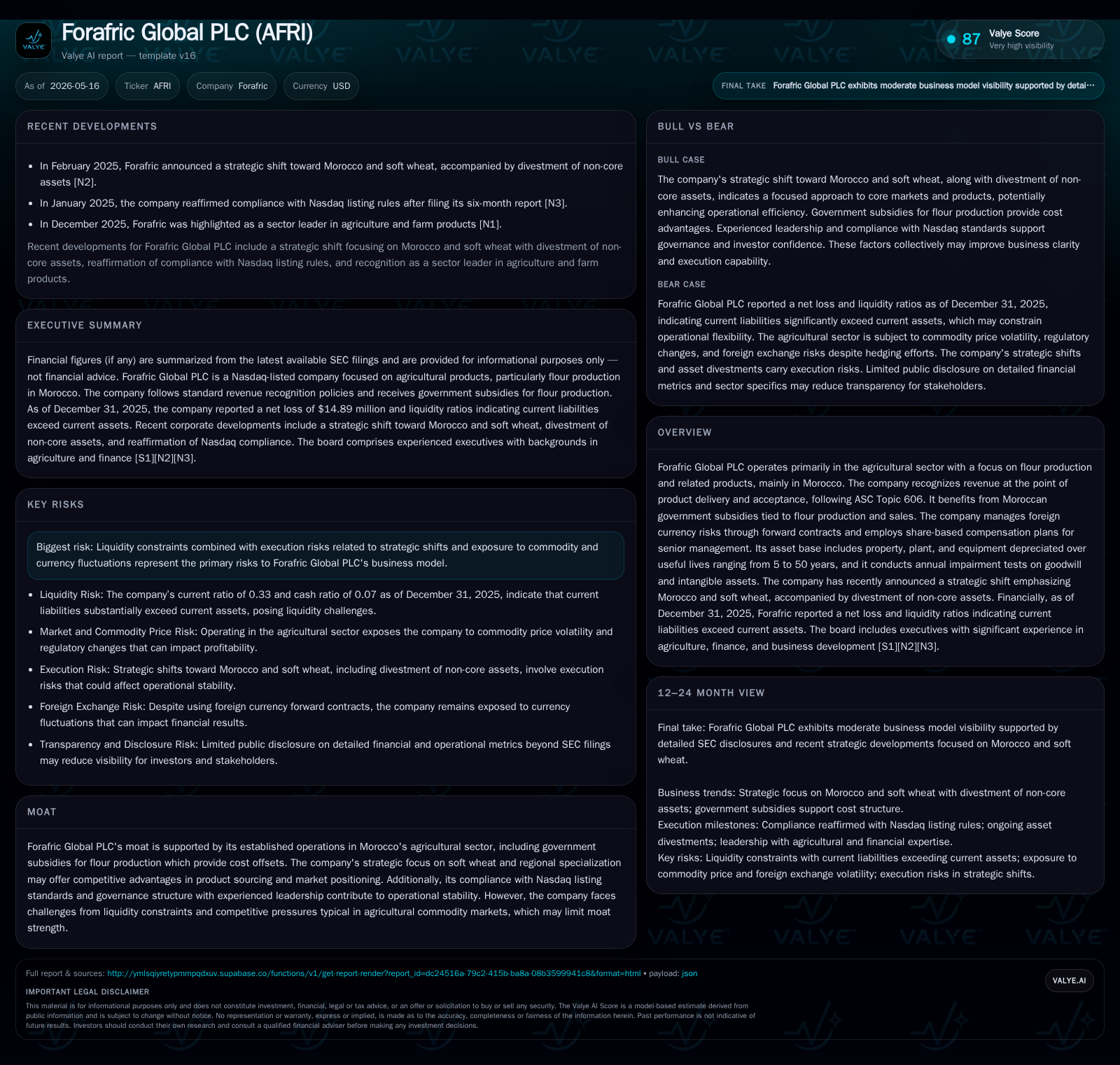
Forafric Global PLC announced a strategic expansion plan in April 2026, emphasizing its Moroccan flour production and soft wheat specialization while divesting non-core assets. The company is pursuing regulatory approval for a transaction that could grant controlling interest of its Moroccan subsidiary to Cap Holding SA. This repositioning aims to enhance shareholder value but occurs alongside liquidity constraints reflected in a low current ratio and ongoing net losses. Forafric faces structural challenges in a competitive agricultural commodity environment, balancing government subsidies with execution risks tied to currency volatility and evolving market dynamics.
Recent Operating Update
Forafric Global PLC's latest quarterly disclosure on April 23, 2026, elaborated on a strategic expansion plan prioritizing Morocco—a key operational hub—and concentrating on soft wheat production as its main growth vector [S2]. This includes divesting non-core assets to streamline operations. Notably, the company submitted a transaction for regulatory approval that would allow Cap Holding SA, a Moroccan industrial group, to obtain a controlling stake in Forafric Maroc SA, an indirect subsidiary [S3]. This transaction remains subject to board approval and antitrust clearance.
Concurrently, Johann Elbaz—a veteran Forafric executive with nearly two decades' experience in marketing, strategy, and innovation—was appointed to the Board of Directors, reinforcing the company’s leadership alignment with the new strategic direction [S3].
Business Model
Operating predominantly in agricultural processing—with an emphasis on flour production—Forafric generates revenue by selling flour products primarily in Morocco. Revenue is recognized at the point of legal title transfer upon delivery and customer acceptance under ASC Topic 606 [S1]. The company benefits from Moroccan government subsidies tied directly to flour production and sales volumes, providing critical cost offsets that underpin its operating economics. These subsidies help mitigate typical margin pressures associated with agricultural commodities.
The company’s business model revolves around leveraging local raw materials—particularly soft wheat—to produce high-quality flour products distributed regionally. Its offerings are largely commodity-based but differentiated via scale and government-backed subsidy access. However, Forafric must carefully manage procurement pricing dynamics during fluctuating global wheat prices and foreign exchange variability.
Foreign currency risk is managed through forward contracts not designated as hedges but accounted for at fair value with changes flowing through earnings [S15]. Share-based compensation plans are employed principally for senior management remuneration, including options and phantom options measured at fair value [S12].
Capital-intensive operations necessitate significant investment in property, plant, equipment (depreciated over spans from 5 up to 50 years) and rigorous impairment testing conducted annually or when asset recoverability might be impaired [S22][S19].
Industry Structure and Competitive Position
Within Morocco’s agricultural sector—specifically flour milling—the market is characterized by substantial government involvement through subsidy programs that stabilize pricing frameworks for essential staples like bread. Forafric’s established footprint capitalizes on these subsidies while competing against regional millers who may lack similar governmental support or scale advantages.
The competitive landscape is pressured by commodity price cycles affecting raw material costs and by currency translation impacts due to operational cost components denominated in multiple currencies. Additionally, regional industrial groups such as Cap Holding have strong local influence and the capacity to reshape competitive dynamics if they consolidate stakes in companies like Forafric Maroc SA.
This combination of government ties, local operational expertise, and scale presents a defensible moat but is tempered by structural risks endemic to agricultural commodity sectors—including demand sensitivity to macroeconomic conditions—and competitive pressures where differentiation beyond cost control is limited.
Growth Drivers
Strategic Focus on Morocco: Concentrating efforts regionally allows Forafric to optimize supply chain efficiencies, capitalize on local subsidies more effectively, and drive market penetration within a defined geography.
Soft Wheat Specialization: By focusing on soft wheat—a staple input for their core flour products—the company aims to improve supply certainty and potentially capture higher margins through product optimization.
Divestment of Non-Core Assets: Streamlining the asset portfolio reduces operational complexity and reallocates capital toward more profitable or strategic segments.
Potential Capital Infusion Through Cap Holding Transaction: Should the transaction close successfully, having an industrial partner with controlling interest could provide additional financial resources and operational synergies supporting expansion or modernization efforts.
Operational Excellence Initiatives: Leadership appointments such as Johann Elbaz suggest increased emphasis on marketing acumen and R&D innovation, which may enhance brand positioning or lead to incremental product improvements.
Risks / Watchpoints / Growth Constraints
Liquidity Constraints: Current assets of approximately $68 million sharply trail current liabilities nearing $208 million as of year-end 2025 ([F1]), yielding a concerning current ratio of roughly 0.33. Such imbalance constrains working capital flexibility and could impact supplier relationships or capacity investments.
Profitability Challenges: A net loss of $14.9 million during the latest fiscal year signals ongoing operational headwinds possibly stemming from commodity cost inflation, subsidy changes, or inefficiencies [F1].
Execution Risks Around Strategic Shift: The success of refocusing on Morocco and soft wheat depends heavily on seamless asset divestitures and integration of potential new ownership influence from Cap Holding—both complex undertakings requiring regulatory clearance.
Commodity Price Volatility: Flour production margins remain tightly linked to global wheat pricing dynamics which fluctuate with weather patterns, geopolitical tensions affecting supply chains, and speculative market activity.
Currency Exchange Exposure: Foreign currency fluctuations affect costs structure notably given cross-border input sourcing; even though managed via forward contracts accounted for at fair value [S15], residual mismatches can impair earnings consistency.
Regulatory Dependence: Government subsidies are pivotal yet vulnerable to fiscal policy shifts or subsidy scheme reformulations that could erode cost advantages.
Shareholder Return Limitation: No historical dividends have been declared; prospective payments will require stabilized profitability post-business realignments [S1].
What To Watch Next
- Regulatory approval status of the proposed Cap Holding SA transaction for controlling interest in Forafric Maroc SA ([S3]). The timing and terms here will critically influence governance structure and potential capital investment.
- Execution progress of divestment initiatives targeting non-core assets announced as part of the strategic realignment ([S2]). Successfully reducing non-strategic exposure improves cash flow profiles.
- Quarterly updates on operating income trends clarifying whether refocused strategy translates into margin recovery or volume growth.
- Developments in Moroccan government subsidy policies impacting flour production economics.
- Management commentary on liquidity management plans addressing the large mismatch between current liabilities and current assets ([F1]).
- Impact assessment if new accounting standards (like ASU 2025-10 concerning government grants) adopted early materially shift reported results ([S10]).
- Follow-up executive leadership changes or strategic hires that may signal deeper shifts in operational priorities or innovation orientation ([S3]).
Financial Profile Snapshot (As of December 31, 2025) [F1]
Latest financial snapshot
FY 2025 |
The above metrics underscore ongoing liquidity stress despite cash reserves backed by substantial total debt load relative to cash holdings. Negative profitability continues challenging cash generation capability.
Disclaimer
This analysis is provided solely for informational purposes based on disclosures available as of May 2026. It does not constitute investment advice nor an endorsement of securities mentioned herein. Readers should conduct their own due diligence considering broader market conditions before drawing conclusions.
Disclaimer: This is research-only, informational analysis and not investment advice. It may include AI-generated interpretation and general industry context. Always verify important details using primary sources.

Comments