
U Power Ltd Advances Battery Swapping Commercialization Supported by Capital Raises and Strategic Partnerships
Latest Q1 2026 developments position U Power to expand electric vehicle battery swapping infrastructure amid competitive and regulatory challenges.
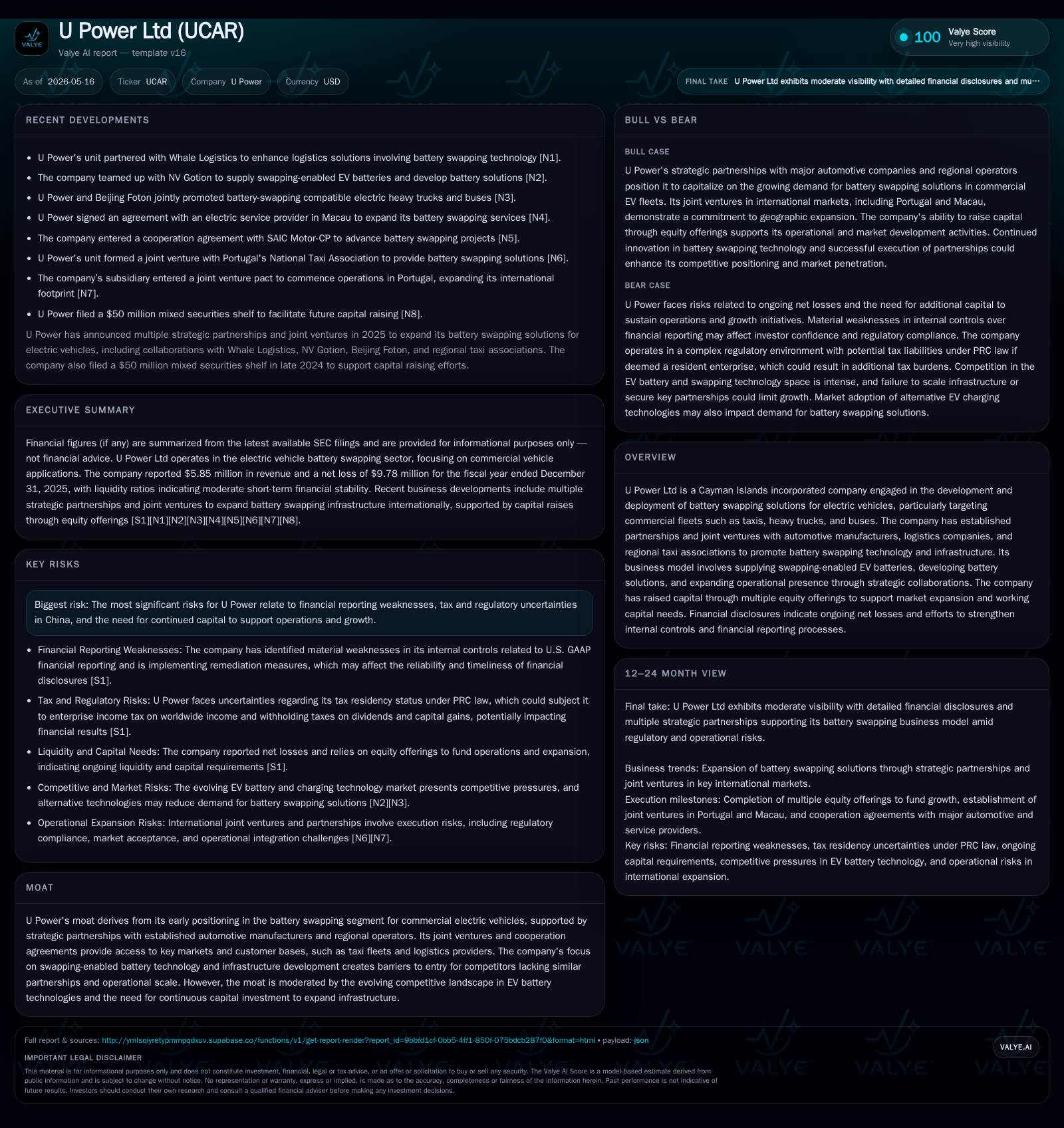
U Power Ltd recently canceled an Extraordinary General Meeting of Shareholders, indicating a pause in governance actions as it furthers operational execution. The company's core business involves developing battery swapping solutions targeting commercial EV fleets, leveraging partnerships with automakers and fleet operators. Continued capital raises, including a $25.7 million private placement in April 2026 and previous equity offerings, underpin expansion and working capital. Despite ongoing net losses, U Power's moat stems from early market positioning and joint ventures, but financial reporting weaknesses and regulatory uncertainties in China present notable risks.
Recent Operating Update
The latest filing from May 14, 2026 (Form 6-K) revealed the cancellation of an Extraordinary General Meeting of shareholders originally scheduled for May 19 [S2]. This cancellation may indicate a temporary pause in shareholder actions or consolidation of governance initiatives while management focuses on operational priorities. Earlier filings leading up to this pointed to several rounds of equity fundraising completed through April 2026 aimed at bolstering market expansion efforts and general working capital needs [S3,S9,S10]. The April 27, 2026 private placement alone raised approximately $25.7 million in gross proceeds at $1.64 per Class A ordinary share with none of the proceeds directed towards insiders or affiliates, emphasizing external funding reliance [S10,S25].
Business Model Overview
U Power Ltd operates as a developer and deployer of battery swapping technology designed primarily for electric commercial vehicles such as taxis, freight trucks, and buses. Their revenue mechanics pivot on selling swapping-enabled batteries to fleet operators coupled with constructing battery-swapping station infrastructure often via joint ventures. The company’s strategic model leverages cooperative agreements with automotive manufacturers—such as SAIC Hongyan—and logistics providers to anchor their solution within established transportation networks [S26].
Customers pay primarily for battery units configured for swapping compatibility alongside associated service contracts covering infrastructure access and maintenance. Revenue growth depends on volume uptake by commercial fleets, pricing terms embedded in contracts with partners, asset utilization rates at swapping stations, and ongoing sales of replacement/upgrade battery units. Margins are sensitive to cost control on battery production, station build-out efficiencies, and scale benefits realized through increasing network density.
Industry Structure and Competitive Position
The EV battery swapping industry remains nascent but rapidly evolving especially in markets like China where urban fleet electrification accelerates. U Power’s early mover advantage is supported by its exclusive joint ventures granting access to critical fleet customer bases including regional taxis and freight operators [S1,S26]. This strategic embedding creates switching costs because existing vehicles must be compatible with the company’s battery designs and customers benefit from established swapping infrastructure.
However, competition intensifies from global OEMs investing in proprietary fast-charging tech reducing dependence on battery swap models. Furthermore, large-scale energy companies developing battery leasing or second-life recycling solutions pose alternative approaches to EV energy management that could disrupt pure swap-based businesses. U Power’s niche lies in serving commercial fleets where quick vehicle turnaround is essential—a credit to their moat driven by technical integration expertise and local partnerships but necessitating continual capital investment.
Growth Drivers
Growth opportunities center on escalating electrification demand among commercial fleets globally paired with the practical advantages of battery swapping—significantly reduced downtime compared to conventional charging cycles. Key drivers include:
- Expansion of the physical network of battery swapping stations tied to geographic concentration of target fleet customers.
- Deepening partnership ecosystems with automotive manufacturers enabling seamless compatibility across new EV models.
- Scaling joint ventures internationally (e.g., Southeast Asia according to previous agreements) capturing broader market penetration [S16].
- Leveraging government incentives aimed at emissions reduction in urban transport sectors which catalyze fleet electrification.
- Continuous innovation on battery design improving lifecycle durability and cost efficiency enhancing value propositions.
KPIs such as number of operational swapping stations, active fleet size under service agreements, contract renewal rates, average revenue per unit swapped, and capital deployment efficiency provide clear sightlines into growth progress.
Risks and Watchpoints
Despite potential upsides, several constraints warrant vigilance:
- Material weaknesses remain in internal financial controls regarding US GAAP compliance posing risks for accurate reporting or timely disclosures that could affect investor confidence [S7].
- Regulatory complexity around PRC taxation for Cayman-incorporated entities continues to create uncertainty regarding effective tax burdens which could materially impact net profitability [S23].
- Dependency on external capital evidenced by multiple equity raises signals cash burn pressures typical at early deployment stages.
- Market adoption risks if competing charging technologies gain preference or if fleet operators exhibit slow uptake due to cost or integration hurdles.
- Infrastructure build-out faces inherent challenges including securing real estate sites for swapping stations, negotiating co-locations with fleet hubs, obtaining permits amidst evolving environmental standards.
Monitoring these factors alongside macro trends such as inflation impacts (currently modest per Chinese consumer price index data) supports ongoing risk assessment [S20].
What to Watch Next
Investors should monitor:
- Execution updates on network expansion milestones reflecting physical deployment pace (facility openings or JV launches).
- Quarterly progress on customer contract wins particularly major fleet operator adoption announcements.
- Management commentary on remediation progress addressing financial reporting weaknesses which influence transparency credibility.
- The timing and outcomes related to any future shareholder meetings signaling strategic shifts post-cancellation notice.
- Capital markets activity such as additional equity issuances or debt arrangements influencing liquidity runway.
- Regulatory rulings or clarifications affecting tax treatment given the company’s Cayman incorporation with Chinese operational base.
Financial Profile Snapshot
Latest financial snapshot
| Metric | Value | Period |
|---|---|---|
| Cash & equivalents | $3.1mm | |
| 2025-12-31 | ||
| Current assets | $21.0mm | |
| 2025-12-31 | ||
| Current liabilities | $11.6mm | |
| 2025-12-31 | ||
| Current ratio | 1.8x | |
| 2025-12-31 |
Source: SEC companyfacts cache [F1].
As of December 31, 2025: FY Ended 2025 |
The financials convey an early commercial phase typified by revenue generation still trailing operating expenses leading to net losses [F1]. The company held a net cash position of approximately $2.2 million as of June 30, 2023, indicating a strong liquidity buffer relative to debt [F1]. It does not constitute investment advice or an offer to buy or sell securities. Readers should conduct independent due diligence before making any investment decisions concerning U Power Ltd.
Disclaimer: This is research-only, informational analysis and not investment advice. It may include AI-generated interpretation and general industry context. Always verify important details using primary sources.

Comments