
K Wave Media Fuels $2 Billion AI Infrastructure Push with Strategic $485 Million Financing
K Wave Media’s recent capital infusion and strategic partnership mark a decisive pivot toward AI infrastructure investment alongside its core Korean content business.
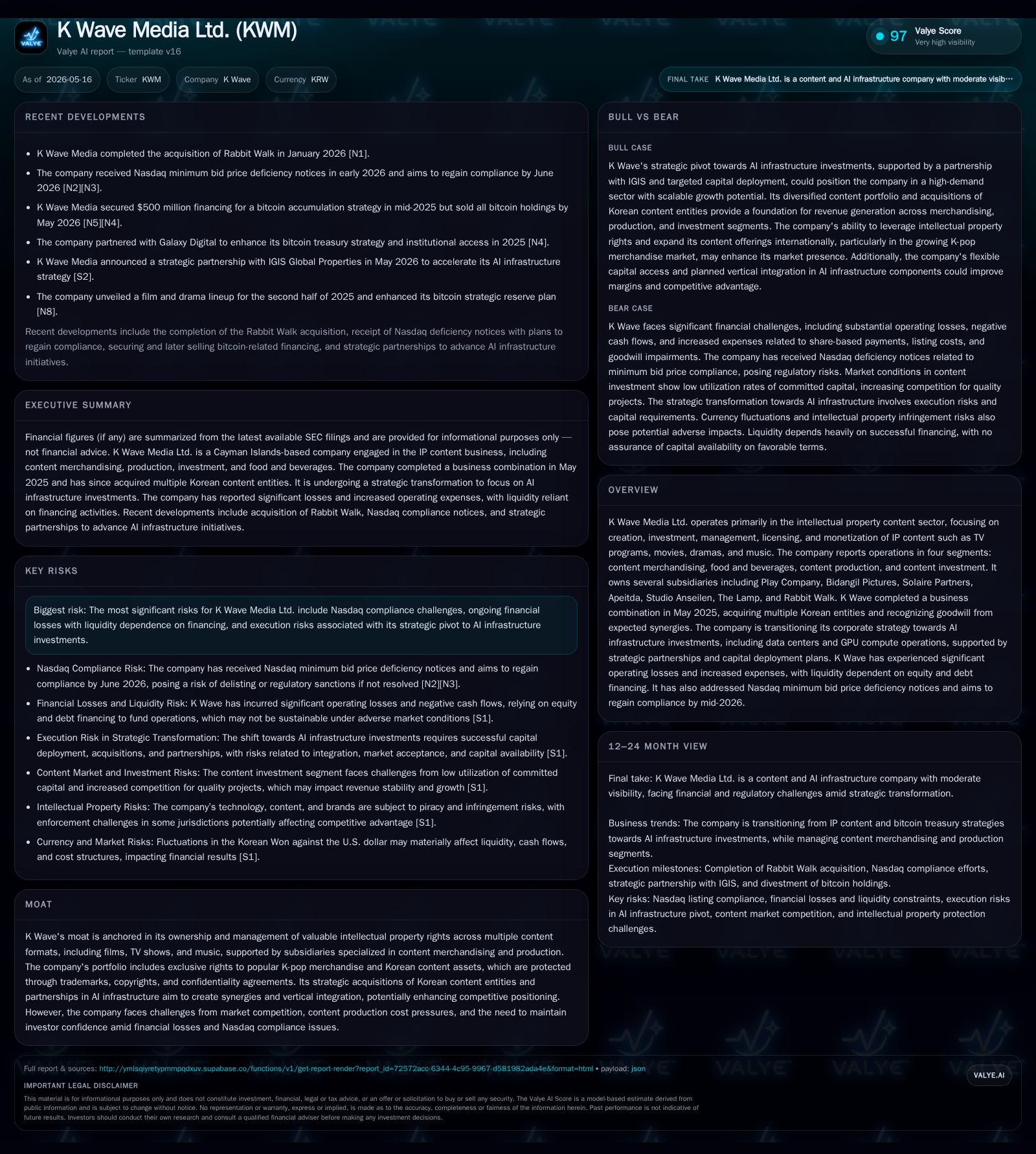
In early May 2026, K Wave Media secured a critical $485 million financing amendment and forged a strategic partnership with IGIS Global Properties, aiming to deploy over $2 billion in AI infrastructure assets. This landmark shift represents a move beyond its traditional intellectual property focus in Korean entertainment toward capital-intensive data centers and GPU compute operations. Although content merchandising remains its primary revenue generator, the company faces execution risks from this strategic pivot amid ongoing operating losses and Nasdaq listing pressures. Investors should closely monitor AI deployment milestones and additional financing progress in the coming quarters.
Latest Quarterly Breakthrough: Strategic Partnership and Capital Injection
In the most recent filings dated May 4–5, 2026, K Wave Media announced two pivotal developments reshaping its near-term trajectory. The first was the closing of an amended financing agreement with the Ansson Funds for $485 million that allowed the company not only to bolster its liquidity but also to eliminate $48 million of outstanding debt obligations [S3]. This step materially strengthens K Wave's balance sheet as it gears up for ambitious capital deployments.
Shortly thereafter, on May 5, K Wave formalized a strategic partnership agreement with IGIS Global Properties LLC—a subsidiary of the $50 billion asset manager IGIS Asset Management. This collaboration aims at accelerating the company’s pivot into artificial intelligence (AI) infrastructure investments, primarily focusing on data centers and GPU compute facilities. The partnership targets deploying over $2 billion across multiple geographies in the near to medium term [S2].
These announcements collectively signal K Wave’s deliberate repositioning from a predominantly content-driven IP licensing model toward capital-intensive technology infrastructure ventures. Eliminating debt improves flexibility while the scale of planned investments demands robust long-term partnerships such as IGIS’s expertise in property and operational asset management.
Business Model Overview: From Intellectual Property Driving Revenue to AI Investment
Historically, K Wave Media has operated as an IP-centric entertainment group involved in producing and monetizing Korean cultural content including TV shows, dramas, music, and associated merchandise. Its consolidated operations span four segments:
- Content Merchandising — principally via Play Company which manages licensed sales of video merchandise linked to major K-pop acts;
- Food and Beverages — retail-oriented bakery and café operations;
- Content Production — creating original programming supported by subsidiaries produced primarily after acquiring six Korean entities in early 2025;
- Content Investment — making financial stakes in Korean film and TV projects through specialist venture arms.
The business combination completed in May 2025 notably expanded K Wave’s content production and investment lines increasing revenues but also introducing integration costs that have pressured profitability [S1]. Licensing exclusivity combined with short-run merchandise aligned to concert tours underpin a "360° revenue stacking" approach yielding strong international fan engagement especially in North America [S7, S22].
The emerging AI infrastructure line overlays this foundation with heavy capital commitments directed at building or acquiring data centers optimized for AI workloads (GPU-enabled). For fiscal year 2025, this segment experienced a 56% revenue increase to about KRW44 billion (USD $31 million), driven by expanded overseas tours supporting K-pop boybands where merchandise costs were strategically reduced through global supply chain adjustments improving gross profit by over 200% year-over-year [S7].
Conversely, food and beverages revenue declined modestly (15.8%), though gross margins improved following supplier renegotiations lowering raw material unit costs and improving cost structures across bakery-coffee hybrid outlets [S7].
Content production showed incremental revenues post-acquisition but remains challenged by rising production costs amid evolving OTT commissioning dynamics that are squeezing traditional mid-budget Korean cinema formats; this structural pressure necessitates slate adjustments favoring either premium OTT-commissioned shows or more manageable talent cost projects [S20].
Content investment benefits from increased assets under management through government-backed funds devoted to Korean content but faces low utilization rates reflecting tight deal flow for theatrical films despite robust OTT demand—a dynamic both constraining and selectively creating attractive co-investment terms [S20].
Competitive Environment: IP Ownership Meets Emerging Tech Investment Dynamics
K Wave’s competitive moat has historically been anchored by intellectual property rights protection covering copyrights, trademarks for popular Korean cultural content—including unique K-pop merchandise—and contractual exclusivities managed across specialized subsidiaries such as Play Company and Bidangil Pictures [S1]. These IP assets benefit from strong fan loyalty globally and create switching costs favorable for sustained merchandising revenue.
However, entering the AI infrastructure domain introduces new competitive challenges. This sector demands scale economies in data center real estate coupled with advanced technical capabilities in GPU compute management plus partner alignment across multiple development stages. Regulatory compliance poses another layer of complexity given NASDAQ listing requirements impacting governance practices amid foreign private issuer status uncertainties [S23].
Financially intensive infrastructure investments contrast sharply against intangible IP licensing economics whereby upfront capital outlays are larger with longer breakeven horizons. Balancing these divergent models requires execution discipline.
Drivers of Growth: AI Infrastructure Deployment and Korean Content Synergies
Looking ahead, K Wave’s growth drivers bifurcate into two streams. First is the aggressive expansion into AI infrastructure enabled by its established partnerships—primarily IGIS—that provide synergy value in sourcing deals, managing property development expertise worldwide, and co-investing at scale targeting over $2 billion planned deployment [S2][S9]. Successful ramp-up of GPU compute rental capacity leveraging owned data centers may open recurring revenue streams under long-term contracts enhancing cash flow predictability.
Second is maintaining robust growth within its core content merchandising segment capitalizing on the expanding global K-pop memorabilia marketplace valued at approximately USD 2.2 billion in North America alone with sustained double-digit CAGR driven by tightly coordinated album-tour-merchandise release strategies producing episodic peaks aligned with tour cycles [S22].
Further synergies could stem from integrating AI-enhanced analytics to optimize merchandising inventory planning or fan engagement platforms leveraging intellectual property dynamically across digital channels.
Risks and Watchpoints: Execution Risks Amid Pivot, Regulatory Demands, and Debt Reliance
K Wave faces notable risks concentrated around executing this complex strategic pivot amid existing financial vulnerabilities. The company has incurred significant operating losses increasing sharply following acquisitions tied to goodwill impairments exceeding KRW129 billion (USD ~$90 million) in 2025 [S1][S16]. Persistent negative cash flows reflect elevated operating expenses including share-based payments and listing costs.
Nasdaq compliance challenges as a foreign private issuer impose governance reform uncertainty; loss of this status may trigger elevated reporting burdens raising ongoing costs substantially [S23]. Additionally, the transition from an IP licensor model to heavy physical asset investor means exposure to construction delays, utilization ramp risks for new data centers, technological obsolescence risk around rapidly evolving AI hardware platforms.
Near-Term Milestones to Monitor: Deployment Scale, Operating Metrics, and Financing Progress
Investors should track several key indicators over the next one to two quarters:
- Pace of capital deployed into AI infrastructure projects relative to announced >$2 billion target set with IGIS partnership;
- Revenue contribution trends attributable directly or indirectly to new AI-related operations versus legacy content segments;
- Progress on additional financing rounds expected via Ansson Funds including SPA note sales totaling ~$90 million planned across Q2–Q4 2026;
- Demand metrics for Play Company merchandise aligned with artist tour schedules reflected in quarterly lumpiness signals from Google Trends data showing dramatic spikes during event windows;
- Development updates concerning disposition plans around subsidiary Play Company that may rationalize asset portfolios [S15].[S13]
- Any regulatory filings clarifying Nasdaq corporate governance compliance trajectory or foreign private issuer status implications.
These markers will provide clarity on whether K Wave can efficiently manage dual operating portfolios without diluting each other's potential.
Financial Context: Liquidity Improvement and Debt Reduction Supporting Transition
Supported by fresh funding inflows totaling $485 million from the amendment with Ansson Funds realized just before quarter-end May 2026—the company eliminated an immediate $48 million debt tranche significantly reducing leverage risk profile [S3].
Profitability remains elusive given substantial goodwill write-downs plus operating expense escalation post-acquisition; net loss expanded drastically to roughly KRW208 billion (USD $146 million) for calendar year 2025 compared with prior periods underscoring high investment burn rates funded largely via external capital raises rather than internal free cash flow generation yet demonstrating intent to extend runway through committed financing programs [S1][S16].
Readers should conduct their own due diligence considering all risks described within official disclosures before forming any views on K Wave Media Ltd.'s securities or strategic prospects.
Disclaimer: This is research-only, informational analysis and not investment advice. It may include AI-generated interpretation and general industry context. Always verify important details using primary sources.

Comments