
Core AI Holdings Accelerates Global AI-Ready Data Center Expansion Through Allianca Joint Venture
Core AI has pivoted sharply toward AI infrastructure via a strategic joint venture with Allianca, enhancing its global footprint and operational expertise.
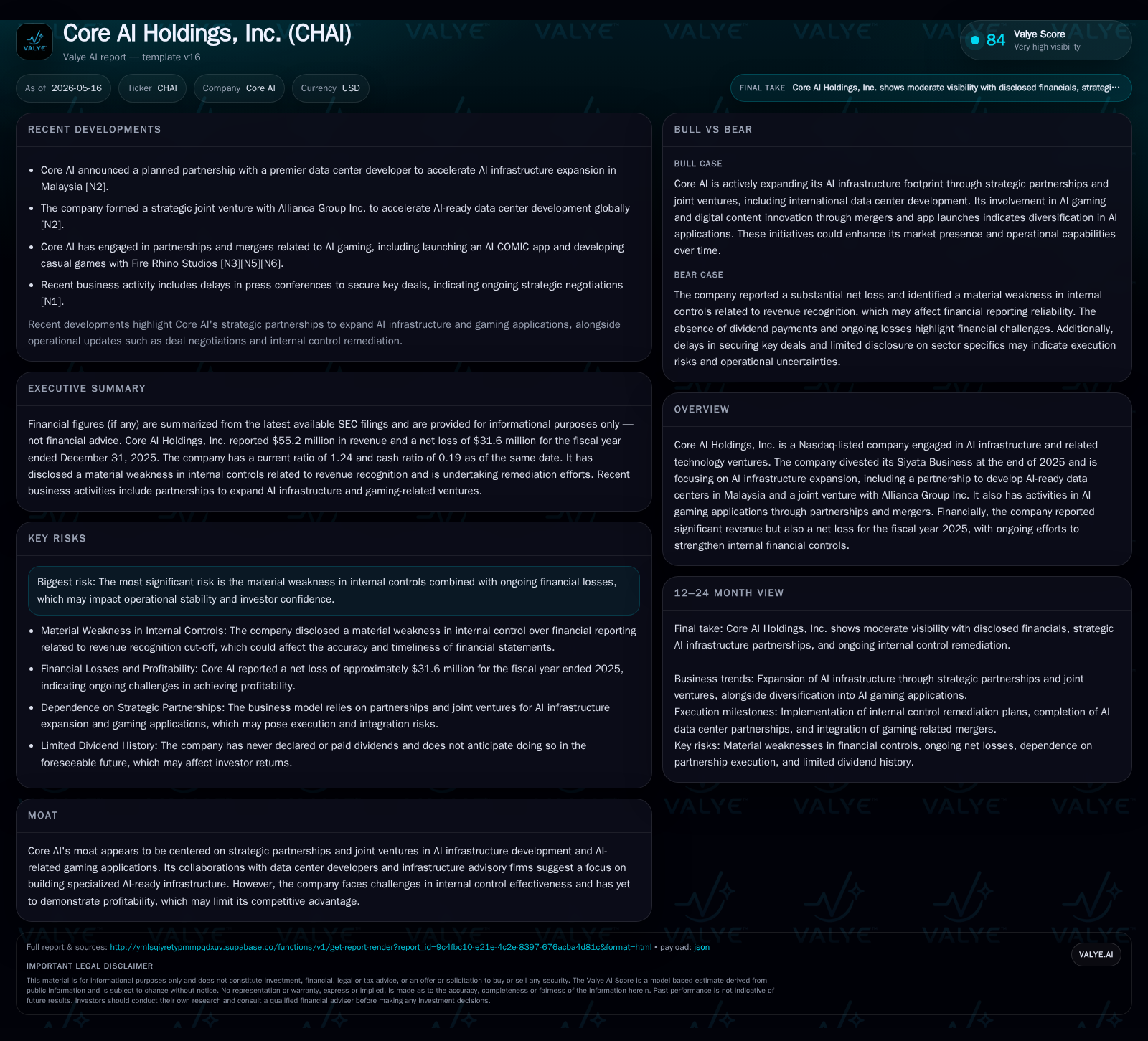
Core AI Holdings recently formalized a joint venture with Allianca Group Inc. to speed up global development of AI-ready data centers, marking a clear strategic refocus following divestment of its Siyata business. Complementing this, the appointment of Allianca's COO Sonali Garg to Core AI’s advisory board injects critical execution capability amid ongoing growth and control challenges. The company’s business model now prioritizes capital-intensive AI infrastructure and gaming applications through partnerships, targeting scalability in a competitive market with considerable operational and financial risks. Near-term milestones will focus on JV developments, advisory board leverage, and remediation of internal control weaknesses while managing cash flow pressures.
Recent Operating Highlights: Strategic Partnerships and Leadership Moves
Core AI Holdings crystallized a strategic pivot in early 2026 through two pivotal developments detailed in its latest quarterly disclosures. On April 14, 2026, the company announced the formation of a joint venture (JV) with Allianca Group Inc., a recognized infrastructure advisory and execution firm specializing in large-scale development projects [S3]. This JV is explicitly designed to accelerate the deployment of AI-ready data centers on a global scale, a response to increasing demand driven by generative AI workloads that require specialized facilities.
Shortly after, on May 5, 2026, Core AI enhanced its leadership capability by appointing Sonali Garg—Co-Founder and COO of Allianca—to its Advisory Board [S2]. Her operational expertise is expected to provide critical guidance in navigating the complex capital-intensive infrastructure landscape as Core AI scales up its footprint.
These moves represent a clear reorientation after the company's divestment of its Siyata business at the end of 2025—a transaction aimed at concentrating resources on core artificial intelligence initiatives [S5]. This realignment reflects management's intent to transition from legacy telecom-adjacent assets toward scalable infrastructure investments fundamental to supporting next-generation AI workloads worldwide.
Business Model Overview: Shifting to AI Infrastructure and Integrated Offerings
Core AI’s revenue generation now primarily revolves around developing and investing in purpose-built AI infrastructure capabilities. The joint venture with Allianca signals a commitment to delivering AI-ready data centers tailored for high-density compute operations integral to scaling generative AI models globally [S3]. These facilities offer advanced cooling solutions, low-latency network connectivity options, and scalable power capacities—features essential for accommodating hyperscale clients.
This business model is inherently capital intensive requiring substantial upfront investment in land acquisition rights, construction costs, specialized equipment procurement, and ongoing maintenance expenses. Returns are expected over multi-year horizons linked closely to lease or service contracts secured with cloud providers or enterprise customers deploying AI workloads.
Complementing infrastructure development is Core AI's expansion into the AI gaming sector through previous mergers and partnerships which tap evolving consumer engagement trends driven by immersive interactive experiences enabled by artificial intelligence enhancements [S1]. Synergies between these verticals present potential cross-selling opportunities and diversified revenue streams; however, they also introduce complexity amid integration challenges.
The exit from the Siyata business concentrated focus but also eliminated an existing source of recurring revenues related to mobile communication products. Henceforth, success hinges on accelerating JV execution pace coupled with securing new commercial arrangements within burgeoning global markets.
Competitive Environment and Industry Dynamics in AI Data Centers and Gaming
The global market for specialized data centers optimized for artificial intelligence demands has matured into a contested arena involving hyperscalers like Google Cloud, AWS Nitro Enclaves providers alongside niche firms specializing in turnkey build-outs for regional enterprises. Core AI competes indirectly by leveraging Allianca’s established advisory credibility during site selection, regulatory navigation, design customization, and construction oversight phases—facilitating speed-to-market advantages over less connected competitors [N1].
Pricing power remains nuanced; while strong demand underpins high utilization rates at core locations providing margin support, competitive pressures incentivize aggressive lease terms especially in emerging markets such as Southeast Asia where Malaysia presents substantive growth potential targeted through this JV arrangement [S3].
In parallel, the gaming-related component faces traditional margin pressures typical for content-driven models yet benefits from accelerating consumer adoption of AI-powered gaming applications derived from prior mergers within Core Gaming Inc. This diversification mitigates some cyclical volatility but requires continuous technology refresh cycles to maintain relevance.
Key Growth Drivers: Joint Ventures, Partnerships, and Market Expansion
The primary catalyst for near-term value creation rests on tangible progress from the JV with Allianca Group Inc. This partnership aims at expanding Core AI’s geographical presence by initiating developments across multiple regions starting with Malaysia—an emerging hub characterized by supportive regulatory frameworks for data center projects and affordable power costs [S3]. Milestones likely hinge on securing necessary permits, groundbreaking ceremonies, procurement contracts being signed for IT loads consumption equipment as well as client commitments for tenancy or managed services deployments.
Sonali Garg’s appointment provides an infusion of firsthand operational experience expected to streamline project delivery timelines while elevating governance standards around capital deployment decisions amid rapidly evolving technological requirements [S2]. Enhanced advisory involvement aligns with Core AI’s ambitions to balance aggressive expansion with risk mitigation.
Further indirect growth drivers include cross-selling opportunities through integrated offerings where gaming ecosystems leverage underlying infrastructural assets—potentially boosting annual recurring revenues (ARR) through bundled client contracts or subscription services anchored on proprietary platforms developed post-merger [S1].
Risks and Constraints: Profitability Challenges and Control Weaknesses
Despite promising strategic initiatives, Core AI confronts formidable challenges that temper unqualified optimism. Foremost among these is its persistent inability to achieve profitability; FY2025 results showed an operating loss exceeding $7 million alongside a hefty net loss north of $31 million reflecting heavy investment phases without commensurate earnings generation yet realized [F1]. Cash resources remain tight—with approximately $1.9 million in cash and equivalents and current liabilities of about $10.3 million—yielding a current ratio of 1.24 that underscores a modest short-term liquidity buffer [F1].
Moreover, material weaknesses identified in internal controls over financial reporting fuel uncertainty about stability in financial processes which could impair timely disclosure or induce corrective restatements if not effectively remediated soon [S1,S25]. These governance deficiencies challenge investor confidence particularly given scale ambitions requiring robust funding oversight.
From an industry standpoint, capital intensity inherent in building globally dispersed data centers exposes Core AI to risks linked to economic cycles affecting availability of financing as well as supply chain disruptions that may inflate input costs or delay completion milestones. Additionally regulatory approvals sometimes uncertain around power usage/heat emissions further add execution friction.
Near-Term Catalysts and What to Watch Next
The immediate watchpoints center on observable progress updates from the joint venture projects initiated globally—with investor briefing ideally confirming milestone achievements tied to site acquisitions or construction ramp-ups especially regarding Malaysian developments where regulatory pipelines appear most advanced so far [S2,S3]. Management commentary reflecting enhanced financial controls effectiveness will be another key metric signalling improved operational stability reducing audit risk premium.
Potential announcements expanding partnership portfolios beyond Allianca could materially alter growth trajectories by signaling enhanced ecosystem integration or access to complementary markets; no such specifics surfaced yet but merit monitoring.[S1]
Quarterly filings due later in 2026 will afford clearer visibility into revenue cadence shifts stemming from these ventures as well as refinement of guidance if any formally provided.
Financial Snapshot: Capital Structure, Liquidity, and Profitability
Latest financial snapshot
| Metric | Value | Period |
|---|---|---|
| Cash & equivalents | $1,931,174 | |
| 2025-12-31 | ||
| Current assets | $12,819,357 | |
| 2025-12-31 | ||
| Current liabilities | $10,303,585 | |
| 2025-12-31 | ||
| Current ratio | 1.24x | |
| 2025-12-31 |
Source: SEC companyfacts cache [F1].
| Metric | Amount (USD) | Period |
|---|---|---|
| Revenue | 55,239,839 | FY2025 |
| Operating Income | -7,117,460 | FY2025 |
| Net Income | -31,591,331 | FY2025 |
| Current Ratio | 1.24 | FY2025 end |
As reflected above from the FY2025 consolidated figures ([F1]), Core AI posted revenues exceeding $55 million largely driven by initial strides into its new core arenas but operated at notable losses reflecting ongoing investments into R&D and property development costs associated with data center build-outs. The operating loss underscores negative margins currently inherent during scale-up phases before full asset monetization occurs.
Liquidity is modest with cash and equivalents of approximately $1.9 million against current liabilities of about $10.3 million, resulting in a current ratio of 1.24 that indicates a limited short-term liquidity buffer [F1]. Debt levels were reported minimal per last available estimates indicating relatively low leverage but still dependence on equity or external financing sources exists for future capital expenditures required by high fixed costs within physical infrastructure development domains.
Overall financial positioning highlights a company actively investing for future market relevance rather than short-term earnings stability consistent with growth-stage technology infrastructure plays yet subject to careful watch given working capital tightness combined with control issues delineated earlier.
Disclaimer: This is research-only, informational analysis and not investment advice. It may include AI-generated interpretation and general industry context. Always verify important details using primary sources.

Comments