
Natuzzi Faces Margin Pressure and Restructuring Challenges Amid Production Shift and Trade Tariffs
The luxury furniture maker’s 4Q 2025 financials reveal operational strains from realigning production and navigating trade barriers, weighing on profits despite modest sales growth.
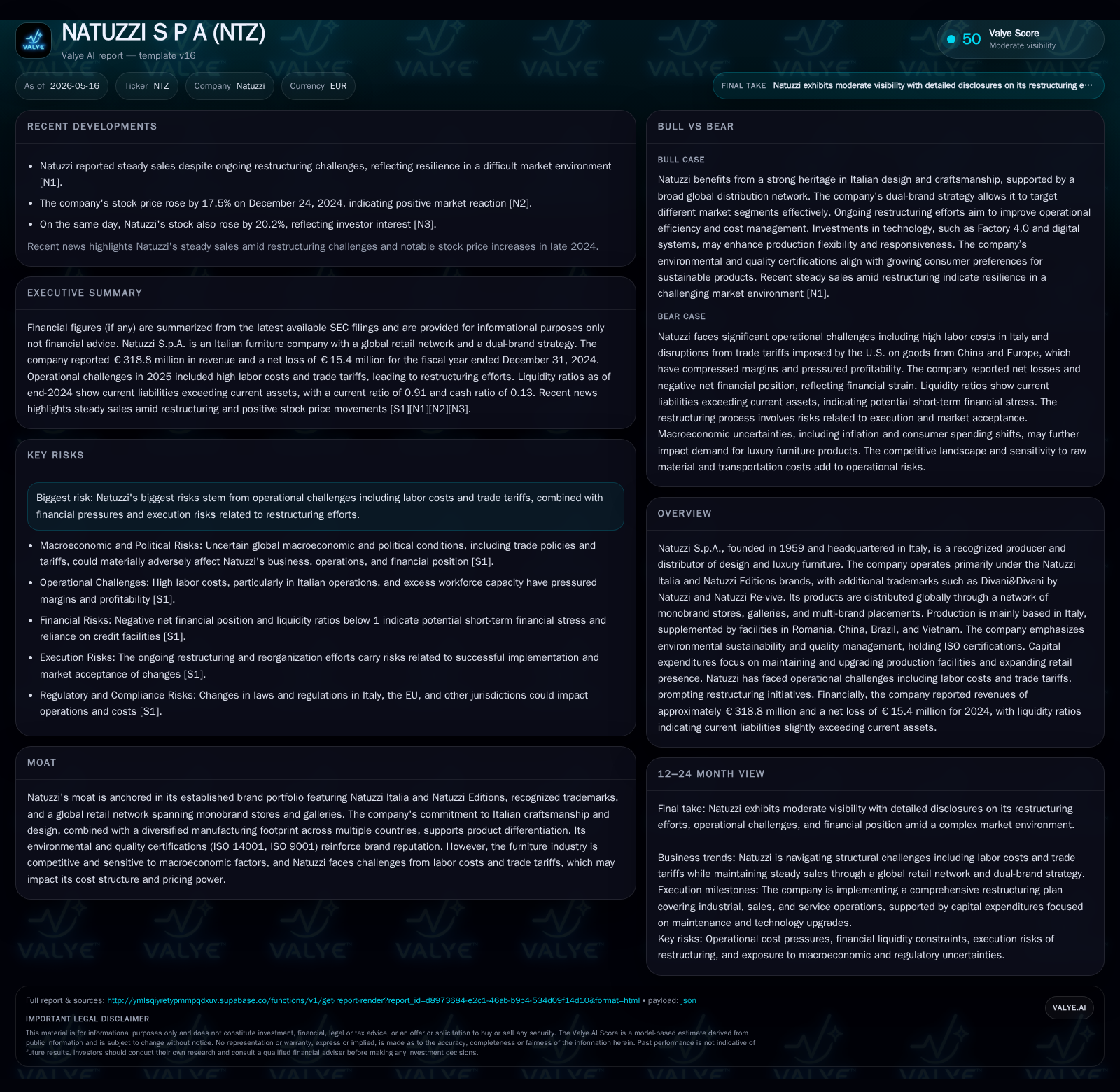
Natuzzi S.p.A., a global producer of Italian-designed luxury furniture, reported a revenue increase in the fourth quarter of 2025 but experienced significant margin compression and operating losses due to production realignment and new trade tariffs. The company has moved part of its manufacturing footprint from China to Italy to avoid U.S. tariffs but faces higher labor costs and tariff impacts on European-produced goods. Efforts to reduce fixed costs and streamline operations are underway, alongside capital strengthening initiatives including asset disposals and talks with institutional investors. Liquidity remains adequate for near-term obligations, but restructuring execution risks persist amid a challenging furniture market environment.
Recent Operating Update
Natuzzi S.p.A.'s latest quarterly filing for the period ended December 31, 2025 [S2][S3] presents a nuanced picture balancing modest sales gains against profound margin pressures. Total net sales rose by 3.4% year-over-year to €77.5 million, reflecting resilient demand in certain segments despite mixed consumer trends globally [S3]. However, gross margin fell drastically from 38.1% in Q4 2024 to just 30.2%, primarily due to a strategic shift in production allocation: Natuzzi Editions' manufacturing moved significantly from lower-cost Chinese facilities back to Italy—a move intended to circumvent punitive U.S. tariffs on Chinese imports but which escalated labor expenses [S3]. This transition quadrupled Italian production volumes year-over-year for that line but introduced inefficiencies while the firm adjusted operations.
Additionally, the quarter absorbed a €2.3 million impairment charge on machinery and equipment at select Italian facilities, further pressuring cost of sales [S3]. Operating expenses bore more impairments (€3.4 million in selling expenses and €1.9 million in administrative expenses), driving operating losses sharply deeper to €13.6 million versus €2.7 million previously (excluding impairments the operating loss would be €6.0 million) [S3]. The bottom line deteriorated accordingly: net loss widened from €3.9 million to a substantial €15.5 million.
Liquidity remains cautious but stable; cash reserves held firm at €20.3 million compared with prior year-end levels, with available credit lines supporting near-term obligations despite ongoing operational strains [S3][S4]. A notable corporate development includes authorization by the board for the CEO to initiate an out-of-court negotiated composition proceeding per Italian insolvency frameworks—suggesting proactive restructuring efforts [S3]. Concurrently, negotiations continue with trade unions over labor-related adjustments as Natuzzi seeks cost rationalization during complex workforce dynamics.
Business Model
Natuzzi operates as a vertically integrated producer and distributor of design-focused luxury furniture under its flagship brands Natuzzi Italia and Natuzzi Editions, supplemented by trademarks such as Divani&Divani by Natuzzi and Natuzzi Re-vive [S1]. The company’s core revenue mechanism hinges on premium product offerings rooted in Italian craftsmanship combined with design innovation—largely manufactured in Italy but also through ancillary factories in Romania, China (transitioning), Brazil, and Vietnam.
Revenues derive chiefly from wholesale contracts via an extensive network of around 564 monobrand stores worldwide combined with approximately 487 galleries and over 550 multi-brand placements [S1]. Brand strength is anchored in patented designs protecting unique features like those of their Re-vive armchair series.
Pricing power stems from brand equity tied to "Made in Italy" quality perceptions; however, this positioning also entails exposure to labor-intensive cost structures and international trade dynamics affecting margins [S1][S14]. The revenue mix is influenced by direct retail operations versus wholesale distribution; changes in channel performance impact overall profitability.
Volume growth correlates directly with global economic conditions shaping consumer discretionary spending on home furnishings—a category sensitive both cyclically and structurally given shifting demographic preferences towards experiential consumption or minimalism.
Industry Structure and Competitive Position
The global furniture industry blends traditional craftsmanship with rising automation pressures within a highly competitive landscape featuring both mass-market producers with low-cost manufacturing bases and niche luxury players emphasizing design differentiation.
Natuzzi’s competitive moat lies in its heritage brand portfolio backed by Italian manufacturing credibility coupled with geographically diversified production assets enabling some hedging against localized disruptions or tariff regimes [S1]. Its trademark protections covering thousands of design applications establish barriers against commoditization.
Nonetheless, the industry contends with intense pricing competition fueled by Chinese manufacturers benefiting from economies of scale alongside growing e-commerce platforms altering retail paradigms. Labor cost inflation across Europe compounds challenges for firms like Natuzzi reliant on higher-cost production hubs.
Tariff changes introduced recently by the U.S.—impacting both Chinese-origin products since early 2025 and subsequently European-made goods after April—have distorted supply chains for exporters like Natuzzi that previously benefited from strategically placed Asian operations [S23]. These policy shifts have precipitated production realignments back towards Italy at higher cost.
Growth Drivers
- Brand Expansion: Continued rollout of monobrand stores especially in priority markets such as the U.S., China, UK, and Italy aims to bolster direct retail sales and brand control [S7].
- Product Innovation: Leveraging patented designs like Re-vive recliners sustains product relevance amid evolving consumer tastes [S1].
- Strategic Production Shifts: Moving some manufacturing capacity to Italy mitigates tariff risks while aiming for improved quality perception.
- Digital Enhancements: Investment in software systems for analytics (e.g., CRM Dynamics) enhances customer relationship management effectiveness [S1].
- Environmental Certifications: ISO-compliant sustainability programs align with growing consumer demand for ethically manufactured goods.
- Cost Rationalization: Restructuring programs target fixed cost reductions and flexible manufacturing capacity deployment responding more nimbly to demand fluctuations.
- Asset Monetization: Recent disposal agreements—for instance a photovoltaic plant business unit generating €7.1 million received post-period end—provide capital resources for reinvestment into retail channels or debt mitigation [S24][N1].
Risks / Watchpoints / Growth Constraints
- Labor Cost Pressures: Elevated labor expenses in Italian plants counterbalance tariff advantages gained through production relocation; ongoing union negotiations remain challenging [S3][N1].
- Trade Tariffs Uncertainty: New U.S. tariffs on European-made products erode margins negatively impacting supply chain optimization strategies adopted mid-2025 [S23].
- Execution Risk on Restructuring: Implementing operational improvements amidst financial constraints requires tight management control; failure could worsen losses.
- Demand Volatility: Sluggish global economic backdrop coupled with low consumer confidence depresses discretionary furniture purchases particularly in luxury segments [S1][N1].
- Competitive Intensity: Pressure from lower-cost competitors and digital channel disruptors threaten market share gains.
- Financial Leverage: Net financial position remains negative at about €81.7 million including lease liabilities, reflecting substantial indebtedness relative to equity attributable as indicated by filings [S4][S8]. Liquidity hinges on successful capital increases including advances classified as future issuance payments totaling €12.5 million recently received [S15].
- Regulatory Risks: Manufacturing compliance across multiple jurisdictions invites potential regulatory changes affecting costs or operational capabilities [S14].
- Macroeconomic Headwinds: Inflationary trends, energy price volatility, geopolitical tensions (Russia-Ukraine conflict), all impose uncertainty on raw material sourcing costs and transport logistics.
What To Watch Next
Investors should focus on:
- Progress updates related to the out-of-court negotiated composition proceeding—a key step toward financial stabilization outlined by management [S3].
- Results of ongoing labor negotiations impacting fixed costs structure.
- Quarterly revenue trends post-shift completion—particularly if margin recovery ensues when tariffs stabilize or if volume momentum strengthens.
- Capital deployment plans using proceeds from recent asset disposals and any formalized agreements with institutional investors contributing capital strength.
- Management commentary following Q1 2026 results illuminating execution capabilities amid current market challenges.
- Any shifts in trade policy regimes especially relating to EU-U.S.-China tariff developments affecting supply chain strategies.
Financial Profile Context
As of December 31, 2025, Natuzzi held cash balances steady at €20.3 million compared with year-end 2024 figures—the bulk retained within Asia despite repatriation tax considerations potentially limiting liquidity flexibility there [F1][S13]. Total debt outstanding includes long-term borrowings (€30.3 million) plus short-term bank overdrafts/borrowing (€22.2 million), compounded by lease liabilities bringing net financial position into approximately negative €81.7 million territory inclusive of current/non-current portions—a leverage situation calling for focused deleveraging actions going forward [S4][S15][F1].
Adjusted EBITDA plummeted from €13.5 million (2024) down to about breakeven (€0.8 million) in 2025 highlighting severity of operational headwinds while operating losses widened markedly (-€18.8 million vs -€6.3 million prior year) alongside persistent net losses exceeding -€30 million annually based on underlying IFRS results [S7][S12].[F1]
Capital expenditure spend was contained at around €5.5 million in 2025 mainly targeting maintenance & upgrades of factories plus retail network expansion supported by public incentive programs - expected capex guidance remains modest (~€2.6M in 2026) consistent with preserving cash flow sufficiency amidst ongoing restructuring commitments.[S1]
Collectively these financials underline both the near-term profitability challenges tied closely to structural transformation initiatives as well as need for sharpening balance sheet resilience through prescribed capital strengthening negotiations underway heading into mid-2026.[S15][N1]
This report synthesizes information solely provided by Natuzzi's recent SEC filings as of May 15–16, 2026 without forecasting outcomes or offering investment advice.
Disclaimer: This is research-only, informational analysis and not investment advice. It may include AI-generated interpretation and general industry context. Always verify important details using primary sources.

Comments