
Amber International's Strategic Expansion in Digital Assets and Advertising: License Gains and Operational Reform
Amber International secures a Dubai VASP license and advances operational control amid ongoing digital asset market volatility.
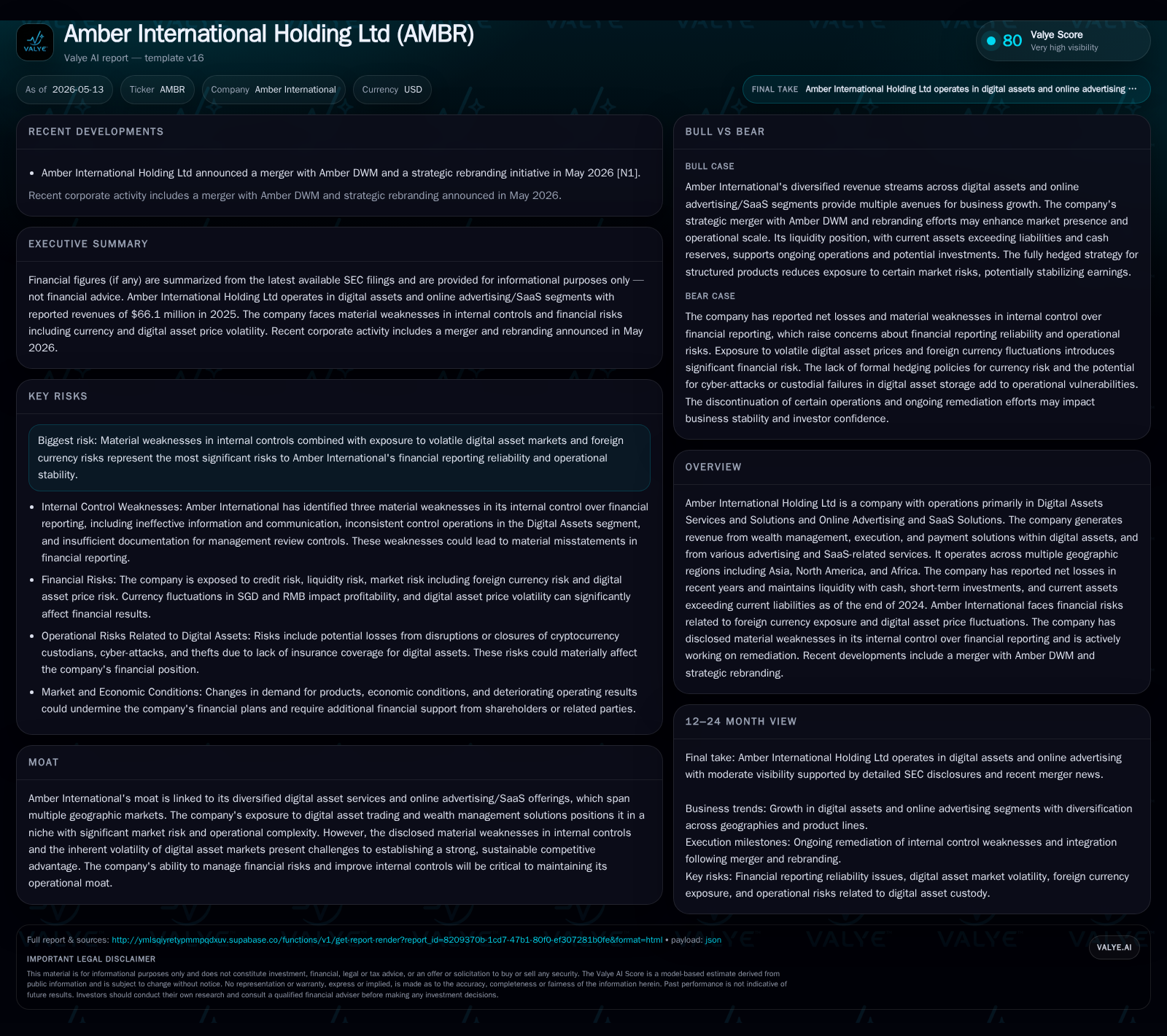
Amber International Holding Ltd recently announced a significant regulatory milestone by securing a Virtual Asset Service Provider (VASP) license from Dubai's VARA, expanding its footprint in the Middle East digital asset market. The company's business model integrates wealth management, execution/payment solutions in digital assets, and an online advertising and SaaS segment, traversing diverse geographies with inherent exposure to volatile crypto markets. While growth initiatives include leveraging new licensing for geographic expansion and a disciplined share repurchase program, Amber continues to confront material weaknesses in internal controls and financial reporting risks linked to digital asset price fluctuations and foreign currency exposure. The company maintains adequate liquidity supported by a current ratio above 1.4, positioning it to navigate upcoming operational milestones and governance reform efforts.
Latest Quarterly Developments Highlighting Regulatory Progress
Amber International disclosed in its April 28, 2026 Form 6-K filings that its subsidiary Amber Premium FZE officially secured a Virtual Asset Service Provider (VASP) license from Dubai’s Virtual Assets Regulatory Authority (VARA) [S2][S3]. This regulatory accreditation is pivotal as it allows Amber’s platforms to legally operate digital asset services in the burgeoning Middle East market under an increasingly rigorous compliance framework. The license achievement positions Amber to broaden its geographic presence beyond Asia, North America, and Africa where it currently operates. Moreover, this development signals enhanced governance protocols given VARA’s stringent requirements around security, corporate oversight, transaction monitoring, and mandated signatories – aspects reflected in the company’s recent filings indicating adherence to tightened reporting controls [S2][S3].
This move can be understood as a cornerstone of Amber’s strategic push into newer jurisdictions with strong interest in regulated digital asset infrastructure — essential for differentiating Amber among competitors navigating fragmented global crypto markets.
Business Model Overview: Dual Focus on Digital Assets Services and Advertising SaaS
According to the latest annual report dated May 13, 2026 [S1], Amber International structurally bifurcates revenue generation into two main operating segments:
Digital Assets Services and Solutions: This segment encompasses wealth management solutions primarily catering to individual clients' asset accumulation strategies within crypto portfolios; execution solutions facilitating transactions across public exchanges for digital assets including major cryptocurrencies like BTC and ETH; and payment solutions integrating digital currency payments into broader fintech ecosystems.
Online Advertising and SaaS Solutions: This newer segment offers services related to mobile content advertising primarily within Asian markets alongside SaaS products focused on marketing technology stacks. The company recently underwent a merger involving Amber DWM with iClick Interactive aiming for operational synergies as per recent news disclosures [N1].
Revenue drivers within digital assets depend heavily on transaction volumes, client asset under management scales, spreads applied on execution services, and fees related to payment facilitation. Within advertising/SaaS channels, revenues stem from ad placements (cost-plus arrangements) tied closely to user engagement metrics and SaaS subscription models.
Cross-border operations expose revenues to foreign currency fluctuation risks given significant transactional activity in SGD (Singapore Dollar), RMB (Chinese Yuan), along with USD functional currency base. The lack of formal currency hedging strategies amplifies earnings variability stemming from FX movements [S1].
Overall, the company’s integrated fintech model is complex — blending dynamic digital asset trading environments with more traditional online advertising technology stacks — requiring robust risk management infrastructure which is currently being enhanced.
Market Positioning within Digital Asset and Online Advertising Ecosystems
Amber occupies a niche at the intersection of regulated digital asset wealth management/execution platforms alongside online advertising SaaS providers servicing emerging markets. Its newly acquired Dubai VASP license gives it a regulatory moat allowing compliant operations within one of the world’s fastest-growing cryptocurrency hubs governed by clear fiduciary standards [S3][S1]. Such compliance-driven licenses are increasingly critical competitive differentiators amid rising global regulatory scrutiny against unlicensed crypto entities.
Nevertheless, underlying threats persist including substantial price volatility for primary traded assets BTC/ETH significantly affecting operating results through marked-to-market exposures of digital assets on their balance sheet [S1]. Though the company employs fully hedged strategies around structured products minimizing direct exposure from client-facing offerings, intrinsic crypto market swings impact net valuations.
Additionally, given Amber's operational reach across Asia (notably China), North America, Africa, amid expansion into Dubai/global Middle East markets via its licensed subsidiaries - it confronts administrative overhead complexity coupled with exposure to regional regulatory nuances that may impede scaled growth agility.
Notably absent is evidence of dominant scale relative to large centralized exchanges or globally diversified fintech giants; positioning Amber more as a specialized regional participant leveraging licensing credentials combined with an integrated suite of services rather than volume-driven pricing power hubs.
Growth Catalysts Driving Revenue Expansion and Client Engagement
Amber’s primary near-term growth driver is its expansion enabled by the VASP license secured by Amber Premium FZE allowing legal operation within Dubai's tightening crypto regulatory landscape—a hotspot encouraging institutional crypto participation [S3]. This facilitates onboarding new client cohorts seeking secure Middle Eastern gateway access serviced with compliant infrastructure.
Concurrently, the company’s November 2025 authorization of a US$50 million share repurchase program demonstrates management’s intent to return capital prudently while signaling confidence in underlying business momentum [S6][S15]. Although repurchases hinge on market conditions and liquidity availability they underscore financial discipline aimed at supporting shareholder value during volatile market phases.
Operationally enhancing internal controls has emerged as another critical growth enabler. Addressing previously disclosed material weaknesses—specifically strengthening internal reporting frameworks—aims to bolster investor trustworthiness for future capital raising or strategic alliances [S16]. Effective remediation here could translate indirectly into improved market perception which historically constrains many emerging fintech operators.
Segment revenue data from annual reports highlights outsized growth potential particularly within Digital Assets wealth management expanding from approximately $6.2 million in 2024 reaching upwards of $35 million in 2025 indicating demand traction; Execution services similarly scaled markedly reflecting higher transaction flows synchronized with broadening client activity [S1]. A further boost comes from integration synergies following mergers in the advertising/SaaS vertical adding diversified income streams.
Operational and Market Risks, Including Internal Control Weaknesses
Material risk factors prominently flagged include Vulernabilities stemming from volatile cryptocurrency price fluctuations given crypto assets such as BTC/ETH dominate fair value asset assessments impacting P&L sensitivity substantially — a hypothetical 30% increase in BTC price projects a profit uplift near US$623k for fiscal year ended December 31, 2025 per disclosures [S1]. Conversely negative downward movements impose losses directly influencing operating stability.
Foreign exchange transactional exposures predominantly relating to SGD and RMB potentially alter reported results materially without mitigating hedges currently implemented [S1]. This can inject earnings unpredictability especially during periods of significant currency turbulence vis-à-vis USD functional currency use.
Specific attention falls upon disclosed "material weaknesses" within internal control over financial reporting found during periodic evaluations—management acknowledges these gaps detract from disclosure reliability but communicates active remediation efforts underway incorporating enhanced documentation processes plus upgraded compliance checks [S16]. Such lapses historically augment risk premiums demanded by counterparties or investors hindering strategic financing options.
Finally operational complexity arising from multi-jurisdictional licensing requirements combined with fierce competition among digital wealth platforms presents scalability challenges. Sustained investment is needed both technically (AI-driven tech roadmap signaled by CEO commentary) and administratively (regulatory compliance demands).
Outlook: Key Milestones and Management’s Strategic Priorities
Investors should monitor first the tangible ramp-up of revenue contributions originating from Dubai following VARA VASP authorization use-case maturity alongside client acquisition rates supported by newly compliant service offerings post-license approval set forth April 2026 filings [S2][S3].
The trajectory of the share repurchase program activity offers insight into Board confidence levels; pace of open-market ADS repurchases conveys financial resource allocation priorities while indirectly reflecting stock price stability assumptions given prevailing macro conditions [S6][S15].
Remediation progress against internal control deficiencies will be fundamental to restoring full disclosure effectiveness expected under SEC filing standards—regular updates aligned with annual audit cycles could materially affect market trustworthiness perceptions even absent overt operational setbacks [S16].
Geopolitical or regulatory changes affecting key geographies - especially those relating to PRC-originated activities or Southeast Asia - remain watchpoints given their influence over foreign exchange exposure magnitude alongside localized demand shifts affecting both advertising revenue pools and crypto transaction flow intensity [S1][N1].
Lastly technological innovation efforts directed at AI-enabled platforms to refine wealth management user experience or optimize ad delivery targeting could unlock incremental competitive differentiation if executed effectively amidst crowded fintech landscapes.
Concise Financial Profile Reflecting Liquidity and Risk Management
At December 31, 2024 per companyfacts data [F1], Amber International possessed roughly $19.6 million in cash & equivalents supplemented by total current assets of nearly $48.6 million versus current liabilities slightly below $33.5 million—yielding a comfortable current ratio circa 1.45 indicative of adequate short-term liquidity buffers supporting operating cash flow requirements amidst volatile market conditions.
While recent quarterly filings do not explicitly update debt or leverage figures beyond year-end statistics these snapshots show no red flags around capital adequacy nor imminent covenant pressures; balance sheet robustness emerges as sufficient for continued investments necessary for regulatory compliance upgrades plus geographic expansion ambitions detailed earlier.[F1][S1]
Operating income has been negative historically ($-17.36 million reported at latest full year end) echoing the developmental stage entailed by this complex fintech operator navigating emerging industry headwinds; however net losses have narrowed concurrent with revenue ramp suggesting improving operating leverage dynamics albeit still incurring elevated expenses associated with compliance enhancements and expansion costs[S1][F1].
Liquidity management appears prudent balancing retained earnings reinvestment/operating funding alongside reactive measures such as share buybacks—the latter calibrated not to impair cash runway but instead augment shareholder value signaling amid uncertain macroeconomic backdrops.[S6]
This analysis is based solely on publicly available SEC filings dated through May 13, 2026, news sources cited herein, and official company disclosures without incorporating non-public or forward-looking information.
Disclaimer: This is research-only, informational analysis and not investment advice. It may include AI-generated interpretation and general industry context. Always verify important details using primary sources.

Comments