
China Pharma Boosts Cardiovascular Portfolio to Counteract Declining Segments
Q1 2026 results reveal strategic focus on cardiovascular products supported by centralized procurement and contract manufacturing amid liquidity pressures.
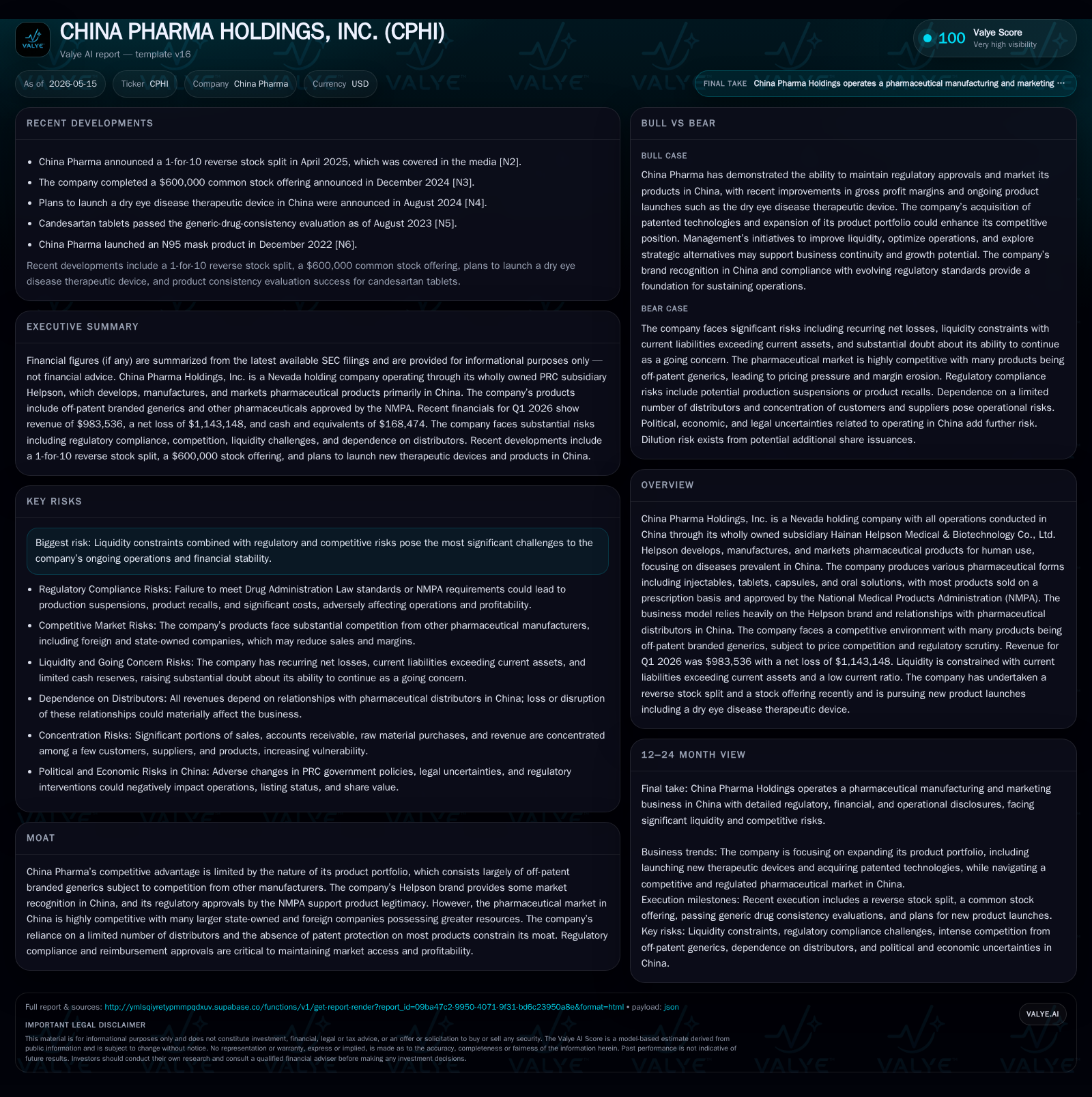
China Pharma Holdings' Q1 2026 results show a pivot toward cardiovascular and cerebrovascular products driven by national and regional centralized procurement successes, reversing prior declines in respiratory and anti-infection categories. The company’s Helpson subsidiary expands contract manufacturing operations, adding a new revenue dimension while managing portfolio optimization. Nonetheless, China Pharma faces tight liquidity marked by a current ratio of 0.28 and significant net debt, alongside persistent competitive challenges tied to its off-patent branded generic portfolio. Regulatory hurdles and distributor dependence add to execution risks. Near-term growth depends on contract manufacturing milestones, procurement renewals, and effective liquidity management.
Quarterly Performance Highlights and Operational Shifts
The latest Q1 2026 filing highlights a notable shift in China Pharma’s revenue mix driven by external policy dynamics within China's pharmaceutical procurement ecosystem. Cardiovascular and cerebrovascular products formed the largest share of revenues at 52.2%, up sharply from under 30% previously. This growth was primarily supported by successful bids in multi-regional centralized procurement programs as well as renewal of the national centralized procurement contracts — key policy levers designed to improve accessibility and cost control across public hospitals in China.
Conversely, the respiratory and anti-infection category saw its revenue share shrink considerably to 41.7% due to diminished market demand compounded by increased competition. This reflects structural headwinds for these therapeutic areas within China’s evolving pharma landscape. The company plans to further optimize its portfolio by managing weaker product lines out of the mix while focusing resources on higher-growth cardiovascular areas to drive sustainable profitability.
Adding complexity and potential diversification benefits is Helpson acting as a Contract Manufacturing Organization (CMO) since April 2024 for a third-party product encompassing R&D as well as commercial production activities. While the project contributed approximately $33K revenue in 2025 — still relatively modest — it positions China Pharma for recurring revenue post-commercial launch should stability testing outcomes remain favorable [S2][S13][S6].
Business Model Overview: Helpson’s Product Mix and Market Position
China Pharma operates as a Nevada holding company with all substantive operations channeled through Hainan Helpson Medical & Biotechnology Co., Ltd., its wholly owned PRC subsidiary specializing in pharmaceutical development and manufacture. Helpson focuses largely on off-patent branded generic products addressing diseases prevalent in China such as cardiovascular conditions, respiratory illnesses, infections, digestive diseases, among others.
Products span multiple dosage forms including dry powder injectables, liquid injectables, tablets, capsules, and cephalosporin oral solutions — all requiring regulatory approval by the National Medical Products Administration (NMPA). Most sales are prescription-based conducted via an intermediary network of certified pharmaceutical distributors rather than direct-to-hospital models [S1][S5][F1].
While the Helpson brand provides some recognition locally, the company lacks patent-protected proprietary products which constrains pricing power given competitive commoditization especially under government-driven tender programs. Furthermore, regulatory scrutiny including adherence to China’s consistency evaluation process imposes ongoing compliance costs critical to maintaining market access.
Competitive Environment and Industry Dynamics in China’s Pharmaceutical Market
China Pharma operates in one of the world’s most crowded pharmaceutical sectors characterized by numerous multinational corporations alongside sizable state-owned enterprises deploying deep resources across R&D, marketing, supply chain optimization, and capital investment.
The majority of China Pharma’s portfolio comprises off-patent branded generics vulnerable to price erosion due to frequent bidding rounds under government-backed centralized procurement policies aimed at cost containment. Such tenders impose severe margin compression but also offer volume scale if secured.
Regulatory frameworks require rigorous consistency evaluations for generic drugs ensuring quality parity with original branded molecules—a process that can disrupt supply continuity if not passed timely.
Additionally, extended credit terms customary within Chinese pharma distribition chains delay cash conversion cycles impacting working capital management. Distributor relationships are crucial but fragile given competitors’ efforts to secure preferred vendor status within hospital systems [S1][S9][S10].
Growth Catalysts: Centralized Procurement, CMO Expansion, and Product Portfolio Management
Key growth levers currently include continued participation in national and regional centralized procurement programs especially within cardiovascular categories that benefit from demographic trends favoring treatments for high-incidence chronic conditions like hypertension or stroke risk factors.
Helpson’s nascent CMO services cater to R&D through production phases for third-party drug launches offering diversification beyond traditional product sales—project validation began January 2025 with ongoing stability tests determining long-term revenue potential.
Strategic portfolio rationalization seeks to retire declining respiratory/anti-infectives lines while directing investment toward higher-margin or higher-volume cardiovascular assets enhancing operating leverage [S2].
Risks and Constraints: Liquidity, Competition, Regulatory Pressures, and Distribution Dependence
Liquidity remains the most pressing constraint with Q1 ending a current ratio of approximately 0.28 reflecting current assets ($2M) falling well below current liabilities (~$7.27M). The company obtained a new line of credit facility in June 2025 amounting to RMB 5,000,000 (approximately $0.7 million) due June 2026, personally guaranteed by the CEO and secured by personal assets [S2].
Price competition is intense within off-patent generics intensified further by government tender processes which prioritize cost savings diluting unit economics.
Failure or delays in passing product consistency evaluations mandated for Chinese generics can result in suspensions or delistings causing immediate revenue losses.
Dependency on a small set of certified distributors elevates counterparty risks whereby loss or deterioration of these relationships could sharply impact sales flows. Absence of direct hospital contracts weakens control over payment terms exacerbating cash flow volatility [S2][F1][S9][S10].
Regulatory approval uncertainties alongside reimbursement policy shifts can unpredictably influence demand trajectories adding execution complexity.
Forward-Looking Considerations: Upcoming Milestones and Potential Demand Signals
Critical near-term operational milestones include successful completion of CMO project stability testing currently underway—stability results anticipated mid-2026 will influence recurring manufacturing revenue visibility.
Renewal outcomes for centralized procurement programs assessing cardiovascular portfolios remain pivotal; inclusion rates directly affect volume scale albeit at thin margins.
Progress in securing additional patents or licensing cutting-edge therapies could revitalize product pipeline though any new approvals will face protracted regulatory timelines.
Liquidity management warrants vigilant monitoring given looming debt maturities; potential refinancing or capital injection efforts will be essential to safeguard ongoing operations amid continued quarterly losses observed through Q1 2026 [S2][S3].
Latest Financial Snapshot: Liquidity Status and Capital Structure
Latest financial snapshot
| Metric | Value | Period |
|---|---|---|
| Cash & equivalents | $168474 | |
| 2026-03-31 | ||
| Current assets | $2mm | |
| 2026-03-31 | ||
| Current liabilities | $7mm | |
| 2026-03-31 | ||
| Current ratio | 0.28x | |
| 2026-03-31 |
Source: SEC companyfacts cache [F1].
| Metric | Value | Period End |
|---|---|---|
| Cash & Equivalents | $168,474 | |
| 2026-03-31 | ||
| Current Assets | $2,003,555 | |
| 2026-03-31 | ||
| Current Liabilities | $7,267,678 | |
| 2026-03-31 | ||
| Line of Credit Facility | $700,000 | Due June 2026 |
As per latest filings, the company's constrained liquidity position presents sizable operational risk. Its current liabilities exceed current assets by over $5 million leading to severe working capital pressure [F1][S2]. Interest expense remains notable relative to loan size underscoring financial strain despite modest borrowing costs enabled through CEO-backed credit facilities [S2].
Operational losses persist reflective in negative operating margins contributing further cash drain requiring enhanced receivables collection discipline plus possible strategic financings [S2].
This analysis synthesizes publicly filed disclosures up to May 15th 2026 without projecting future performance beyond documented facts or offering investment advice.
Disclaimer: This is research-only, informational analysis and not investment advice. It may include AI-generated interpretation and general industry context. Always verify important details using primary sources.

Comments