
Innovative Solutions & Support Accelerates Growth Amid Contractual and Debt Challenges
ISSC’s latest quarter shows operational resilience with solid cash flow yet highlights risks from customer concentration and leverage.
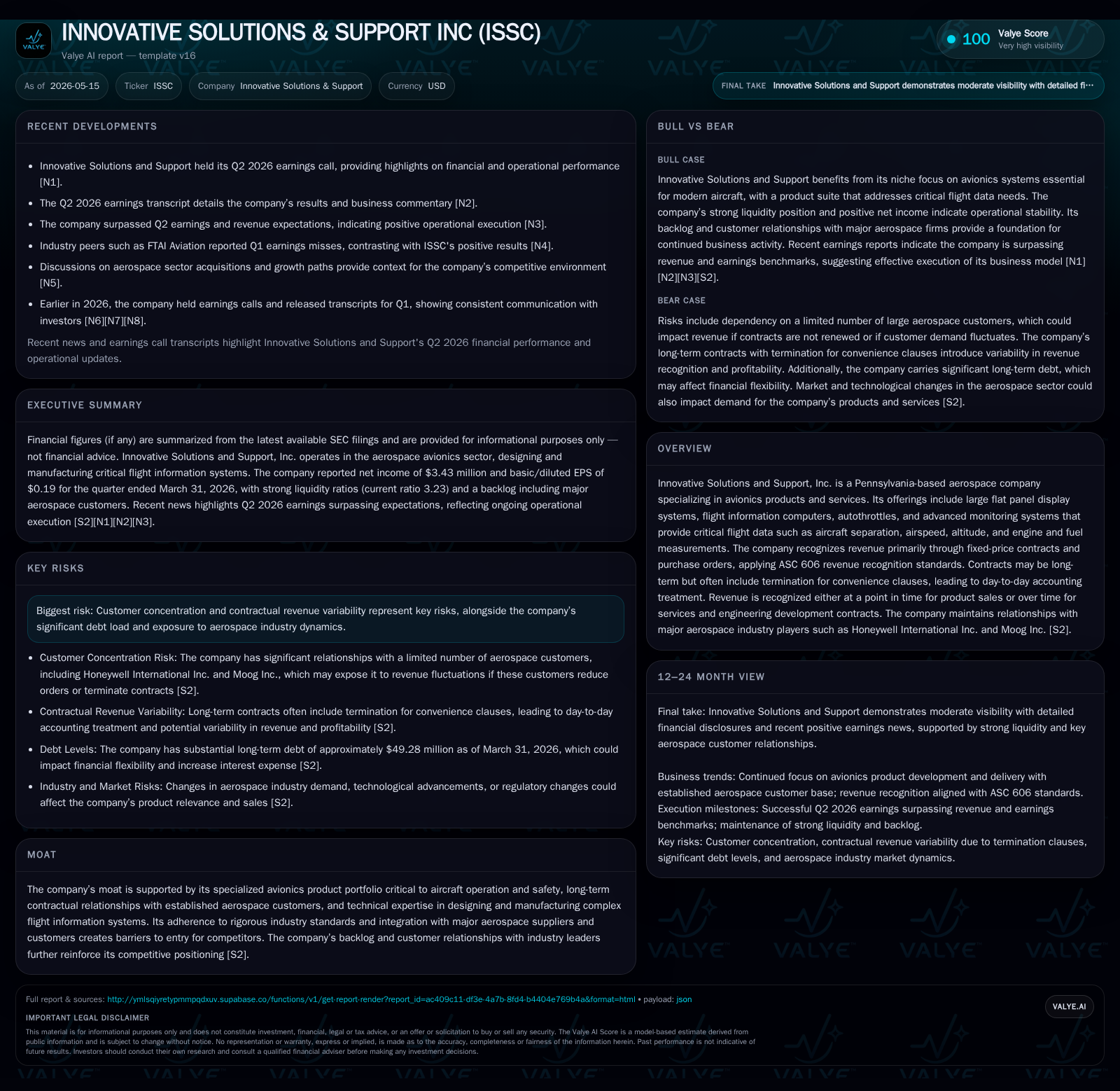
In Q2 fiscal 2026, Innovative Solutions & Support, Inc. (ISSC) reported continued strength in its avionics product sales and engineering services, driven by longstanding aerospace customer relationships and a growing backlog. The company maintains a complex revenue recognition model based on fixed-price contracts with both point-in-time product sales and over-time service deliveries. Despite the progress, ISSC faces structural risks due to heavy customer concentration, contract variability, and significant net debt. Strategic execution on backlog conversion and managing leverage are critical to sustaining momentum in the specialized aerospace avionics sector.
Recent Operating Update
Innovative Solutions & Support, Inc. (ISSC) reported its latest quarter ending March 31, 2026, showing operational resilience despite ongoing macroeconomic and industry complexity [S2]. The company emphasizes its role as a specialized supplier of avionics systems—ranging from large flat panel displays to flight information computers critical for real-time aircraft operations. ISSC’s revenue recognition reflects an ASC 606 framework where product sales are recognized at delivery (point in time), whereas engineering development contracts (EDCs) and services follow over-time recognition [S2].
The Q2 results revealed sustained cash inflows from operations amounting to approximately $10.5 million, nearly tripling prior-year periods, underscoring improved working capital management and contract execution efficiency [S20]. Simultaneously, the balance sheet shows a strong current ratio of 3.23 with cash reserves exceeding $6.7 million against current liabilities near $16.5 million as of quarter-end [F1], [S2]. However, total debt stands at about $55 million leading to a net debt position of roughly $48.3 million after accounting for cash — highlighting leverage as a crucial financial constraint [F1].
The recent earnings press release on May 14, 2026 reiterates the company's focus on converting backlog into revenue while managing contract variability risk stemming from termination-for-convenience clauses embedded in many agreements [S3]. Despite this, ISSC achieved operating income near $4.9 million in Q2 supported by gross margins resilient to heightened R&D spends necessary for product innovation [S15].
Business Model Analysis
ISSC operates primarily as an aerospace avionics technology provider specializing in mission-critical hardware and software controlling key flight parameters such as altitude, airspeed, engine status, and aircraft separation via integrated monitoring systems [S1], [S2]. Its business mechanics hinge on fixed-price contracts that can be segmented into:
- Product sales: Large flat-panel displays, flight computers, autothrottles delivered under purchase orders with revenue recognized upon shipment or customer acceptance.
- Engineering development contracts (EDCs): Customized integration projects requiring design enhancements or software updates; revenue is typically recognized over the project timeline based on milestones or percentage completion.
- Service agreements: Aftermarket support including installation support, maintenance consulting often billed over time.
Customers predominantly comprise Tier-1 aerospace manufacturers like Honeywell International Inc. and Moog Inc., reflecting deep industry integrations that complicate switching but also concentrate revenue risks [S1], [S10]. Contracts often feature termination-for-convenience clauses allowing customers flexibility but introducing day-to-day revenue uncertainty beyond typical long-term contract protections.
Margins are influenced by program mix between relatively higher-margin proprietary avionics products versus labor-intensive development services requiring R&D investments. Operating expenses include substantial spending on research ($3.1M over six months ended March 31), selling/general/administrative costs ($9M+ six-month run rate), which impact operating leverage but also drive continued product relevance amidst fierce technological demands [S15].
Industry Structure & Competitive Position
Aerospace avionics suppliers operate within a niche ecosystem defined by stringent regulatory oversight (FAA/EASA certification requirements), high technical complexity, and critical safety mandates that create significant entry barriers. ISSC's portfolio addresses these challenges by offering tailored avionics systems embedded deeply into aircraft operation workflows.
The company’s moat stems from:
- Technical expertise: Ability to design sophisticated flight information systems aligned with regulatory compliance.
- Customer relationships: Long associations with dominant industry OEMs cement trust.
- Integrated supply chain: Partnerships with Honeywell and Moog facilitate procurement efficiencies and collaborative innovation.
However, the market is oligopolistic with intense competition from large multi-national suppliers with broader scale advantages; thus ISSC relies heavily on its specialized know-how rather than cost leadership. Industry cyclicality tied to commercial aircraft production rates means demand fluctuations can be amplified through contract timing variation.
Growth Drivers
Structurally, growth for ISSC is linked to several key drivers:
- Commercial Aircraft Modernization: Airlines upgrading fleets demand next-generation avionics for efficiency gains.
- Aftermarket Services Expansion: Increasing aircraft volumes globally support growing demand for aftermarket installation and maintenance engineering support.
- Backlog Conversion: Robust order backlog provides near-to-medium-term revenue visibility if executed effectively amid contract risks.
- Innovation Pipeline: Continued R&D feeding new products meeting evolving standards helps defend pricing power.
These factors suggest a mostly structural demand base supported by aviation industry modernization trends despite cyclical headwinds from global economic or geopolitical disruptions. Monitoring backlog changes serves as a tangible KPI reflecting success in capturing future business opportunities.
Risks and Growth Constraints
Several watchpoints could constrain ISSC’s trajectory:
- Customer Concentration: Reliance on a handful of aerospace giants concentrates counterparty risk; loss or deferral of orders could materially impact revenues.
- Contractual Variability: Termination-for-convenience provisions allow clients to reduce committed volume unexpectedly leading to volatile quarterly throughput.[S2]
- Leverage Burden: Net debt near $48M against operating cash flow could pressure liquidity if operating performance softens or interest rates rise unexpectedly.[F1]
- R&D Expense Growth: Rising investment requirements to maintain technical edge may pressure margins if not offset by pricing or volume gains.[S15]
- Industry Cyclicality & Regulation: Aerospace production cycles coupled with tightening certification standards may delay new programs or increase compliance costs.
What To Watch Next
Key milestones for assessing ISSC’s forward momentum include:
- Quarterly backlog reports signaling order intake sustainability beyond one-off contract timing effects.
- Gross margin trends reflecting ability to contain rising labor/R&D costs while maintaining pricing discipline.
- Operating cash flow trajectory relative to debt servicing needs indicating financial flexibility in capital-intensive sectors.
- Management commentary on defense vs commercial revenues given aerospace budget shifts post-pandemic recovery cycles.
- Progress against strategic partnerships especially extensions or new wins with major OEMs potentially unlocking new program flows.[S3]
Financial Profile Summary
Latest financial snapshot
| Metric | Value | Period |
|---|---|---|
| Cash & equivalents | $7mm | |
| 2026-03-31 | ||
| Total debt | $55mm | |
| 2026-03-31 | ||
| Net debt | $48mm | |
| 2026-03-31 | ||
| Current assets | $53mm | |
| 2026-03-31 | ||
| Current liabilities | $16mm | |
| 2026-03-31 | ||
| Current ratio | 3.23x | |
| 2026-03-31 |
Source: SEC companyfacts cache [F1].
ISSC retains strong liquidity backed by high current assets vs liabilities; however the leverage level prescribes scrutiny considering cyclical end-market sensitivities. The company generated operating income close to $4.9 million in Q2 FY2026 despite increased SG&A costs supporting expanded operations [S15]. Enhanced operating cash flow also signals improved working capital dynamics supporting ongoing R&D spending essential for sustaining its technological edge [S20], [S15].
This analysis focuses strictly on facts disclosed through recent SEC filings and public disclosures without providing investment recommendations or price forecasts.
Disclaimer: This is research-only, informational analysis and not investment advice. It may include AI-generated interpretation and general industry context. Always verify important details using primary sources.

Comments