
AIM ImmunoTech Confronts Regulatory and Financial Hurdles While Advancing Ampligen in Pancreatic Cancer
Recent filings highlight AIM ImmunoTech’s efforts to regain NYSE American compliance amid ongoing clinical trials and funding challenges.
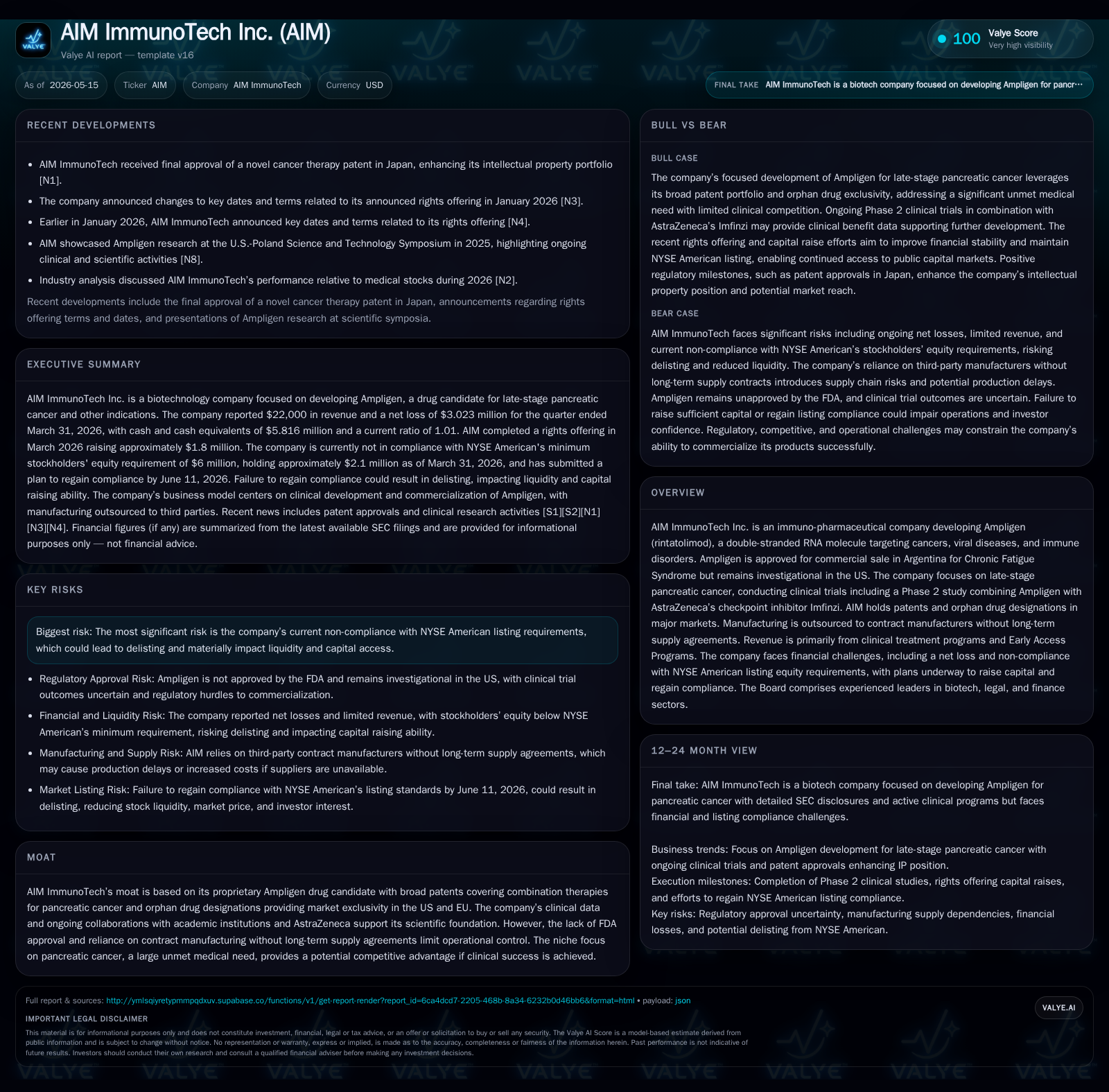
In its latest 10-Q filed May 15, 2026, AIM ImmunoTech reported ongoing non-compliance with NYSE American stockholders' equity requirements, holding a plan to restore compliance by June 11, 2026. The company continues clinical development of Ampligen, focusing on pancreatic cancer in combination with AstraZeneca’s Imfinzi, supported by broad patent protection and orphan drug exclusivities. However, dependency on outsourced manufacturing and limited commercial revenues underscore operational risks. Capital raising through rights offerings and ATM sales agreements remains critical for sustaining R&D programs and exchange listing. The niche therapeutic target in pancreatic cancer offers potential upside if clinical data validates the drug candidate’s efficacy.
Recent Operating Update
AIM ImmunoTech’s latest quarterly report filed May 15, 2026 (10-Q) spotlights continuing financial stress primarily due to non-compliance with the NYSE American's stockholders’ equity requirement of $6 million. As of March 31, 2026, AIM reported stockholders’ equity of approximately $2.1 million, well below the listing threshold [S2]. The company has submitted a detailed compliance plan accepted by the exchange with a deadline for resolution set for June 11, 2026. Failure to execute this plan could trigger delisting from NYSE American, sharply reducing trading liquidity and materially impairing access to capital markets—both critical for an R&D-heavy biopharma firm [S2].
Alongside financial updates, AIM provided insights into its ongoing clinical development activities. The company is advancing Ampligen (rintatolimod), focusing heavily on pancreatic cancer where it is engaged in a Phase 2 study combining Ampligen with AstraZeneca’s checkpoint inhibitor Imfinzi [S3]. This collaboration underscores an important strategic alliance designed to leverage synergistic immuno-oncology mechanisms.
The company continues to rely predominantly on revenues from clinical treatment programs and Early Access Programs since Ampligen retains an investigational status in major territories including the US [S1], limiting commercial sales exclusively to Argentina for Chronic Fatigue Syndrome. Notably, operating losses persist; reported net loss rose to $13.958 million as of December 31, 2025 highlighting ongoing R&D investment outpacing revenue generation [F1].
Business Model
AIM ImmunoTech operates principally as an immunopharmaceutical developer focused on Ampligen—a synthetic double-stranded RNA molecule intended to stimulate antiviral and anticancer immune responses. The company generates revenue primarily from administering its investigational drug within clinical trials and compassionate use frameworks rather than robust commercial product sales given Ampligen's current regulatory status.
Ampligen works as an innate immune modulator activating toll-like receptor pathways to potentiate immune system activity against viruses and tumor cells. This positioning enables diverse indications but also requires substantial costly clinical validation across those therapies.
Patents held by AIM cover both Ampligen’s core composition and key combination therapy uses—particularly relevant in pancreatic cancer where synergy with checkpoint inhibitors like Imfinzi is being clinically tested. These patents coupled with orphan drug designations provide periods of regulatory exclusivity if eventual approvals are secured in principal markets such as the U.S. and EU.
Manufacturing processes are outsourced under contract manufacturing organizations (CMOs), enabling flexibility but exposing the company to supply chain risks without long-term agreements framing secure inventory planning or cost stability [S1]. This model suits a firm currently emphasizing trial supply over mass production but limits quick lift-off post-approval.
Industry Structure and Competitive Position
The oncology therapeutics ecosystem is intensely competitive yet holds significant unmet needs especially for hard-to-treat cancers like pancreatic adenocarcinoma. Existing treatments show limited survival benefits leading to heightened interest in combination immunotherapies.
AIM's proprietary Ampligen offers a novel mechanism divergent from standard chemotherapy or small molecule kinase inhibitors. The partnerships with established players such as AstraZeneca enhance AIM's scientific credibility and market visibility within this space.
However, the absence of FDA approval keeps Ampligen outside formal reimbursement channels or widespread clinical adoption in principal markets. Competitors advancing more mature PD-1/PD-L1 checkpoint inhibitors or other immune stimulants may capture market share absent credible late-stage data demonstrating superiority or additive benefit.
The company's niche focus provides potential differentiation but also concentrates risk around one platform’s success trajectory amid evolving regulatory standards.
Growth Drivers
- Clinical Trial Progression: Advancement of Phase 2 trial data combining Ampligen with Imfinzi could unlock pivotal efficacy signals that justify late-stage development investment or licensing deals.
- Regulatory Milestones: Securing FDA approvals or expanded orphan drug designations can extend market exclusivity empowering pricing power once commercialization occurs.
- Collaborations: Continued academic partnerships plus pharma alliances improve developmental velocity and validate scientific rationale enhancing investor confidence.
- Capital Raising: Execution of the latest rights offering (~$1.8 million gross proceeds) alongside potential utilization of ATM sales agreements supports runway extension for R&D activities while targeting NYSE listing compliance restoration [S1,S15].
- Intellectual Property: Protection through broad patents underpins entry barriers allowing AIM time to capitalize on proprietary compounds particularly around combination therapies.
Risks / Watchpoints / Constraints
- Regulatory Approval Uncertainty: Lack of FDA approval places heavy reliance on clinical trial outcomes which remain subject to typical biotech volatility including possible failures or delays.
- Financial Sustainability Risks: Substantial operating losses, working capital deficits, coupled with pressure to meet exchange listing requirements constitute acute near-term threats.
- Manufacturing Dependency: No long-term supply agreements with CMOs increase exposure to potential production interruptions complicating scale-up timelines post-approval.
- Exchange Listing Compliance: Failure to deliver sufficient equity capital by June 11, 2026 threatens delisting—with cascading impacts on liquidity, investor access, share price stability, institutional interest retention, media coverage, and secondary market activity [S2].
- Market Acceptance & Competition: Even if approved commercially, adoption hurdles persist given entrenched therapies in oncology needing significant incremental benefit demonstrations.
- Legal/Litigation Exposure: Ongoing historical litigation concerning governance matters may divert resources or impact perception though no new litigation noted recently [S1].
What To Watch Next
Key upcoming developments include:
- Completion of compliance remediation efforts ahead of June 11 exchange deadline including new capital raises or equity restructuring actions explicitly evidenced by further SEC disclosures.
- Updates from Phase 2 pancreatic cancer clinical trial evaluating Ampligen plus Imfinzi—early efficacy or safety signals can materially influence strategic options.
- Any progress towards additional regulatory milestones such as FDA interactions or orphan drug designation expansions increasing pathway clarity.
- Additional partnership announcements or academic collaborations that diversify risk concentration or expand therapeutic indications.
Monitoring ML-based KPIs like patient recruitment levels, interim data readouts (if publicly discussed), funding milestone slips/deliveries will be crucial for gauging execution capability.
Financial Profile Summary
Latest financial snapshot
| Metric | Value | Period |
|---|---|---|
| Cash & equivalents | $6mm | |
| 2026-03-31 | ||
| Total debt | $5mm | |
| 2026-03-31 | ||
| Net debt | $-976000 | |
| 2026-03-31 | ||
| Current assets | $6mm | |
| 2026-03-31 | ||
| Current liabilities | $6mm | |
| 2026-03-31 | ||
| Current ratio | 1.01x | |
| 2026-03-31 |
Source: SEC companyfacts cache [F1].
As per the March 31, 2026 balance sheet snapshot ([F1]):
FY ended Dec '25|
This snapshot reflects tight liquidity conditions marked by thin working capital buffers despite recent equity raises—underscoring urgent capital raising imperatives linked directly to exchange listing viability [F1,S2,S15]. Operating losses continue unabated driven by extensive R&D expenses behind Ampligen’s development efforts.
Disclaimer: This analysis summarizes publicly available information as of May 15, 2026 without providing investment advice or recommendations.
Disclaimer: This is research-only, informational analysis and not investment advice. It may include AI-generated interpretation and general industry context. Always verify important details using primary sources.

Comments