
Scientific Industries Advances Bioprocessing Amid Revenue Concentration and Funding Challenges
Latest quarter shows ongoing investment in bioprocessing despite operating losses and reliance on a key customer.
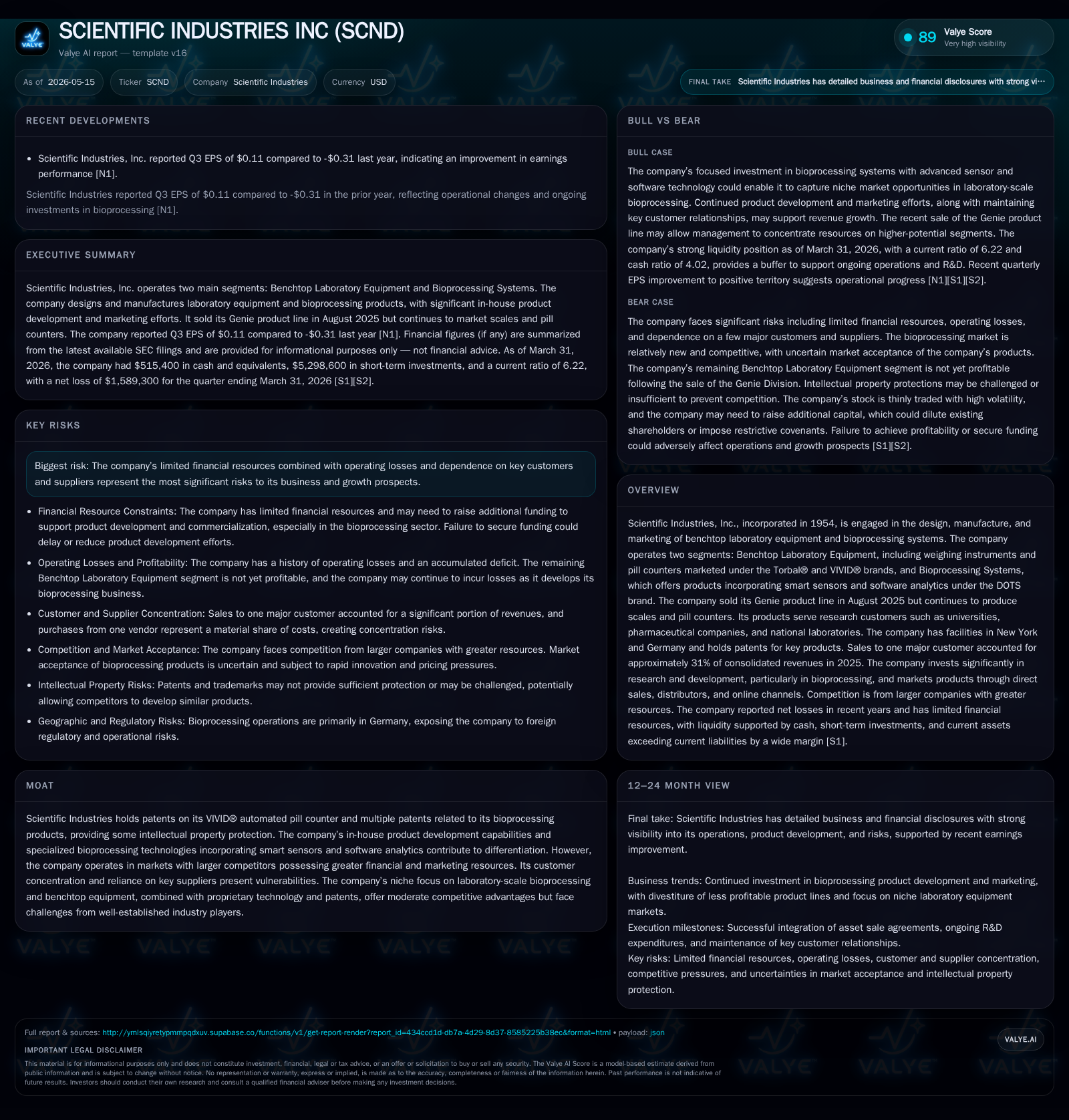
Scientific Industries reported continued strategic emphasis on its Bioprocessing Systems segment in the latest quarter, investing heavily in R&D while divesting less profitable product lines. The company remains dependent on a significant customer for a large portion of revenue, highlighting concentration risk. Competitive pressures, financial constraints, and slow bioprocessing market adoption constitute key challenges ahead. Growth will hinge on new product commercialization and sustaining operational funding.
Recent Operating Update
Scientific Industries' latest quarterly filing as of May 15, 2026 ([S2]) underscores a continuation of its dual-segment approach focusing on Benchtop Laboratory Equipment and Bioprocessing Systems. The major restructuring event post-August 2025—the divestiture of the Genie Division—reshaped the Benchtop segment to concentrate on scales and automated pill counters marketed via the Torbal® and VIVID® brands ([S1], [S8]). This strategic move aimed at shedding less profitable operations while focusing resources on core product lines.
The Bioprocessing Systems segment continues to absorb significant investment, emphasizing proprietary technologies like smart sensors integrated with advanced software analytics under the DOTS platform. Despite considerable R&D spending (over $2.4 million in recent years) ([S1]), this segment remains nascent with substantial operating losses reflecting its start-up profile.
Revenue concentration remains a critical short-term issue. Sales to one major customer represented approximately 31% of consolidated revenues in 2025, mainly driven by VIVID® automated pill counters ([S10], [S15]). Such concentration can amplify risks if order volumes fluctuate. Meanwhile, supply chain challenges persist due to reliance on select suppliers producing components overseas during tariffs and electronic part shortages—a factor that pressures gross margins ([S16], [S14]).
Business Model
Scientific Industries generates revenue from two principal sources: standard benchtop laboratory equipment including weighing devices and pill counters sold primarily through distributors and online (Torbal® and VIVID®), alongside its developing bioprocessing systems which incorporate sensor-enabled hardware coupled with proprietary software sold mainly direct via an internal sales force ([S1], [S8]).
Revenue mechanics depend heavily on sales volume of pharmaceutical lab balances and automated pill counters—with pricing influenced by distribution contracts—and incremental licensing or service agreements related to supply arrangements, especially following recent asset divestitures such as the Genie product sale ([S8], [S13]). For Bioprocessing Systems, recurring revenue potential hinges on adoption cycles for novel instruments integrating real-time biomass monitoring (CGQ), automated feeding solutions (LIS), multi-parameter sensors (MPS), and specialized DO sensor pills ([S8]).
Margins are variable across segments; Benchtop products face intense competition from larger incumbents like Ohaus Corporation and Adam Equipment Co., limiting pricing power ([S6]). Bioprocessing offerings warrant higher margins contingent upon achieving broader market penetration given their technical differentiation. However, ongoing R&D costs currently outpace related revenues leading to aggregate operating losses ([F1], [S10]).
Customer retention dynamics tether notably to a few key pharmaceutical clients and academic research institutions who value precision instrumentation but remain price sensitive. Switching costs exist but are mitigated by competitors’ alternative solutions including systemic bioprocess alternatives from giants like Sartorius AG or Eppendorf SE ([S6]).
Industry Structure & Competitive Position
The company operates within two intersecting industry verticals: benchtop laboratory equipment—a mature commodity market marked by fierce price competition; and laboratory-scale bioprocessing instrumentation—a specialized emerging field requiring integration of sensors with analytical software.
Within benchtop tools, Scientific Industries is a relatively small player compared to globally recognized brands supported by expansive financial resources. There is also minimal patent protection aside from its VIVID® automated pill counter patent lasting until March 2039 ([S14]). Its competitive strategy hinges on cost-effective manufacturing, online distribution, and maintaining product reliability.
Conversely, bioprocessing leverages more distinct technological moats via multiple patents held by Aquila GmbH subsidiary expiring during mid-to-late 2030s across U.S. and European jurisdictions ([S14], [S25]). The company’s investment in R&D has enabled development of unique system components rarely matched at this niche laboratory scale. Still, larger competitors dominate total solution markets limiting Scientific Industries' technical niche expansion.
Market demand drivers include expanding pharmaceutical research budgets and growing biotech sector focus on efficient cell culture monitoring. Yet the specialized nature slows widespread commercial adoption, requiring prolonged beta testing and iterative design refinements that prolong time-to-revenue realization ([S24], [S25]).
Growth Drivers
Key growth opportunities stem from several vectors:
- Product Innovation: New launches within the VIVID® line anticipate accelerating sales volume leveraging automation trends in pharmacy workflows. Future planned releases could propel uptake if they address unmet user needs effectively ([S10], [S24]).
- Bioprocessing Expansion: Successful commercialization of smart sensor-based instruments will underpin long-term revenue lift as biotech customers increasingly seek performance transparency at shake-flask scales (R&D commitment indicates firm belief in this path) ([S10], [S24]).
- Geographic Reach: Export sales comprised roughly 17% of revenues in Asia and about 23% in Europe in recent years ([S15]), providing space for further international distributor development particularly for bioprocessing tools.
- Direct Sales Efforts: Augmentation of internal sales teams including application scientists aligns with deeper client engagement essential for complex instrument adoption ([S18]).
- Strategic Partnerships: Licensing or collaboration deals could provide non-organic channels for market access or technology leverage though none have been specified recently.
Risks / Watchpoints / Growth Constraints
- Financial Resource Limits: The company repeatedly flags limited capital availability threatening delays or cutbacks to critical product development programs if further funding is not secured ([S1], [S12], [S17], [S28]). Operating losses are expected to continue as Bioprocessing Systems are scaled.
- Customer Concentration: Dependence on a single large customer exposing over 30% consolidated revenue makes future cash flows vulnerable to contract renegotiations or lost orders ([S15]).
- Competitive Pressure: Larger firms’ deeper pockets allow aggressive marketing spending and innovation that could erode scientific industries’ market share especially if it cannot sustain investing pace or develop differentiated products quickly enough.
- Supply Chain Vulnerabilities: Reliance on few overseas component suppliers risks production interruptions or margin compression amid volatile tariff environments ([S16], [S14]).
- Slow Market Adoption Cycles: Bioprocessing tools require extensive customer beta-testing plus validation before widespread acceptance limiting early revenue ramp prospects ([S24]).
- Limited Patent Scope Outside Bioprocessing: Benchtop equipment faces commoditization due to low patent barriers except for pill counter IP which itself has finite life (-2039) diminishing protection over time (incremental innovation necessary).
- Currency Exposure: Euro exchange rate fluctuations affect translational earnings given German operations although transactional risk is moderated by US dollar invoicing practices ([S16], [S24]).
What to Watch Next
Critical milestones will involve:
- Progress reports from upcoming bioprocessing instrument releases indicating commercial traction or technical feedback.
- Sales volume trends especially from the VIVID® pill counter line reflecting distributor acceptance.
- Renewal terms or changes in status with top customers signaling retention risk mitigation.
- Evidence of successful capital raises or partnerships providing runway extension amid operating losses.
- Supply chain stability reports addressing lead-time disruptions or cost inflation pass-through effectiveness.
- R&D expense trajectories relative to incremental revenue gains suggesting improving product portfolio mix.
Financial Profile (Latest Snapshot)
Latest financial snapshot
| Metric | Value | Period |
|---|---|---|
| Current assets | $9mm | |
| 2026-03-31 | ||
| Current liabilities | $1445000 | |
| 2026-03-31 | ||
| Current ratio | 6.22x | |
| 2026-03-31 |
Source: SEC companyfacts cache [F1].
Based on current available data from companyfacts as of March 31, 2026 ([F1]):
Liquidity appears adequate based on high current ratio; however cash balances are modest relative to operating losses indicating need for near-term capital management attention. Total debt levels last recorded are low (~$433k) suggesting limited leverage risk but also constrained borrowing capacity.
Disclaimer: This analysis is based solely on disclosed SEC filings and publicly available data as cited; it does not constitute investment advice or recommendations. Readers should conduct their own due diligence before making any decisions related to Scientific Industries Inc. (SCND).
Disclaimer: This is research-only, informational analysis and not investment advice. It may include AI-generated interpretation and general industry context. Always verify important details using primary sources.

Comments