
Permianville Royalty Trust’s Passive Model Anchors Cash Flow Amid Regulatory Uncertainty
The latest quarterly filing confirms ongoing distribution stability for Permianville Royalty Trust despite regulatory and operational risks.
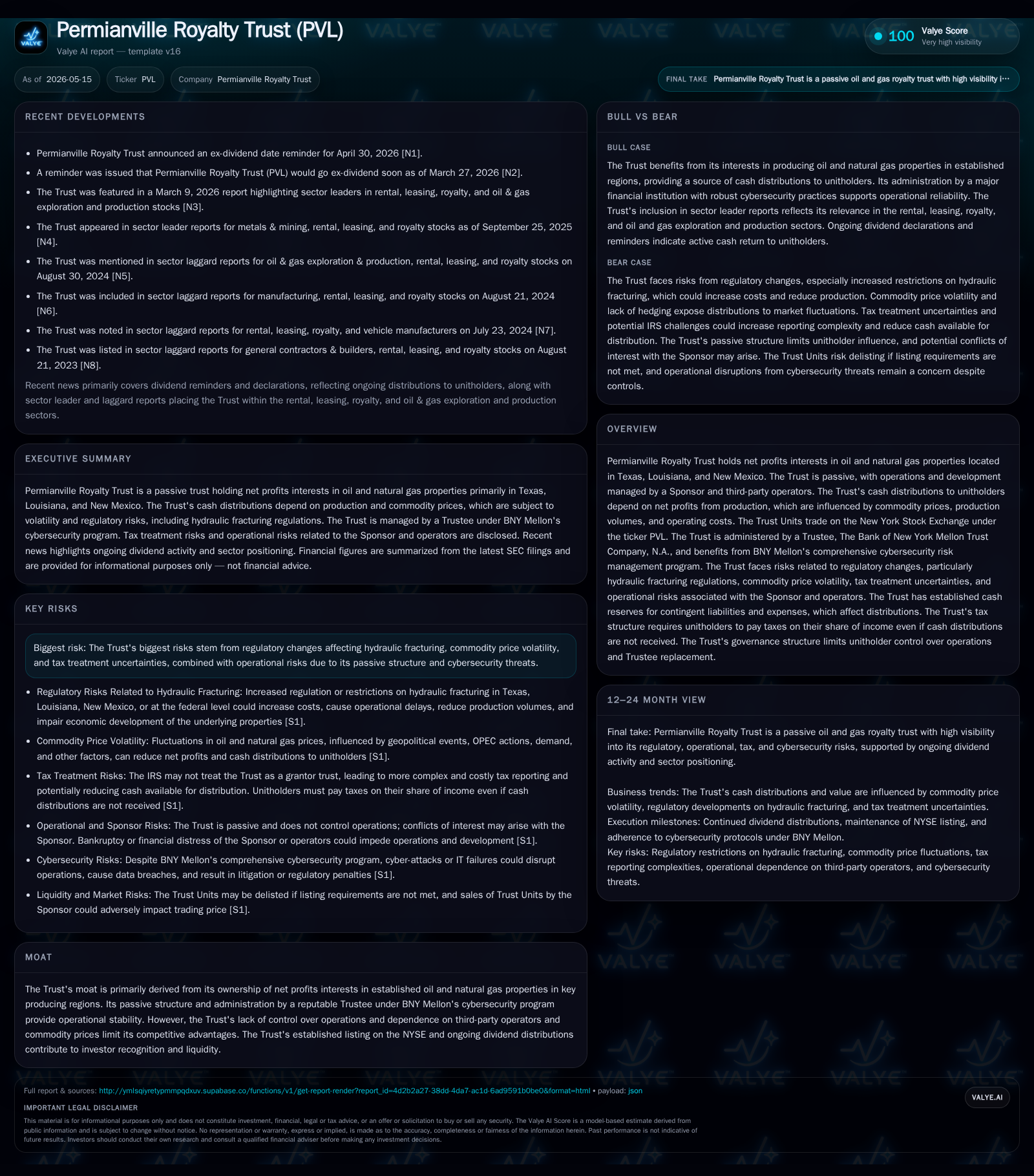
Permianville Royalty Trust (PVL) reported compliance with all required electronic filings in its May 2026 10-Q, reaffirming its steady cash distribution framework supported by net profits interests in oil and gas properties across Texas, Louisiana, and New Mexico. The Trust remains passive, relying on third-party operators for production, which limits control but provides predictable royalty-like income directly tied to commodity prices and production volumes. Regulatory headwinds, particularly hydraulic fracturing restrictions, alongside commodity price volatility and operational risks from the Sponsor and operators, continue to pose challenges to growth and distribution sustainability. BNY Mellon’s trustee role and cybersecurity program add operational oversight layers, while near-term monitoring should focus on distribution announcements and any regulatory developments impacting underlying operations.
Latest Quarterly Operating Update: Trends and Implications
In its latest 10-Q filing dated May 15, 2026 [S2], Permianville Royalty Trust (PVL) reaffirmed full compliance with SEC electronic data submission rules over the preceding twelve months. This reflects stable governance adherence during a passive operating model. The Trust continues to receive and announce monthly cash distributions regularly as evidenced by recent press releases incorporated by reference in associated 8-K filings [S3]. Notably, there were no new legal proceedings initiated against the Trust or materially affecting its assets during the quarter.
Distribution reminders such as the ex-dividend notice on April 30, 2026 [N1] reinforce the continued priority placed by management and unitholders on yield generation. While the Trust holds no operational control over underlying wells or development activities, these quarterly updates serve as crucial markers for income predictability.
Business Model Fundamentals: Net Profits Interests and Revenue Streams
PVL is structured as a royalty trust owning net profits interests (NPIs) in a portfolio of oil and natural gas properties located mainly in Texas, Louisiana, and New Mexico [S1]. Unlike typical overriding royalty interests which receive a share of gross revenue without deduction of expenses, NPIs entitle PVL to receive proceeds only after deducting specified operating costs related to production. This structure means revenue is explicitly sensitive to both commodity price movements and cost inflation.
The Sponsor oversees operations but PVL remains passive with no managerial involvement; therefore, cash flow variability correlates heavily with external factors like well productivity and market pricing [S2]. The net profits interest typically yields stable income streams akin to royalties but with added exposure to operational efficiencies (or inefficiencies) controlled externally. This places strategic emphasis on securing interests in rigorously producing established fields rather than exploratory ventures.
Operational Structure and Product Quality Control
PVL's dependence on third-party Sponsors and operators requires robust oversight mechanisms despite its passivity. The Trustee role fulfilled by The Bank of New York Mellon Trust Company ensures administrative processes including cash handling adhere to institutional standards [S1]. Importantly, the Trustee leverages BNY Mellon's cybersecurity risk management framework—a key consideration given growing digitalization of exploration-production workflows.
The Sponsor’s escalating reliance on IT systems introduces potential vulnerabilities from cyberattacks or system failures which could disrupt production forecasting or data integrity [S1]. While PVL itself does not conduct drilling or development activities, these cyber risks form a part of the operational risk profile since they could affect net profit calculations indirectly.
Industry Environment and Competitive Positioning
Within the oil and gas royalty trust universe, PVL occupies a niche marked by exposure to top Permian Basin jurisdictions plus Louisiana's mature fields. This geographic concentration provides access to prolific reserves but brings regulatory scrutiny particularly related to hydraulic fracturing practices that are politically contentious in Texas, Louisiana, and New Mexico [S1]. These states have seen a patchwork of moratoria, disclosure mandates for fracturing chemicals, and increased permitting complexities.
Although PVL benefits from NYSE listing enhancing liquidity relative to private minerals investments, its competitive moat is modest due to lack of operational autonomy. It primarily competes for investor capital against other royalty trusts or energy income vehicles offering varied exposure profiles. Investors valuing steady income distributions may find PVL appealing but must weigh that against inherent commodity price cyclicality.
Growth Drivers: Potential Catalysts and Limits
Growth opportunities hinge largely on two factors: increases in production from underlying wells managed by the Sponsor/operators and favorable commodity price environments [S2,S1]. Higher oil or natural gas prices translate into larger net profits payable after expenses are deducted. Additionally, improvements or expansions in infrastructure such as gathering systems can reduce processing bottlenecks boosting net revenue.
However, PVL cannot directly influence drilling schedules or capital expenditures on properties it holds interests in—curtailing growth autonomy. Reserve depletion is an inexorable limitation since these are depleting assets. Consequently, any acceleration in well attrition not offset by drilling activity could erode distributions over time.
Risks and Challenges: Regulatory, Operational, and Market Pressures
Regulatory risks rank highest given the evolving legal landscape surrounding hydraulic fracturing [S1]. Restrictions that delay permits or impose costly environmental compliance measures can adversely affect well economics diminishing distributable net profits. Litigation risks based on chemical disclosures also loom.
Market volatility represents a persistent threat—commodity price drops reduce gross revenues immediately impacting cash flows available for distribution [S1]. Furthermore, PVL’s passive nature means it depends heavily on Sponsor/operator competence; insolvency or breaches under debt covenants among these parties would introduce operational disruptions or delays in development activities.
Tax uncertainties compound risk—IRS challenges regarding grantor trust classification could increase reporting costs or reduce cash flows if unfavorable rulings occur [S1]. Cybersecurity remains an emerging hazard given Sponsor reliance upon digital tech systems susceptible to attacks which may disrupt data integrity or operations.
Upcoming Milestones and Key Developments to Monitor
Investors should track upcoming distribution declarations announced through periodic press releases filed alongside Form 8-K reports [S3,N1]. Seasonal shifts influencing regional production volumes may alter next quarter payouts.
Regulatory updates at state legislative sessions concerning hydraulic fracturing permits or chemical disclosure statutes represent critical events that could signal potential cost inflation or curtailment of development prospects [S1]. Monitoring Sponsor disclosures about capital expenditure plans or operator performance metrics can offer insight into near-term volume trajectory.
Cybersecurity governance enhancements communicated through Trustee reporting may indicate mitigation effectiveness against increasing digital threats [S1]. Lastly, any changes in NYSE listing status attributable to compliance issues should be noted for their market access implications.
This analysis synthesizes recent filings up to May 2026 focusing on core operating facts without financial tables per policy constraints. It reflects observations grounded strictly in disclosed company information without speculative forecasts.
Disclaimer: This report is intended solely for informational purposes reflecting public filings as of May 2026. It does not constitute investment advice or an offer to buy/sell securities.
Disclaimer: This is research-only, informational analysis and not investment advice. It may include AI-generated interpretation and general industry context. Always verify important details using primary sources.

Comments